
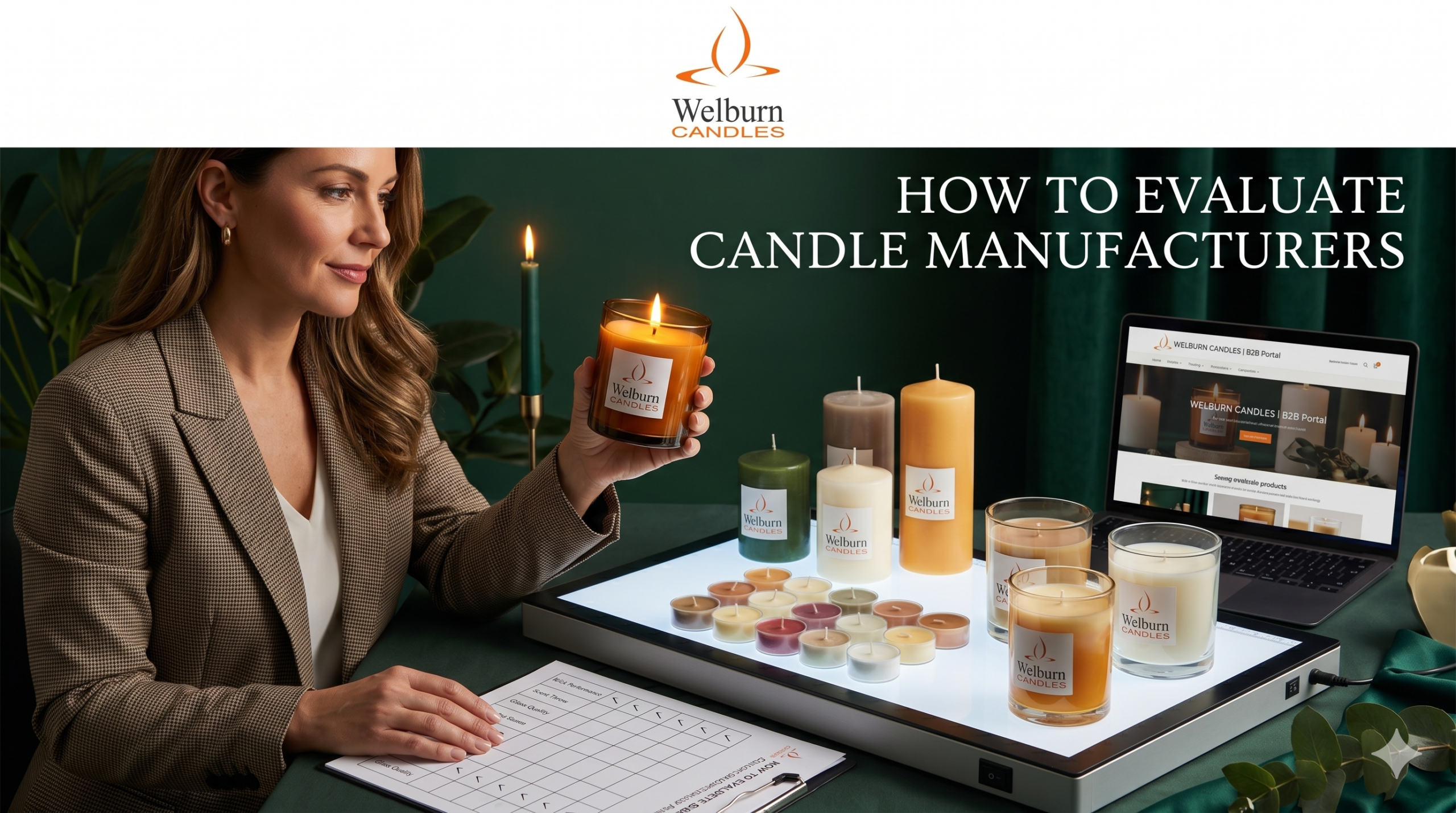
The decision to work with a candle manufacturer is not simply a procurement transaction — it is a brand-shaping commitment. The manufacturer you choose determines your product quality, your compliance standing in target markets, your ability to scale, and ultimately your customers’ experience. Choosing on price alone is one of the most common and costly mistakes new candle brand owners and retail buyers make. This guide provides a practical, comprehensive framework for evaluating candle manufacturers before committing to production. For an overview of what world-class candle manufacturing looks like in practice, explore our global candle manufacturer guide.
Step 1: Verify Quality Management Certifications
The first filter when evaluating candle manufacturers is documented quality management. A manufacturer without verifiable quality certifications is relying on goodwill rather than systems — and goodwill does not scale.
The most important certification to look for is ISO 9001:2015, the internationally recognised quality management system standard. ISO 9001 certification means a manufacturer’s production processes are documented, audited, and controlled — guaranteeing consistent output across production runs of any size. At Welburn Candles, our ISO 9001:2015 certification and SA 8000 social accountability certification are available for inspection by all prospective clients.
💡 Ask any candle manufacturer you are considering to send their current ISO certificate before progressing to sampling. A legitimate manufacturer will share it immediately — with no hesitation.
Step 2: Assess Compliance Documentation Capability
Candle compliance requirements vary by market — and the gap between a manufacturer who truly understands compliance and one who merely knows the terminology is often only discovered when a shipment is rejected or a retailer refuses to list your product.
For the European market, your candle manufacturer must demonstrate working knowledge of:
- REACH regulations — chemical substance compliance for all wax, fragrance, and dye components
- CLP labelling requirements — allergen disclosure, hazard pictograms, and EU Responsible Person requirements
- IFRA Standards — fragrance ingredient safety limits for candle category applications
- BS EN 15493 / European candle safety standards — burn performance compliance
For the US market, look for knowledge of ASTM F2179 candle safety standards and California Proposition 65 requirements. See our European candle compliance guide for a detailed breakdown of EU-specific requirements.
Step 3: Request and Evaluate Production Samples
No evaluation framework replaces physical sample testing. A professional candle manufacturer will provide samples rapidly and welcome burn testing scrutiny. When evaluating samples:
- Burn test for a minimum of four hours in your first session — assess melt pool development, flame stability, and fragrance throw
- Check wick centring — an off-centre wick is a manufacturing quality control failure, not a cosmetic issue
- Assess vessel quality — inspect for surface bubbles, seam visibility, and lid fit
- Evaluate fragrance — cold throw on arrival, hot throw at full melt pool, and fragrance longevity through successive burns
- Inspect labelling and packaging for compliance readiness and presentation quality
At Welburn Candles, our sampling process includes burn-tested samples produced to your wax and fragrance brief, with full quality documentation.
Step 4: Verify Production Capacity and Lead Times
A manufacturer who can produce 1,000 units beautifully may not be able to produce 50,000 units to the same standard. Verify that your manufacturer has demonstrated capacity at the scale you require — now and as you grow.
Welburn Candles produces 27 tonnes of candles per day — including 1 million tealights, 20,000 jar candles, and 200,000 household candles — using advanced German manufacturing machinery. This scale guarantees that your volume requirements can be accommodated without compromise. Explore our full product collections to understand the breadth of formats available.
Step 5: Evaluate Export Experience and Logistics Capability
For buyers sourcing from India or other manufacturing hubs, the manufacturer’s export experience is as important as their production capability. Ask for a list of countries they currently export to, examples of documentation packages they provide, and the freight partners they work with.
Welburn Candles exports to over 20 countries including Italy, France, Spain, the Netherlands, Germany, the UK, the USA, and the Middle East. Our export documentation team handles Certificates of Origin, commercial invoices, IFRA certificates, REACH declarations, and CLP compliance documentation as standard.
Frequently Asked Questions
Q: How many candle manufacturer samples should I evaluate before choosing a partner?
A: We recommend evaluating samples from three to five manufacturers before making a decision. This gives you a meaningful comparison baseline without creating an unmanageable evaluation workload. Prioritise manufacturers who offer burn-tested samples with accompanying quality documentation — not just aesthetic samples.
Q: What is the most common red flag when evaluating candle manufacturers?
A: The most common red flag is reluctance to share compliance documentation. A manufacturer who cannot immediately provide an IFRA compliance certificate, ISO quality certificate, or REACH declaration for a product they claim to be export-ready is either not compliant or is concealing a compliance gap. In either case, do not proceed.
Q: How do I verify that a candle manufacturer’s quality certifications are genuine?
A: All major quality certifications include the issuing body, the scope of certification, and an expiry date. You can verify ISO 9001 certifications by contacting the issuing certification body. For SA 8000 certification, the Social Accountability International (SAI) database is publicly searchable.
Q: Should I use a trading company or source directly from a candle manufacturer?
A: Direct manufacturer sourcing offers significant advantages: lower unit cost, direct quality oversight, faster sampling, and clearer compliance accountability. Trading companies add a layer of intermediation that increases cost and reduces transparency. Welburn Candles is a direct manufacturer — not a trading company — operating our own production facility in Bangalore, India.
Q: What is a reasonable sampling timeline before placing a production order?
A: A professional candle manufacturer with your brief in hand should deliver initial samples within a clearly agreed timeline depending on formulation complexity. Allow time after samples arrive for thorough burn testing — at minimum 40 hours of testing per new SKU before production approval. Rush decisions based on inadequate burn testing are a significant source of quality disappointment. Contact Welburn Candles to discuss your sampling requirements