
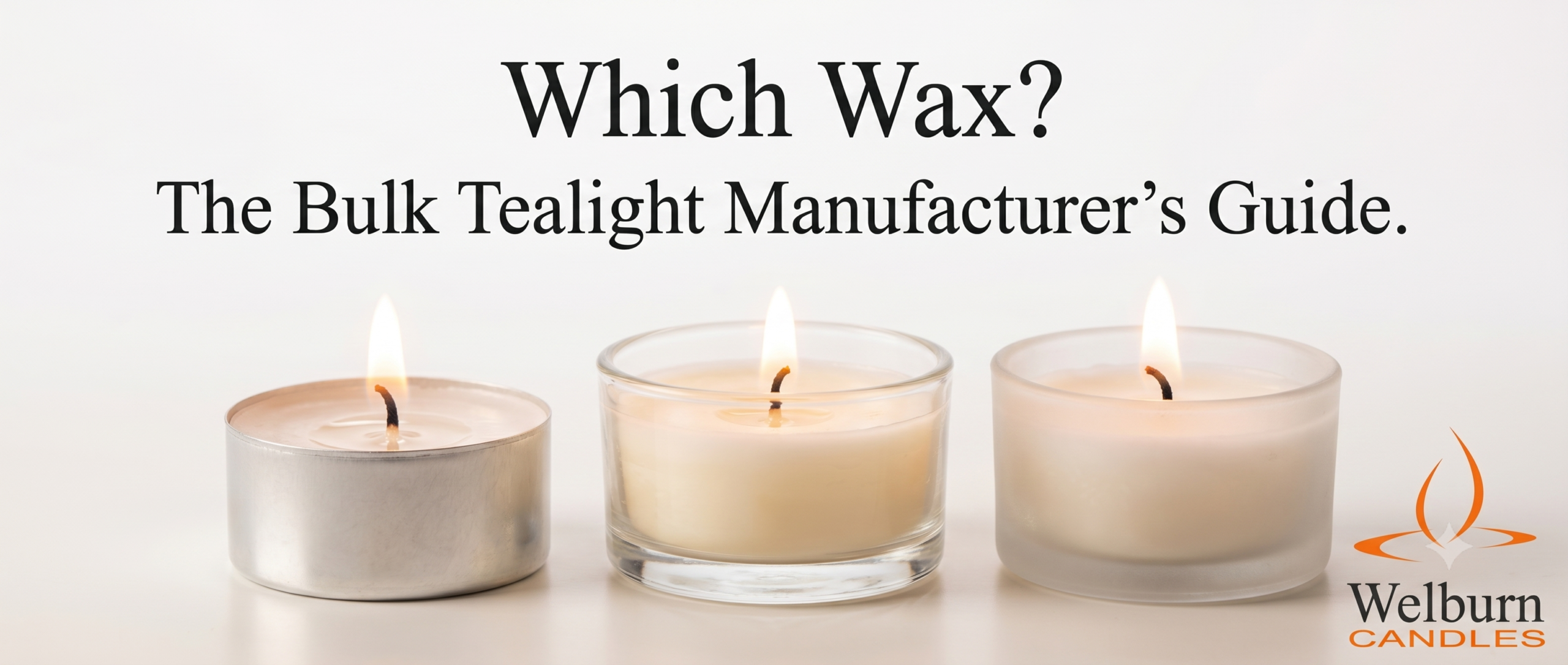
Wax selection is the most consequential decision in bulk tealight candle manufacturing. It determines your product’s burn performance, retail price point, sustainability positioning, compliance profile, and target customer. This guide compares the three main options for US and EU buyers.
This sub-blog is part of our main guide: Tealight Candle Bulk Manufacture: Complete Buyer’s Guide.
Fully Refined Paraffin Wax Tealights
Best for: Value retail, hospitality, events, food service, candlelit dining establishments.
Fully refined paraffin is the dominant tealight wax globally — used in an estimated 80%+ of tealights sold in the US and EU. According to the NCA (National Candle Association), paraffin wax is a highly refined petroleum by-product that meets strict purity standards when used at food-grade or cosmetic-grade specifications. Key characteristics: consistent melt point, excellent scent throw, high clarity, and predictable burn-time behaviour at scale.
For US and EU market compliance, ensure your manufacturer uses fully refined (not crude) paraffin that meets ASTM and REACH specifications.
Natural Soy Wax Tealights
Best for: Natural/organic retail, health food stores, premium gift shops, D2C wellness brands in the US and EU.
Soy wax tealights appeal strongly to the “clean ingredient” consumer segment that has grown rapidly in both North American and European markets. Soy wax is biodegradable, derived from a renewable source, and burns at lower temperatures, which translates to a longer burn time versus paraffin at the same weight. According to USDA BioPreferred Program data, soy wax qualifies for biobased content labelling — a marketable certification in US retail.
Natural Coconut Wax Tealights
Best for: Luxury positioning, premium gift, boutique retail, high-end hotel amenity, Whole Foods/specialty retail buyers.
Coconut wax produces the cleanest, slowest burn of the three options. It has the highest fragrance load capacity, meaning tealights can carry more scent per gram of wax. In the EU luxury candle market, coconut wax has seen significant growth as an alternative to soy, particularly in France, Germany, and Scandinavia. The cost premium over paraffin is 3–5x per unit, justified by the retail positioning.
Wax Selection by Market and Channel
| Market Channel | Recommended Wax | Price Sensitivity | Retail Price Premium |
| US Mass Retail (Walmart, Target) | Fully Refined Paraffin | High | Low (₹0.08–0.18/unit) |
| US Natural/Health (Whole Foods, Sprouts) | Soy or Coconut | Medium | Medium–High |
| EU Supermarket | Paraffin or Soy Blend | High | Low–Medium |
| EU Premium Gift / Boutique | Coconut or Soy | Low | High (€2–5/unit retail) |
| Hotel / Hospitality | Paraffin (smokeless) | High | Medium |
Quick Links
← Back to Main Blog: Tealight Candle Bulk Manufacture: Complete Guide
→ Related: Tealight Bulk Manufacture for Hotels and Events
→ Contact: Request a Sample from Welburn Candles
FAQs: Wax Types for Tealights
Is paraffin wax safe for tealights sold in the EU?
Yes. Fully refined cosmetic or food-grade paraffin wax used in candles is compliant with EU REACH regulations when fragrance ingredients meet IFRA and CLP classification requirements. Lead-free wicks are mandatory.
Can I mix wax types in a single tealight order?
Yes. Welburn can produce multiple wax variants in a single consolidated order. This is common for buyers testing multiple product lines for different retail channels simultaneously.
Does soy wax tealight qualify for ‘natural’ or ‘organic’ labelling in the US?
Soy wax qualifies for ‘natural wax’ and ‘plant-based’ claims. For ‘organic’ labelling, the soy must be USDA certified organic — a separate certification with higher raw material cost. Welburn Candles can supply USDA-organic-source soy on request.