How to Launch a Private Label Candle Brand With No Prior Industry Experience
The single most common misperception about private label candle brand building is that it requires prior industry expertise. It does not. What it requires is a clear brand vision, a reliable private label candle manufacturer, and a structured process. Welburn Candles’ private label programme is designed to guide brand owners who are new to the candle industry through every step of the journey — from the first fragrance brief to the first wholesale order. This is your complete starter guide. For the broader commercial strategy context, see our private label candle retail strategy guide. Step 1: Define Your Brand Identity Before Choosing Your Products The most common mistake new private label candle brand owners make is starting with product selection rather than brand definition. Your brand identity — the values, aesthetic, and emotional positioning you want to own — should drive every product decision that follows. Ask yourself: Who is your target customer? What do they value — natural ingredients, luxury aesthetics, wellness benefits, or sustainable production? What emotional state are your candles designed to create? What price point and retail environment does your brand aspire to? These answers shape fragrance selection, vessel choice, label design, and every other product decision. Step 2: Brief Your Fragrance Direction Fragrance is the most powerful differentiator for a private label candle brand. At Welburn Candles, our fragrance development team works with brand owners — including first-time brand owners — to translate a brand identity into fragrance directions through a structured brief process. You do not need perfumery knowledge; you need a clear sense of the emotion and sensory world your brand inhabits. See our private label candle fragrance guide for the full fragrance brief process. Step 3: Choose Your Launch Vessel and Format For a first private label candle range, simplicity is commercially wise. Starting with a single vessel format — typically a medium round jar (200–250ml) — in two to three fragrances is the most capital-efficient approach. This focused launch enables you to test market response, collect genuine customer feedback, and make informed decisions about range expansion based on real data rather than speculation. Step 4: Understand Your Compliance Requirements Even if you are new to the candle industry, you are not exempt from regulatory requirements. If you are selling in Europe, your candles must meet CLP labelling requirements and your fragrances must be IFRA compliant. Welburn Candles manages this compliance for you as part of our private label service — providing all required documentation and producing compliant labels before dispatch. Our private label candle compliance guide explains what you need to know. Step 5: Build Your DTC Platform Before Retail Outreach Your direct-to-consumer website — typically Shopify — is your brand’s home and your first proof of commercial viability. Build it before approaching retail buyers: a functioning DTC website with professional product photography and initial customer reviews gives retail buyers the confidence that your brand has genuine commercial traction. Welburn Candles’ private label brand guide covers the full DTC-to-wholesale strategy. Frequently Asked Questions Q: How much investment does a first private label candle brand launch require? A: Investment requirements vary significantly depending on your starting vessel range, packaging specification, and initial order volume. Welburn Candles’ team can provide a realistic cost breakdown once your product brief and volume requirements are defined. Contact our private label team to begin a no-obligation consultation. Q: Do I need a business registration before approaching a private label candle manufacturer? A: You do not need an established business entity to begin the consultation and sampling process with Welburn Candles. However, before placing a production order and particularly before importing goods for commercial sale, you should have appropriate business registration and tax registration in place. Consult a business adviser in your market for the specific requirements. Ready to start your private label candle brand journey? Contact Welburn Candles to request our private label starter guide and begin your consultation.
Luxury Jar Candle Manufacturing: What Separates Premium from Average
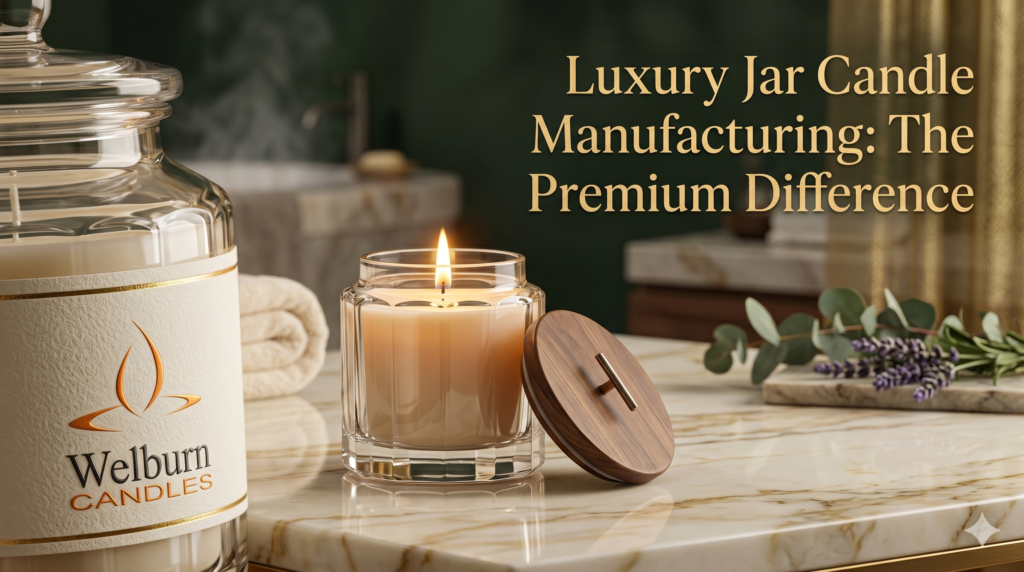
In the home fragrance market, the word ‘luxury’ is used more freely than almost any other descriptor — applied to candles that range from genuinely exceptional to merely adequately presented. For buyers sourcing jar candles for the premium and luxury tier, understanding the specific manufacturing decisions that create genuine luxury is essential for both sourcing and positioning. This guide identifies the exact dimensions of luxury jar candle manufacturing that Welburn Candles executes for clients across Europe, the USA, and the Middle East. For our full jar candle manufacturing overview, see the jar candle manufacturing guide. Premium Glass: The First Luxury Signal The vessel communicates luxury or its absence before a customer reads a single word of copy or smells a single molecule of fragrance. Premium glass for luxury jar candles is characterised by: At Welburn Candles, we source apothecary and premium round vessels in weights and dimensions that meet luxury retail buyer specifications. Explore our custom jar candle design guide for vessel selection principles. Coconut-Soy Wax: The Luxury Wax Standard Luxury jar candle brands have broadly converged on coconut-soy blends as their wax of choice. The reasons are sensory and commercial. Coconut wax delivers exceptional fragrance throw — stronger than soy and more natural than paraffin. The coconut-soy blend creates a luxuriously smooth, creamy white surface that photographs beautifully and communicates natural quality. Welburn Candles produces coconut-soy blend jar candles with fragrance loads optimised for each vessel-wax combination to maximise hot throw performance. Exclusive Fragrance: The Defining Luxury Differentiator A luxury jar candle brand cannot exist without fragrance exclusivity. If your fragrance is available from multiple suppliers to multiple brands, it is not luxury — it is commodity. Welburn Candles’ private label clients develop fully exclusive fragrance formulations — protected under their manufacturing agreement and unavailable to any other brand. For luxury positioning, we develop complex, multi-note fragrances using premium fragrance ingredients and, where relevant, genuine essential oils verified with GC/MS testing. Luxury Lid and Packaging The lid and secondary packaging complete the luxury presentation. Welburn Candles offers debossed or engraved wooden lids, heavyweight aluminium lids in matte and brushed finishes, and cork lids with brand-embossed options — all with the dimensional precision that luxury packaging demands. For secondary packaging, rigid gift boxes with magnetic closures, premium tissue, and branded inserts elevate the unboxing experience to match the product. Frequently Asked Questions Q: What fragrance load does Welburn Candles use in luxury jar candles? A: Luxury jar candles in coconut-soy wax are typically formulated with fragrance loads of 8–12%, depending on the specific fragrance composition and vessel size. Higher fragrance loads deliver stronger cold throw and room-filling hot throw — both critical for luxury positioning. Our formulation team optimises fragrance load for each SKU through burn testing. Q: How does Welburn Candles ensure colour consistency in luxury coloured glass jar candles? A: Coloured glass vessels are specified with Pantone-referenced colour standards, and incoming vessel batches are assessed against approved colour reference samples. Any batch outside agreed colour tolerance is rejected before entering production. Ready to build a luxury jar candle range? Contact Welburn Candles to begin your vessel selection and fragrance development consultation.
Indian Candle Manufacturers: Why Global Buyers Choose India for Premium Production
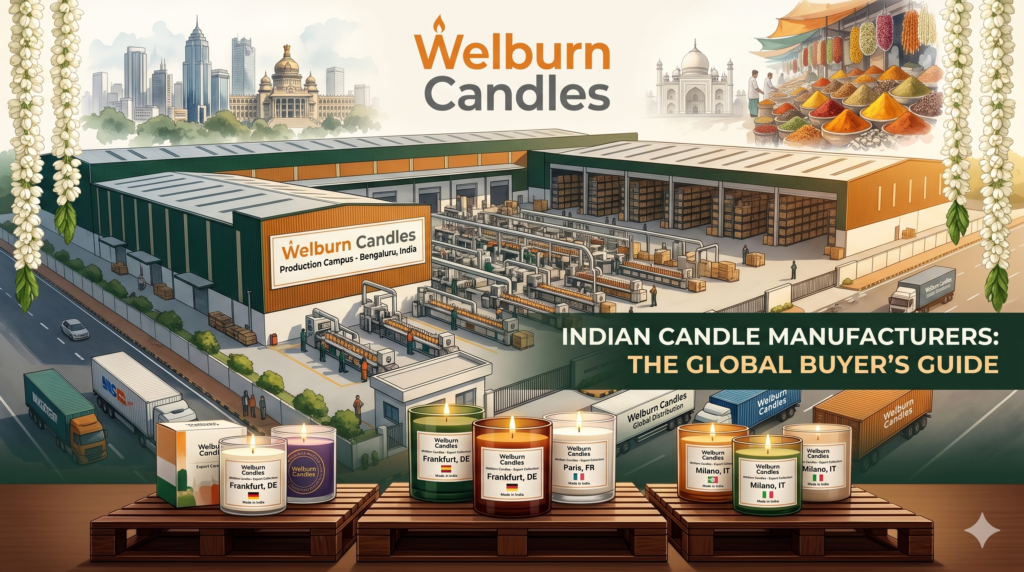
India has emerged as one of the world’s most strategically significant candle manufacturing hubs — not simply because of cost advantages, but because of a genuinely compelling combination of fragrance heritage, production scale, regulatory compliance capability, and export infrastructure that few other manufacturing locations can match. At Welburn Candles, we have been supplying buyers across Europe, the USA, the Middle East, and the Caribbean for over 20 years. This guide explains exactly why global buyers choose Indian candle manufacturers — and what to look for to ensure you are working with the best. For our evaluation framework, see how to evaluate candle manufacturers. India’s Fragrance Heritage: A Manufacturing Advantage India’s relationship with aromatic ingredients spans millennia. From the jasmine cultivation of Tamil Nadu to the rose distillation of Kannauj — India’s ‘perfume capital’ — the country has a living tradition of aromatic ingredient production that directly benefits candle manufacturers operating here. For buyers of scented candles, working with an Indian manufacturer means access to authentic botanical fragrance ingredients sourced at origin — with supply chain transparency that European and US manufacturers sourcing the same ingredients as imports simply cannot match. Explore Welburn Candles’ aromatherapy candle range to see how this heritage translates into therapeutic formulations. Production Scale and Cost Competitiveness India’s manufacturing ecosystem supports candle production at a scale that creates genuinely competitive unit economics for wholesale buyers. At Welburn Candles, our Bangalore facility produces 27 tonnes of candles daily — 1 million tealights, 20,000 jar candles, and 200,000 household candles — using advanced German machinery that combines precision with the volume capacity European and US buyers require. 💡 India’s combination of skilled labour, raw material access, and manufacturing scale makes it possible for Welburn Candles to deliver wholesale pricing that European domestic manufacturers cannot match — while maintaining quality standards that European retailers demand. Compliance Infrastructure: Meeting European Standards From India The most significant shift in Indian premium candle manufacturing over the past decade has been the investment in compliance infrastructure. Leading Indian manufacturers — including Welburn Candles — now operate with the full compliance capability that European retail buyers require: Export Infrastructure to European and Global Markets Welburn Candles exports from Bangalore to European ports including Rotterdam, Hamburg, Genoa, and Barcelona, as well as to US East and West Coast ports, and major Middle Eastern destinations. Our established freight partnerships and documented export processes minimise transit time uncertainty and logistics risk for new importers. For a complete guide to importing from India, see our jar candle export guide. Frequently Asked Questions Q: Is the quality of candles from Indian manufacturers comparable to European-made candles? A: Yes — when sourced from certified, professionally managed Indian manufacturers like Welburn Candles. Our ISO 9001:2015 quality systems, German machinery, and documented quality processes produce candles that meet or exceed European retail quality expectations. Our products are listed by buyers across Italy, France, Spain, the Netherlands, and Germany. Q: What is the lead time for candle orders from India to Europe? A: Sea freight transit from Bangalore to European ports typically ranges from several weeks depending on the destination port and shipping line schedule. Air freight options are available for urgent or sampling requirements. Our export team provides accurate current transit time guidance based on your destination and preferred shipping route. Q: How does currency fluctuation affect candle pricing from Indian manufacturers? A: Welburn Candles quotes prices in US dollars, euros, or British pounds for European, US, and UK buyers — minimising currency risk in your purchasing model. Contact our sales team to discuss the most appropriate currency for your purchasing relationship. Ready to explore what Indian candle manufacturing can deliver for your brand? Contact Welburn Candles for our export capability overview and catalogue.
Building an Aromatherapy Candle Brand: From Formulation to Retail Success
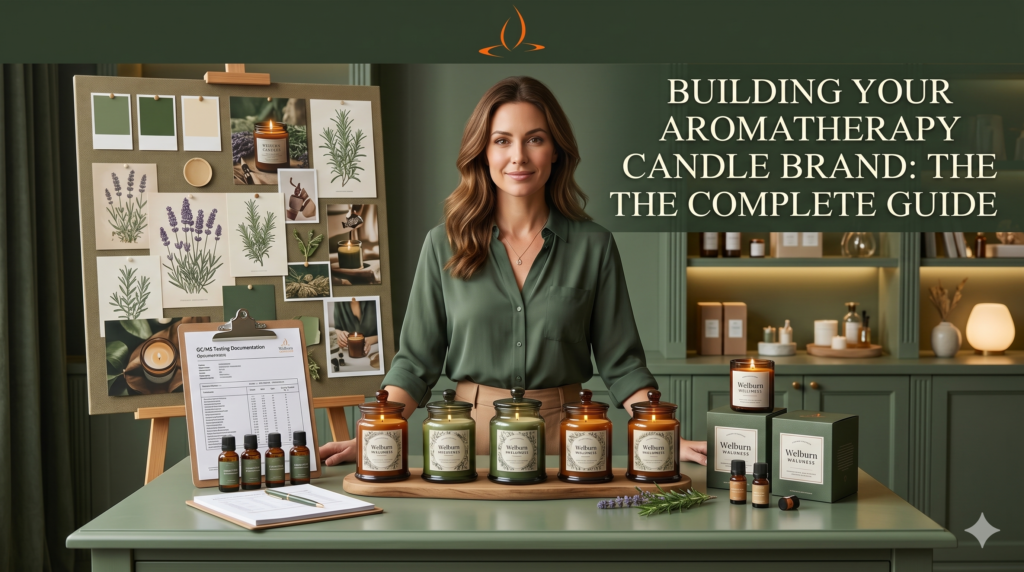
Aromatherapy candles occupy one of the most commercially exciting positions in the consumer goods landscape: at the intersection of home fragrance, wellness, and self-care — three of the fastest-growing consumer categories globally. But building a genuinely credible aromatherapy candle brand requires more than a therapeutic fragrance name and a botanical label aesthetic. It requires authentic essential oil formulation, credible certification, and a retail strategy that connects with genuinely wellness-motivated buyers. At Welburn Candles, our aromatherapy candle manufacturing programme is built specifically for brand owners ready to do this properly. This guide is your complete roadmap. For our full aromatherapy formulation science, see our aromatherapy candle wellness guide. What Genuinely Differentiates an Aromatherapy Candle Brand The aromatherapy candle category is crowded with brands that use therapeutic language without therapeutic substance. The brands that build sustainable commercial success in this category share one characteristic: authentic ingredient differentiation that is verifiable, communicable, and appreciated by genuinely wellness-motivated customers. Authentic aromatherapy brand differentiation is built on: Phase 1: Therapeutic Formulation Development Building an aromatherapy candle brand begins with your therapeutic formulation programme — the set of essential oil blends that will form the core of your range. At Welburn Candles, we guide brand owners through therapeutic brief development, essential oil sourcing and GC/MS verification, synergy blend development, wax compatibility testing, and burn performance validation. See our essential oil candle formulation guide for the full formulation process. Each formulation is developed against a therapeutic objective — sleep and rest, anxiety relief, focus and clarity, meditation and grounding, or energy and uplift — using the essential oil combinations with the strongest evidence base for each intended effect. Phase 2: Certification and Compliance Aromatherapy candle brands require a specific compliance and certification stack that goes beyond standard candle compliance: For the complete certification pathway, see our aromatherapy candle certification guide. Phase 3: Vessel and Packaging for Wellness Positioning Aromatherapy candle packaging must communicate therapeutic authenticity through its materials, typography, and ingredient disclosure. The most effective aesthetic direction for aromatherapy brands combines: For detailed guidance on wellness packaging communication, see our aromatherapy candle packaging guide. Phase 4: Wellness Retail Channel Strategy Aromatherapy candle brands have access to commercial channels that standard home fragrance brands do not. Wellness retail — health food stores, natural beauty retailers, pharmacies, parapharmacies, yoga studios, and spa retail — offers access to highly motivated, quality-focused buyers willing to pay premium prices for authentic therapeutic products. For a complete wellness retail strategy, see our aromatherapy candles for wellness retail guide. Frequently Asked Questions Q: How long does it take to build and launch an aromatherapy candle brand with Welburn Candles? A: The timeline from initial consultation to first production delivery depends on formulation complexity, certification pathway, and packaging development. Clients entering our programme with a clear brief can expect to move from consultation to production within a commercially reasonable timeframe. Contact our team for an accurate timeline based on your specific requirements. Q: Can I build an aromatherapy candle brand that sells both direct-to-consumer and to wellness retail? A: Yes — and the most commercially successful aromatherapy candle brands operate in both channels simultaneously. DTC sales provide the brand story, customer data, and review content that wellness retail buyers evaluate when considering listing decisions. Welburn Candles supports clients in producing compliant products suitable for both D2C and wholesale channels from a single production run. Q: What is the price premium I can expect for an authentic aromatherapy candle brand versus a standard scented candle brand? A: Authentic aromatherapy candle brands with genuine essential oil credentials, verified testing, and credible certification typically command a 30–50% retail price premium over equivalent non-therapeutic scented candles in European wellness retail channels. This premium more than justifies the additional investment in essential oil ingredients, GC/MS testing, and certification. Contact Welburn Candles to discuss the commercial case for your specific brand concept.
The Scented Candle Buyer’s Guide: How to Source, Evaluate, and Order at Scale
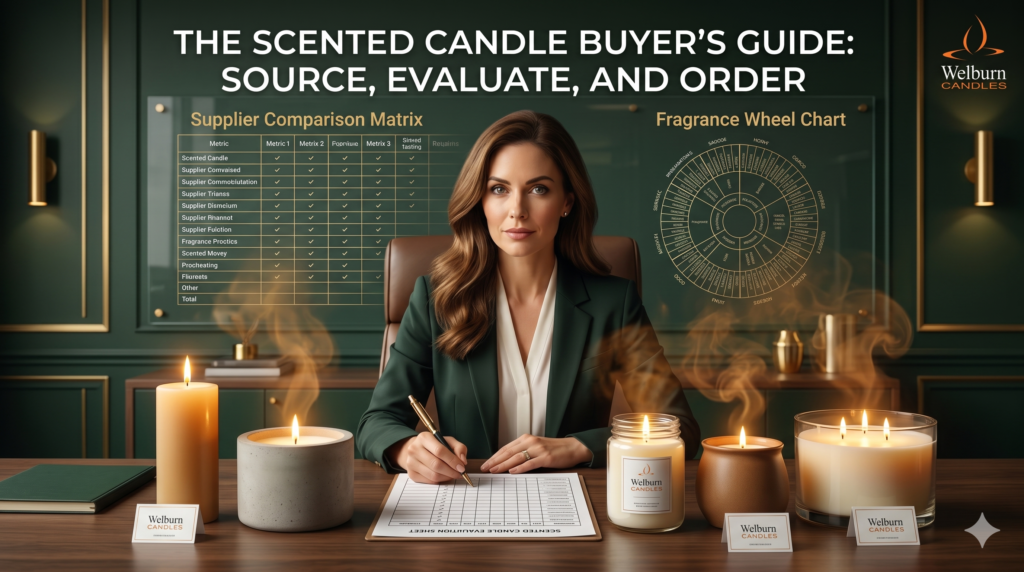
Scented candles are one of the most commercially dynamic product categories in European and global home fragrance retail. But the gap in quality between the best and worst scented candle manufacturers is enormous — and for buyers placing large-scale orders, the consequences of partnering with the wrong supplier extend far beyond a disappointing product: they include compliance exposure, customer returns, and brand reputation damage. This guide provides a complete framework for scented candle buyers — from initial supplier evaluation to sample testing, compliance assessment, and production order management. For our fragrance formulation expertise context, see our scented candle formulation guide. The Scent Throw Evaluation Framework Fragrance performance is the primary quality dimension for scented candles. Buyers evaluating scented candle manufacturers must assess three distinct performance dimensions: 1. Cold Throw Assessment Cold throw is fragrance released by an unlit candle. Assess by removing the candle from its packaging in a neutral-scented room and evaluating fragrance strength and character at ambient temperature. A good scented candle should be clearly perceptible at cold throw — giving customers a meaningful in-store scent experience before purchase. 2. Hot Throw Assessment Hot throw is the fragrance released at full melt pool burn. This is the performance dimension that drives repurchase. To assess hot throw properly, burn the candle in a 15–20 square metre room for a minimum of three hours, allowing a full melt pool to develop. Assess fragrance strength (room-filling versus subtle) and character (does the fragrance match its description?). Compare across all suppliers you are evaluating in the same room under the same conditions. 3. Fragrance Longevity Assessment Fragrance longevity measures whether the scented candle maintains consistent fragrance throw across its full burn life — not just in the first few burns. Ask for multi-session burn data from any manufacturer you are seriously evaluating. At Welburn Candles, our 40-hour burn test protocol captures fragrance performance across the full product burn life. See our scented candle wax types guide for how wax type affects fragrance longevity. Compliance Documentation: The Non-Negotiable Standard Every scented candle in your range sold in European markets must be accompanied by full compliance documentation. This is not a bureaucratic formality — it is the documented proof that your products are safe for consumers and legally compliant for retail in your target markets. Required documentation for EU market scented candles: Welburn Candles provides all of the above as standard for European-market scented candle orders. For market-specific detail, see our scented candle export guide. Ordering at Scale: Planning Your Production Schedule Large-scale scented candle orders require coordinated planning across fragrance sourcing, vessel procurement, packaging production, and production scheduling. At Welburn Candles, buyers placing large-scale orders work with our production planning team to develop a production schedule that meets delivery requirements without compromising quality. Frequently Asked Questions Q: How do I compare fragrance throw performance objectively across multiple scented candle suppliers? A: The most objective comparison methodology is to conduct all hot throw assessments in the same room, with the same ambient conditions, at the same burn stage (full melt pool, same burn duration). Evaluate all candidates on the same day if possible to eliminate environmental variability. Record your assessments against a consistent scoring scale for each performance dimension. Q: What fragrance families sell most consistently in European markets? A: Warm woody and spice compositions, clean florals, and fresh citrus-botanical blends are the most consistently commercial fragrance families across European markets year-round. Gourmand fragrances (vanilla, caramel) perform strongly in colder months and gifting seasons. Our private label fragrance guide covers European fragrance preferences by country in detail. Q: What batch documentation does Welburn Candles provide with scented candle orders? A: Every Welburn Candles scented candle order is accompanied by a quality certificate, fragrance batch IFRA certificate, and packing documentation. For European-market orders, REACH declarations and CLP allergen disclosures are included as standard. Additional documentation including burn test records and raw material safety data sheets is available on request. Contact Welburn Candles to request a specimen documentation pack.
Private Label Candle Manufacturing for Amazon Sellers: The Complete 2026 Guide

Amazon is one of the most commercially accessible and competitively intense retail environments for private label candle brands. The combination of massive reach, discovery-driven search behaviour, and review-powered conversion makes Amazon an attractive channel — but also one where product quality, packaging compliance, and listing optimisation must all function together for commercial success. At Welburn Candles, we supply private label candle manufacturing for Amazon sellers across the US, UK, EU, and Indian markets. This guide covers every dimension of building a successful Amazon private label candle brand from a manufacturing perspective. For the broader private label brand-building framework, see our private label candle brand guide. Understanding Amazon’s Requirements for Candle Products Amazon applies category-specific requirements to candles that sellers must meet before listing. These include: FBA Packaging: What Your Private Label Candle Manufacturer Must Know Amazon FBA (Fulfilled by Amazon) has specific packaging requirements that must be observed for products to be received into fulfilment centres without rejection. Welburn Candles has experience preparing candle orders to Amazon FBA specifications: 💡 FBA packaging errors cause rejection at Amazon’s receiving docks — a costly problem that delays inventory availability. Always confirm your manufacturer’s FBA experience before production, and request a pre-shipment inspection against the FBA specification. Building an Amazon-Optimised Private Label Candle Range Success on Amazon as a private label candle brand requires product selection, pricing, and presentation strategies aligned with how Amazon’s search and recommendation algorithms work. Product Selection Amazon candle searches skew strongly toward jar candles in the 200–300ml size range. This is the sweet spot for Amazon candle purchasing: strong burn time, attractive retail price, and manageable shipping weight. Welburn Candles produces 200–300ml jar candles in soy, coconut-soy, and paraffin blend wax options. Fragrance Selection for Amazon Amazon candle reviews consistently identify fragrance performance as the primary positive or negative review trigger. Investing in fragrance development that maximises both cold throw (in-box product experience) and hot throw (burning performance) is the most impactful product quality decision for Amazon private label success. Our scented candle formulation guide explains how Welburn Candles approaches scent throw optimisation. Review Generation Strategy Amazon’s review system is the primary commercial differentiator between private label candle brands. Product quality drives review frequency and sentiment — customers who experience a genuinely excellent candle are more likely to leave positive reviews. At Welburn Candles, our 40-hour burn test protocol and fragrance performance standards are designed precisely to deliver the consistent, high-quality experience that generates positive Amazon reviews. Compliance for Amazon EU Marketplaces Amazon EU marketplaces (Amazon.de, Amazon.fr, Amazon.it, Amazon.es, Amazon.nl) require candles to meet EU CLP labelling and REACH compliance standards. For UK Amazon, UK CLP and UK REACH apply. Welburn Candles provides market-specific compliance documentation sets and multi-language labelling for all EU Amazon marketplaces, produced and applied before dispatch. Frequently Asked Questions Q: Can Welburn Candles ship directly to Amazon FBA warehouses? A: Yes — Welburn Candles can ship to Amazon FBA fulfilment centres in the USA, UK, Germany, France, Italy, Spain, and other Amazon markets. Our export team prepares all required documentation for Amazon FBA receipt, including commercial invoices with correct HS codes, certificates of origin, and import compliance documentation. Q: How many SKUs should I start with for an Amazon private label candle launch? A: We recommend starting with three to five SKUs for an Amazon launch. This focused range allows you to collect meaningful review data and conversion metrics before expanding. Choose SKUs that cover two or three fragrance families — typically one floral, one woody/warm, and one fresh — to capture different search intent profiles within the candle category. Q: Does Welburn Candles offer branded insert cards for Amazon unboxing? A: Yes — branded insert cards, brand story cards, and care instruction cards can all be produced and included in packaging as part of your private label production. These inserts contribute to customer experience and can support brand loyalty beyond the Amazon marketplace. Contact Welburn Candles to discuss your full packaging specification.