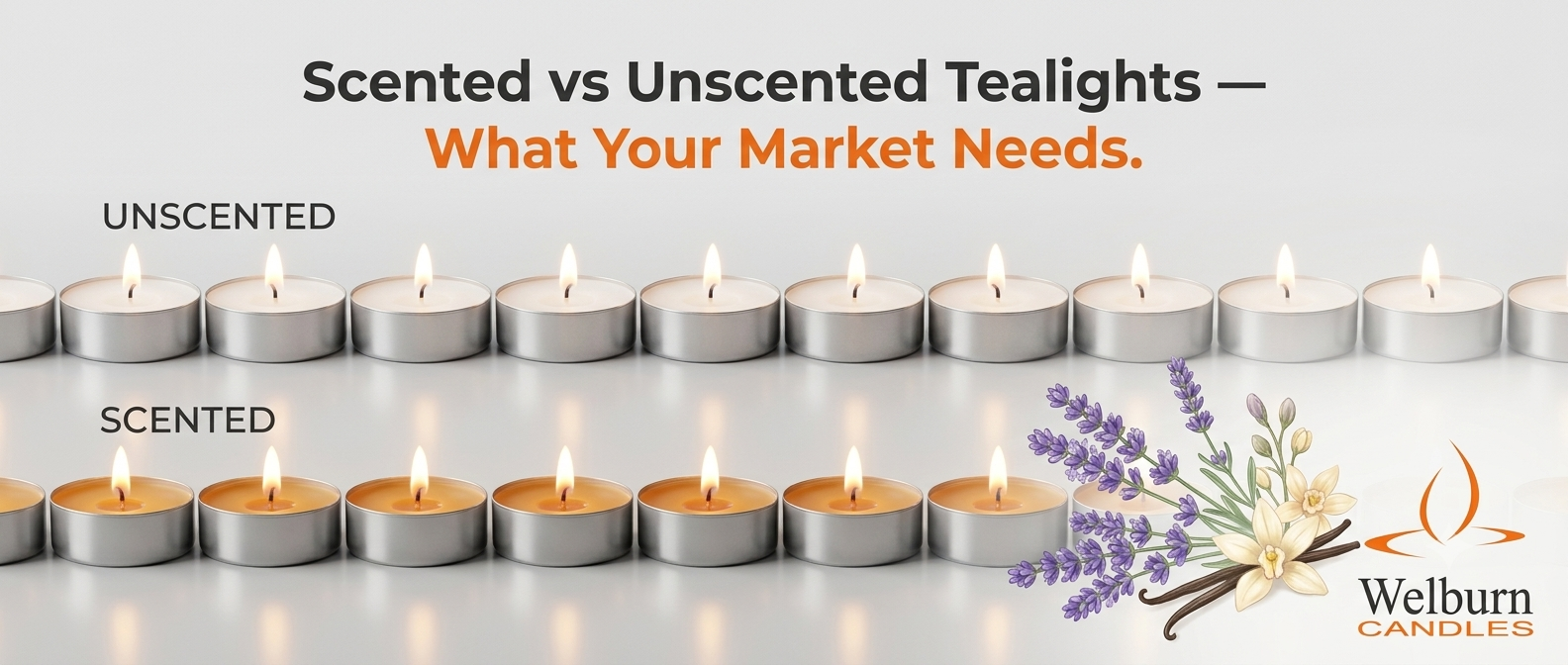
Whether to order scented or unscented tealight candles is more than an aesthetic decision — it has implications for compliance documentation, pricing, MOQ, lead time, and the market channels you can serve. This guide breaks down the key differences for wholesale buyers.
This sub-blog is part of our main guide: Tealight Candle Manufacturers: Complete Sourcing Guide.
Unscented Tealights: Manufacturing Profile
Unscented tealights are the highest-volume, most price-competitive candle product globally. Manufacturing is simpler: wax, wick, and cup — no fragrance development, no IFRA compliance requirements, no allergen declaration. Lead times are shorter, MOQs are lower, and pricing is most competitive.
Best market fit: hospitality (restaurants, hotels, events), religious/votive use, emergency preparedness, birthday cake candles, outdoor events where fragrance is unwanted. These are volume commodity markets where price and burn consistency are the only differentiators.
Scented Tealights: Manufacturing Profile
Scented tealights require fragrance development or selection, blend optimisation for scent throw at tealight scale (small wax volume = different throw dynamics than a large jar candle), IFRA compliance for each fragrance, allergen declaration for EU labelling, and typically longer development lead time. Fragrance load in tealights is typically 3–6% — lower than jar candles due to the smaller wax volume and shorter burn time.
Welburn Candles maintains a library of IFRA-compliant fragrances pre-cleared for EU and US market use. Custom fragrance development for scented tealight OEM orders is available with a 2–3 week development lead time.
Compliance: The Key Difference
Unscented tealights require minimal compliance documentation for EU/US import — primarily wick composition and wax specification. Scented tealights require IFRA compliance statements, REACH substance listing for fragrance ingredients, and EU CLP allergen labelling above threshold concentrations. This compliance overhead adds cost and documentation time but is manageable with a prepared manufacturer.
Quick Links
← Back to Main Blog: Tealight Candle Manufacturers: Complete Guide
→ Related: OEM vs Private Label Tealight Manufacturing
→ Shop: Welburn Scented & Unscented Tealights
FAQs: Scented vs Unscented Tealights
What fragrance load percentage is typical for tealight candles?
Tealight fragrance load typically ranges from 3–6% by wax weight. Higher loads (5–6%) deliver better hot-throw but can affect burn performance if fragrance oil flash point is low. Welburn’s formulation team optimises fragrance load per scent to balance throw and clean burn.
Do scented tealights require different packaging for EU compliance?
Yes. EU CLP regulations require allergen declaration on packaging when certain fragrance allergens exceed threshold concentrations (0.01% in leave-on products, 0.1% in rinse-off — candles are treated as leave-on for CLP purposes). Your manufacturer should provide allergen-flagged fragrance safety data sheets.
Which scented tealight fragrances sell best in the US market?
According to NCA market data, top-performing tealight scents in US retail are: Lavender, Vanilla, Clean/Fresh Linen, Eucalyptus, and seasonal fragrances (Cinnamon Spice in Q4, Floral in spring). Welburn offers all standard profiles in pre-approved formulations.