
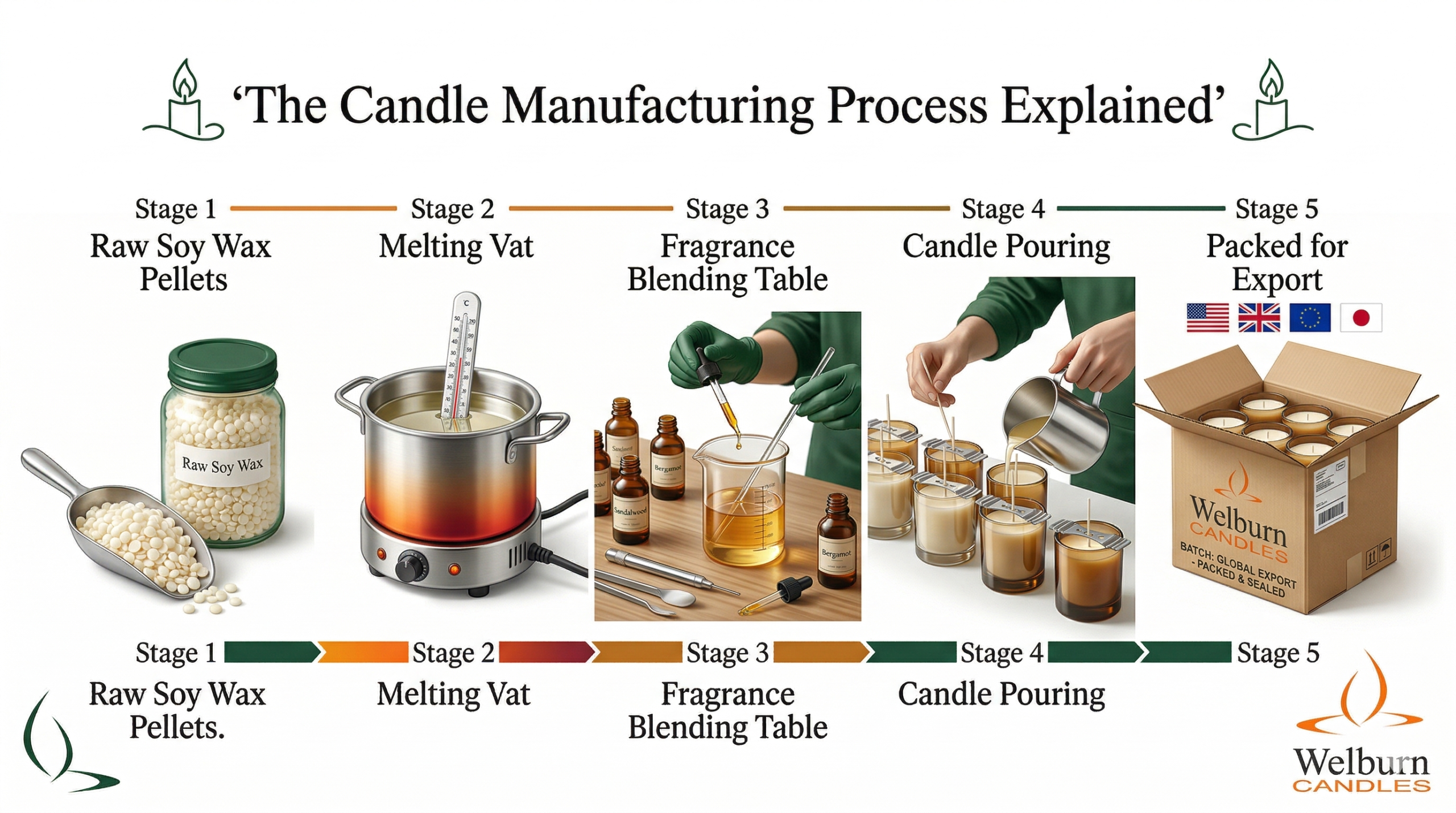
Understanding how professional candle manufacturers operate gives buyers, brand owners, and retailers a critical advantage when evaluating suppliers. At Welburn Candles, transparency is a core value — and we believe that clients who understand our production process become our most successful long-term partners. This guide walks through each stage of professional candle manufacturing, explaining the quality controls and technical decisions that distinguish world-class manufacturers from commodity producers.
Stage 1: Raw Material Sourcing and Incoming Quality Control
Professional candle manufacturing begins well before the first drop of wax is melted. At Welburn Candles, every raw material — wax, fragrance oil, wick, vessel, and packaging component — undergoes incoming quality control before entering production.
- Wax: Tested for melt point, clarity, and absence of contaminants. We source paraffin blends, soy wax, and specialty waxes from certified suppliers.
- Fragrance Oils: Every batch is accompanied by an IFRA compliance certificate confirming that all fragrance compounds are used within permitted safety limits for candle applications.
- Wicks: Pre-tabbed cotton wicks are inspected for correct sizing and that they are free of lead — a critical safety requirement for markets in Europe and the USA.
- Vessels: Glass jars and other containers are inspected for dimensional consistency, surface quality, and absence of defects that could compromise safety during burning.
Stage 2: Wax Preparation and Fragrance Blending
Wax preparation is where the science of candle manufacturing is most exacting. Our production team works to precise temperature protocols — developed through extensive burn testing — that ensure optimal fragrance binding, consistent texture, and correct melt pool behaviour.
💡 Wax pouring temperature is controlled to ±2°C on every production run at Welburn Candles. This precision is the foundation of consistent scent throw and burn performance across every batch.
Fragrance is added to the melted wax at the precise temperature that maximises binding — too hot and fragrance components flash off; too cool and the blend separates. Our in-house team has developed optimal temperature protocols for every fragrance family we produce, ensuring the scented candle formulations we deliver perform to specification every time. Read more in our scented candle formulation guide.
Stage 3: Wick Placement and Candle Pouring
Wick placement is a step that separates professional manufacturers from amateur producers. Off-centre wicks create uneven burn pools, tunnelling, and increased fire risk. At Welburn Candles, we use precision wick-centring systems — adapted for each vessel size and type — that guarantee wicks remain perfectly centred through the pour and cooling process.
For jar candles, our German machinery controls pour rates and temperatures to minimise air pockets, surface cracking, and the wax shrinkage that creates sinkholes around the wick. Each vessel is filled in a single controlled pour where technically feasible, with top-up pours performed under the same temperature-control protocols.
Stage 4: Curing and Quality Testing
Curing is the step that most buyers never see — but it is critical to candle performance. Soy and natural wax blends require adequate curing time to achieve optimal fragrance throw and consistent surface texture. Rushing this stage is a common shortcut taken by lower-quality manufacturers that results in poor cold throw and inconsistent hot throw in the finished product.
Our quality testing protocol includes:
- Burn pool testing: Every new SKU is burn-tested for a minimum of 40 hours, with observations recorded at 2-hour intervals
- Fragrance evaluation: Cold throw assessed before burning; hot throw assessed at full melt pool
- Vessel integrity: Glass vessels inspected for thermal stress cracking during and after burn testing
- Surface inspection: Visual inspection for frosting, sinkholes, and surface cracking under standardised lighting conditions
Stage 5: Labelling, Packaging, and Export Preparation
The final stage of the manufacturing process prepares candles for their journey to retail shelves or directly to end consumers. At Welburn Candles, our packaging team applies labels with automated label dispensers that ensure consistent alignment on every unit. For European market products, we verify that all required CLP labelling elements are present — including allergen declarations, hazard pictograms, and responsible person information.
All export cartons are packed to international freight standards, with appropriate protective void fill and carton specifications for air, sea, and road freight. Our export documentation team prepares all required certificates of origin, compliance declarations, and customs documentation for every destination market. Explore our global candle manufacturing standards guide for more on how we support buyers across Europe.
Frequently Asked Questions
Q: How does Welburn Candles maintain consistent quality across large production runs?
A: Our ISO 9001:2015 quality management system requires documented process controls at every production stage. Each production run begins with a batch sample review, and our quality team conducts in-process inspections at defined intervals. Any batch that falls outside our quality parameters is quarantined for investigation before dispatch.
Q: Can I visit the Welburn Candles manufacturing facility before placing an order?
A: Yes — Welburn Candles welcomes facility visits from prospective clients and wholesale buyers. Our Bangalore facility showcases our full manufacturing capability, quality control processes, and packaging operations. Contact our sales team to arrange a visit.
Q: What wax types does Welburn Candles work with?
A: We work with paraffin wax blends, soy wax, coconut-soy blends, and specialty wax formulations depending on client requirements. Each wax type has distinct burn characteristics, and our R&D team recommends the optimal wax for each specific candle application.
Q: How long does the sampling process take before production?
A: Our sampling process involves material procurement, sample production, and burn testing. The timeline depends on the complexity of the brief — standard fragrance and vessel combinations are generally faster than fully custom formulations. Contact us to discuss your specific sampling requirements.
Q: Does Welburn Candles offer candle manufacturing for the European market specifically?
A: Yes — a significant portion of our production is destined for European markets including Italy, France, Spain, the Netherlands, and Germany. We have extensive experience with EU regulatory requirements and can provide all documentation needed for smooth customs clearance and retail listing across Europe.
Ready to understand how our manufacturing process translates into quality your customers will love? Contact Welburn Candles to request a facility overview and product sample pack.