
Scented Candle Manufacturers for Hotel, Spa & Hospitality Amenity Programs

This guide is part of our main cluster: Scented Candle Manufacturers: A Buyer’s Guide to Fragrance, Wax & Compliance Introduction Hospitality procurement has different priorities than general retail. A hotel or spa amenity program isn’t just buying a candle — it’s buying a consistent piece of brand identity that needs to smell identical whether a guest experiences it in a Dubai property or a New York property, and needs to reliably restock at scale without quality drift between orders. Batch-to-Batch Consistency Is the Real Requirement For hospitality brands with a signature scent, consistency matters more than almost any other factor. A scented candle manufacturer without tight fragrance formulation control can produce a batch that’s subtly “off” from the last one — something a general retail customer might not notice, but that a returning hotel guest or a brand standards audit absolutely will. Burn Safety for Guest Rooms and Spas Hospitality environments carry higher liability exposure than typical retail, which makes burn safety testing and clear burn-time labelling especially important — guests need clear guidance, and properties need documentation they can point to if questioned by insurers or brand standards teams. Bulk Reorder Reliability and Lead Time SLAs Unlike a one-time retail order, hospitality amenity programs need predictable, recurring supply — new property openings, seasonal refreshes, and standard restocking all depend on a manufacturer that can commit to reliable lead times, not just a one-off production run. Private Label Branding for Hotel Gift Shops Beyond in-room amenities, many hospitality brands sell private label candles in gift shops as a retail extension of the guest experience — often using the same signature scent as the in-room amenity candle, which is another reason batch consistency across both product lines matters. Why Jar Format Dominates Hospitality Amenity Programs Most hospitality amenity candles use jar formats specifically for the fragrance throw and shelf presence in guest rooms — see our full jar candle manufacturing guide for the format-specific considerations that apply here. Our Hospitality Manufacturing Experience With in-house fragrance formulation and ISO 9001:2015 certified production, we support hospitality brands with consistent signature-scent production and the reliable reorder scheduling that amenity programs depend on. Reach out to discuss a hospitality amenity program partnership. FAQs Can you match a signature hotel scent consistently across large orders? Yes, our in-house fragrance formulation process is built specifically to maintain batch-to-batch consistency, which is essential for hospitality brands maintaining a signature scent across properties. What burn-time safety standards apply to hospitality candles? Hospitality candles should meet the same core fire safety standards as retail candles, with particularly clear burn-time labelling given the higher liability context of guest-facing environments. Do you support recurring bulk reorder contracts? Yes, we work with hospitality brands on predictable reorder scheduling to support property openings, seasonal refreshes, and standard amenity restocking.
Scented Candle Manufacturers for European Home Fragrance Brands
This guide is part of our main cluster: Scented Candle Manufacturers: A Buyer’s Guide to Fragrance, Wax & Compliance. Also see our related private label guide: Private Label Candles for Italy and Spain Introduction European home fragrance brands operate in one of the most design-literate and regulation-conscious candle markets globally. Whether you’re building a brand out of France, Germany, or the Nordics, sourcing decisions need to account for both fragrance trend sensibility and a compliance framework that goes beyond what’s required in other export markets. REACH Compliance Alongside IFRA EU-bound scented candles need to satisfy REACH chemical registration and safety requirements in addition to IFRA fragrance usage limits. These aren’t interchangeable — REACH covers broader chemical safety and registration obligations, while IFRA specifically governs fragrance ingredient concentration limits. A scented candle manufacturer exporting into the EU needs working familiarity with both. EU Labelling Requirements CLP pictograms and burn time warnings are standard requirements on EU-bound candle packaging, and label accuracy matters — mismatched or missing hazard information is one of the more common reasons shipments get flagged at EU customs or by retail compliance teams. Fragrance Trends Across European Markets Fragrance preference varies meaningfully by country. France and the broader Francophone market lean toward sophisticated, layered fragrance profiles; Germany and the Nordics show strong demand for clean, botanical, minimal-ingredient positioning consistent with the region’s broader naturkosmetik retail culture. A manufacturer capable of formulating across this range — rather than offering one fixed fragrance catalog — gives you room to tailor by market. How This Connects to Private Label Launches Fragrance formulation is really the foundation underneath a private label launch, which is why this guide pairs directly with our existing European private label market guides for Italy and Spain, France, and Netherlands — if you’re building a private label brand for any of these markets, fragrance compliance and formulation is the layer that needs to be right first. Our European Compliance & Formulation Experience We formulate fragrance in-house with REACH and IFRA compliance built into the process, and our export experience into the EU spans two decades of shipping candle products that meet CLP labelling requirements on arrival. Talk to our team about fragrance development for your European market launch. FAQs Is REACH compliance different from IFRA? Yes — REACH governs broader chemical safety and registration requirements for substances sold in the EU, while IFRA specifically sets usage limits on fragrance ingredients. EU-bound candles need to satisfy both. What fragrance trends are popular in the EU home fragrance market? It varies by country — French markets tend toward sophisticated, layered fragrance profiles, while Germany and the Nordics show strong preference for clean, botanical, minimal-ingredient formulations. Can you supply both fragrance formulation and private label packaging together? Yes, we handle fragrance formulation and private label packaging development as one integrated process rather than separate handoffs, which keeps your brand positioning consistent from scent to shelf presence.
Scented Candle Manufacturers: What Buyers Need to Know About Fragrance & Compliance

The Quality Gap You Can’t See on the Label Of everything that goes into a candle, fragrance is the one variable that’s hardest to evaluate from a spec sheet — and the easiest place for a low-quality scented candle manufacturer to cut corners. Two candles can look identical on paper — same wax, same jar, same wick — and still perform completely differently once lit, because fragrance formulation is where manufacturing skill actually shows. If you’re evaluating suppliers, understanding a handful of technical basics will save you from finding out about a problem after your first bulk shipment has already reached customers. Fragrance Load: The Number That Determines Everything Fragrance load refers to the percentage of fragrance oil blended into the wax. Too low, and your candle will smell faint even unlit (weak “cold throw”) and barely noticeable once burning (weak “hot throw”). Too high, and you risk poor burn quality — soot, uneven melt pools, or the fragrance oil actually destabilizing the wax structure. A manufacturer who understands wax-fragrance compatibility will calibrate load differently depending on whether you’re using soy, paraffin, or a blend, not apply one fixed percentage across every product. IFRA Compliance: Non-Negotiable for Export Markets The International Fragrance Association (IFRA) sets usage limits on fragrance ingredients based on safety research, and compliance is effectively required if you’re selling into EU or US retail — non-compliant fragrance formulations can and do get flagged at import or by retail buyers doing due diligence. This is one of the first questions to ask any manufacturer directly: is your fragrance formulation IFRA compliant, and can you provide documentation? A manufacturer who hesitates on this question is a manufacturer worth reconsidering. Wax-Fragrance Compatibility Different waxes retain and release fragrance differently: None of these are “better” in the abstract — the right choice depends on your target market and price point, which is exactly why this conversation should happen with your manufacturer, not be decided by default. Common Defects From Under-Qualified Manufacturers If you’ve dealt with inconsistent quality before, it likely traces back to one of these: A manufacturer with proper in-house fragrance and wick-testing capability catches these before they reach your customer, not after. Why Fragrance and Private Label Should Be the Same Conversation Scented candles are where private label differentiation actually happens — your jar and your packaging can look similar to a competitor’s, but a signature fragrance blend is genuinely yours. This overlaps closely with our aromatherapy candle formulation work, since aromatherapy positioning depends entirely on getting essential-oil-adjacent fragrance blends right. Our Fragrance & Compliance Capabilities We formulate fragrance in-house rather than outsourcing it, which means wax selection, fragrance load, and wick sizing are calibrated together rather than treated as separate steps. Combined with ISO 9001:2015 certification and 20+ years of export experience to the USA, EU, UK, and beyond, that in-house control is what lets us support IFRA-compliant private label fragrance development from first sample to bulk reorder. Want to sample a fragrance blend built specifically around your brand positioning? Talk to our team about a sample run. FAQs What is IFRA compliance and why does it matter for scented candles? IFRA sets safety-based usage limits on fragrance ingredients, and compliance is effectively required for EU and US retail. Non-compliant formulations can be flagged at import or during retail buyer due diligence, so it’s worth confirming compliance documentation with any manufacturer before committing to bulk production. Why do some scented candles lose their smell halfway through burning? This usually comes down to fragrance load and wax-fragrance compatibility. If the load is too low for the wax type, or the wax isn’t retaining fragrance oil well as it melts, hot throw drops off well before the candle is finished. Can I request a custom fragrance blend for my brand? Yes — we formulate fragrance in-house, which allows for iterative sampling until a blend matches your brand positioning, whether that’s a clean minimalist scent profile or a bold, layered fragrance. What’s the difference between cold throw and hot throw? Cold throw is how strongly a candle smells unlit, which matters for retail shelf appeal and unboxing. Hot throw is how the fragrance performs once burning, which is what actually drives repeat purchases.
Scented Candles for Export: Reaching European and Global Markets From India
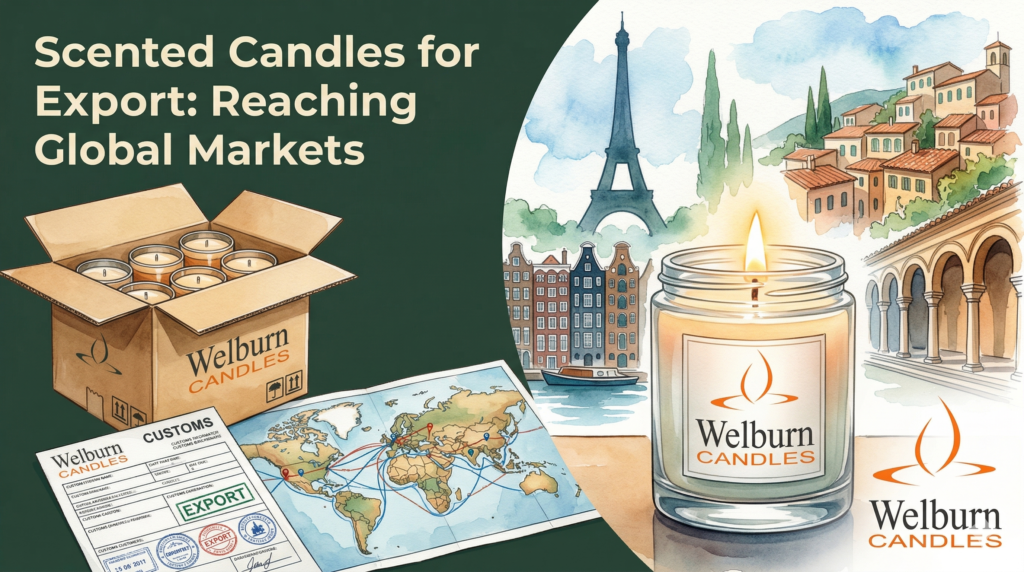
India is one of the world’s leading candle manufacturing hubs, combining artisan fragrance expertise with modern production infrastructure at competitive unit costs. Welburn Candles, based in Bangalore, exports scented candles to over 20 countries — including major European markets, the USA, the Middle East, and the Caribbean. This guide is for importers, brand owners, and retail buyers who want to understand the specific requirements for importing scented candles — with their fragrance compliance dimension — from an Indian manufacturer. For the formulation foundation, see our scented candle formulation guide. The Scented Candle Export Opportunity: Why India? India’s candle manufacturing sector offers a compelling combination of advantages for global buyers: Fragrance Compliance for Scented Candle Export: What Every Market Requires European Union (Italy, France, Spain, Netherlands, Germany). EU fragrance regulations are the most comprehensive in the world. Scented candles exported to EU markets must comply with IFRA Standards for fragrance ingredient usage levels, REACH regulations for chemical substance restrictions, and CLP regulations for allergen labelling. Welburn Candles provides full EU compliance documentation as standard for European-market orders. United Kingdom. Post-Brexit, UK fragrance regulations broadly mirror EU requirements but operate under UK-specific legislation (UK REACH, UK CLP). Welburn Candles has experience supplying both EU and UK market compliant products and provides market-specific documentation sets. United States. US scented candle imports require ASTM F2179 safety standard compliance, IFRA compliance for fragrance ingredients, and California Proposition 65 consideration for products sold in California. Welburn Candles has supplied US market buyers and understands the specific compliance requirements for the US market. Middle East. Middle Eastern markets — particularly the UAE, Saudi Arabia, and Qatar — have significant and growing demand for premium scented candles. Fragrance preferences tend towards rich oud, amber, and rose compositions. Regulatory requirements are generally less prescriptive than European standards, but IFRA compliance provides a sound foundation. Scented Candle Fragrance Labelling for Export Scented candle labels for export must include fragrance allergen disclosures appropriate to each destination market. Welburn Candles produces multi-market label variants and can apply destination-specific labels — in the appropriate language and with the appropriate allergen disclosure format — before dispatch. Fragrance Preferences by Export Market Export-focused scented candle brands benefit from understanding the fragrance preferences of their target markets. Our private label fragrance development guide provides a framework for adapting fragrance strategy to different customer segments and markets. Frequently Asked Questions Q: Does Welburn Candles produce scented candles with market-specific fragrance profiles? A: Yes — Welburn Candles develops scented candle formulations tailored to the fragrance preferences of specific export markets. Our private label clients selling into multiple markets can commission market-specific fragrance variants within their overall range, supported by our fragrance development team. Q: What fragrance documentation is required for scented candle import into Italy? A: Scented candles imported into Italy require IFRA compliance certificates for all fragrance compounds, CLP allergen disclosure documentation for Italian-language label preparation, REACH compliance declarations, and Safety Data Sheets for fragrance ingredients. Welburn Candles provides all of these as standard for EU-market orders. Q: How does Welburn Candles manage fragrance stability during long sea freight journeys? A: Fragrance stability in transit is affected by temperature extremes and prolonged exposure to heat. We use sealed inner packaging for all scented candle export orders and can advise on container placement recommendations to minimise exposure to extreme temperatures. Our quality team can provide guidance on fragrance stability for specific shipping routes. Q: Can I order scented candles in different fragrance strengths for different markets? A: Yes — fragrance load can be adjusted within IFRA safety limits to meet different market preferences. Some markets prefer subtler, lighter fragrance intensities while others respond better to stronger scent throw. Welburn Candles can produce market-specific fragrance intensity variants within your overall scented candle range. Q: What is the most popular scented candle format for European export? A: Glass jar candles in the 200–250ml size range are the most commercially successful format for European export, combining attractive retail price points with substantial burn times and strong fragrance capacity. They also travel well in sea freight with appropriate protective packaging. Planning scented candle exports to European or global markets? Contact Welburn Candles for our export capability overview and fragrance compliance documentation pack.
Scented Candle Wax Types Guide: Choosing the Right Wax for Your Fragrance and Market
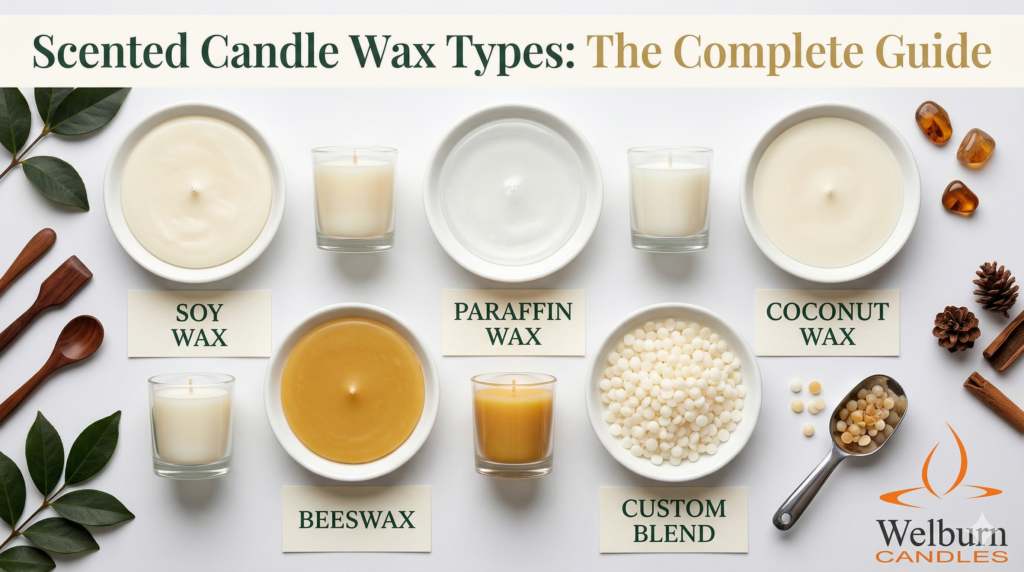
Wax selection is the foundational technical decision in scented candle manufacturing. It determines your candle’s fragrance performance, burn behaviour, surface appearance, sustainability positioning, and commercial cost structure. At Welburn Candles, our scented candle formulation expertise includes extensive experience with all major wax types — and we guide every private label client to the wax choice that best serves their brand’s commercial goals. Paraffin Wax: The Industry Standard Refined paraffin wax remains the most widely used wax in professional scented candle manufacturing globally. Its technical advantages make it the default choice for high-volume production across all market positions from mass retail to premium. Soy Wax: The Natural Market Leader Soy wax has become the first choice for natural and eco-positioned scented candle brands globally. Derived from soybean oil, it offers genuine sustainability credentials alongside strong fragrance performance. Coconut Wax: The Premium Choice Coconut wax is derived from coconut oil and delivers the most exceptional scent throw of any natural wax type. It is the premium wax choice for brands competing at the top of the market. Coconut-Soy Blends: The Best of Both Worlds Welburn Candles recommends coconut-soy blends for private label clients targeting the premium retail segment. These blends combine coconut wax’s exceptional scent throw with soy wax’s natural sustainability positioning and cost management, delivering a performance and positioning combination that neither wax achieves alone. Wax Selection and European Market Positioning European candle consumers — particularly in the Netherlands, Germany, and Scandinavia — are among the world’s most informed and discerning buyers of natural products. Soy and coconut-based waxes are strongly preferred in these markets for their natural credentials. In contrast, French and Italian premium markets often prioritise fragrance performance and luxury aesthetics, where coconut-soy blends excel. Our European compliance guide for private label candles covers market-specific positioning considerations. Frequently Asked Questions Q: Can Welburn Candles produce scented candles in multiple wax types simultaneously? A: Yes — our production facility works with paraffin blends, soy wax, and coconut-soy blends simultaneously. We can produce your core range in soy wax and a premium tier in coconut-soy blend, for example, within the same production schedule. Q: Does wax type affect the fragrance load I can use? A: Yes — different wax types have different saturation points for fragrance oil. Coconut and soy waxes generally accept slightly higher fragrance loads before separation occurs compared to paraffin blends. Our formulation team optimises fragrance load for each specific wax type and vessel combination. Q: Is soy wax genuinely more sustainable than paraffin? A: Soy wax is derived from a renewable agricultural crop rather than petroleum, making it more sustainable in terms of feedstock origin. Overall sustainability also depends on agricultural practices. Welburn Candles sources soy wax from suppliers with responsible farming practices and can provide sourcing documentation. Q: How does wax type affect candle pricing for retail? A: Natural wax candles (soy, coconut) command higher retail prices than equivalent paraffin candles — typically supporting 20–35% premium pricing in European markets due to their natural and sustainable positioning. This premium retail pricing more than compensates for the slightly higher wax cost in most market contexts. Q: Can I switch wax types between batches of the same product? A: No — changing wax type between batches of the same SKU changes the product’s burn and fragrance characteristics, which would represent a product change requiring re-testing and potentially new compliance documentation. Wax type is defined at SKU level and maintained consistently across all production runs. Ready to choose the right wax for your scented candle brand? Contact Welburn Candles for our wax selection consultation and sample comparison set.
Scented Candle Formulation Guide: The Chemistry and Craft Behind Fragrances That Sell
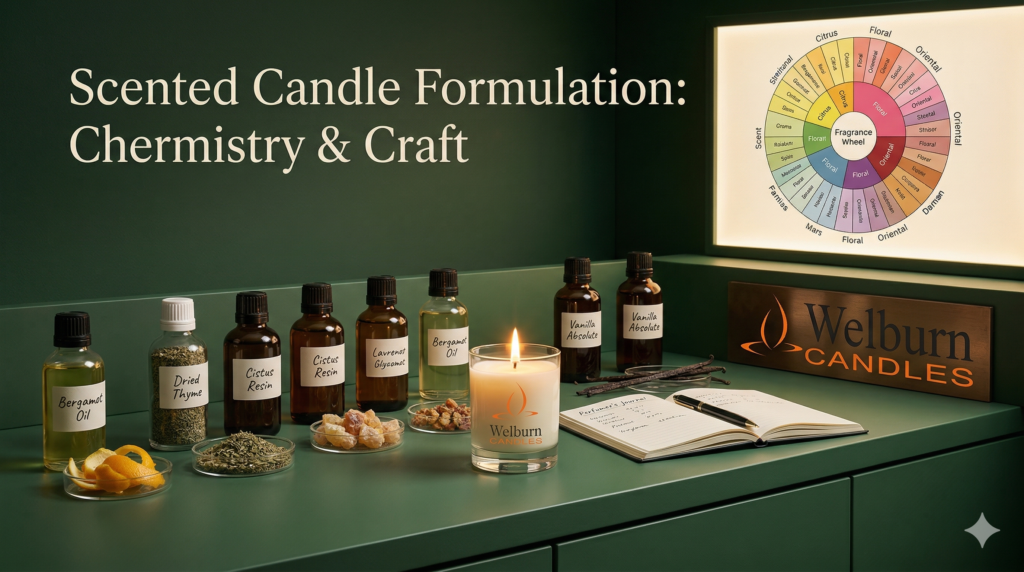
Scent is the invisible dimension of candle quality — the one that drives repeat purchase more reliably than any other factor. At Welburn Candles, we have invested decades in understanding the complex chemistry of wax-fragrance interaction, developing formulation expertise that enables our private label clients to launch scented candles with genuine sensory superiority. This guide exposes the science behind scented candle manufacturing — accessible to brand owners who want to make informed formulation decisions without needing a chemistry degree. For the broader manufacturing context, see our global candle manufacturer guide. The Chemistry of Scent Throw: Why Some Candles Fill a Room and Others Don’t Cold Throw. Cold throw is the fragrance emitted by an unlit candle — what your customer experiences when they pick up your candle in a shop or remove it from its packaging at home. Cold throw is primarily driven by the volatile top notes of the fragrance: lighter molecular weight compounds that evaporate readily at room temperature. Hot Throw. Hot throw is the fragrance released when the candle is burning at full melt pool temperature. It is the scent that fills a room and creates the sensory experience that drives repurchase. Hot throw is driven by the heart and base notes of the fragrance — heavier molecular weight compounds that require heat for effective vaporisation. The Formulation Challenge. Achieving both excellent cold throw and exceptional hot throw is technically demanding. Optimising for cold throw tends to favour lighter, more volatile compounds that can burn off too quickly in hot throw. Optimising for hot throw requires sufficient heavier base notes that may contribute less to cold throw. Welburn Candles’ formulation expertise lies in creating balanced compositions that perform across both dimensions. Wax-Fragrance Interaction: The Science Behind Binding Not all fragrances are compatible with all wax types, and not all wax-fragrance combinations perform equally. The key technical parameters Welburn Candles manages for every new formulation include: IFRA Compliance: The Non-Negotiable Standard All scented candle manufacturers supplying European, UK, and US markets must formulate against IFRA (International Fragrance Association) Standards. IFRA Standards specify maximum usage levels for fragrance ingredients in each product category — candles fall under Category 12. IFRA compliance means: