
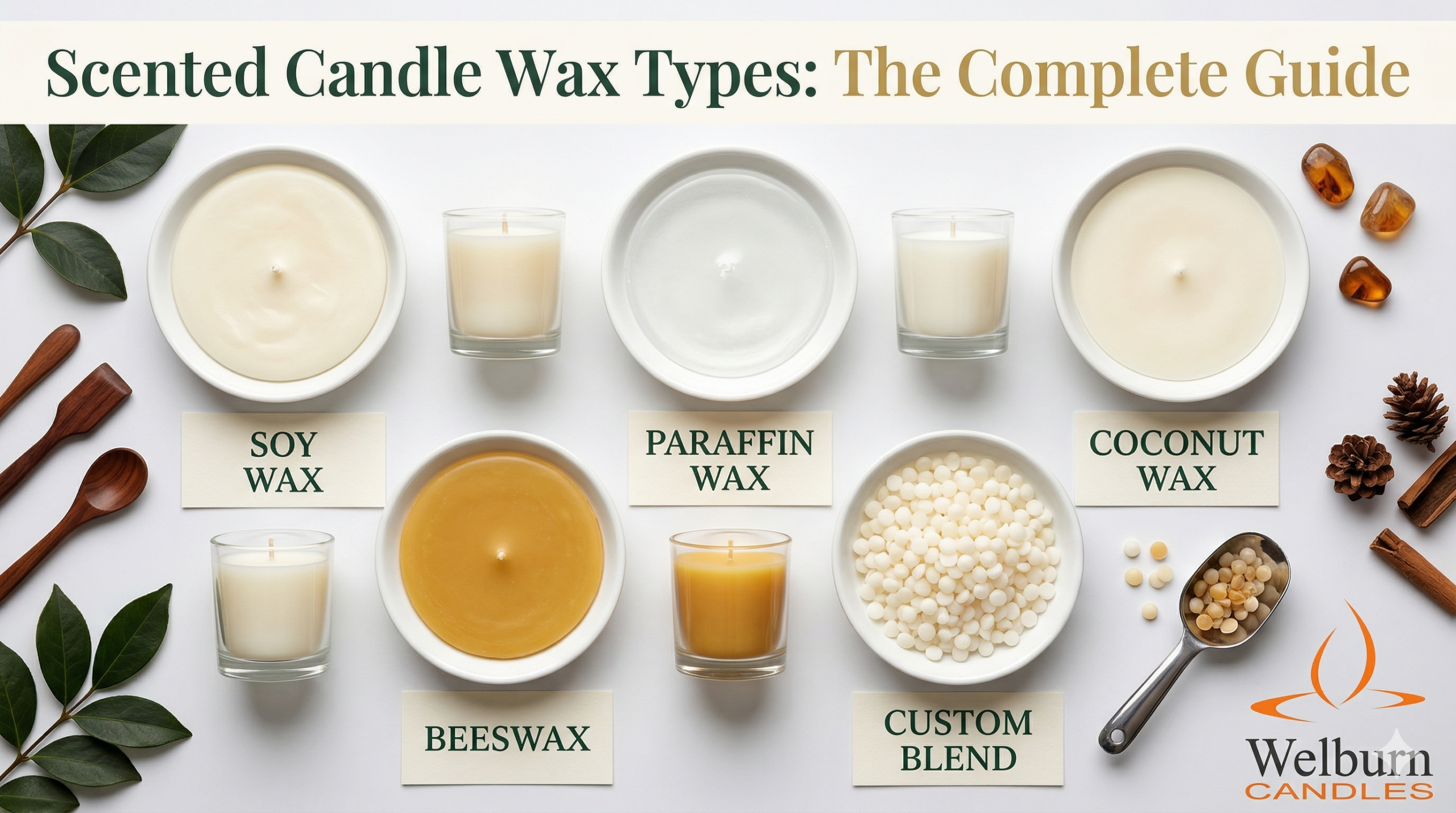
Wax selection is the foundational technical decision in scented candle manufacturing. It determines your candle’s fragrance performance, burn behaviour, surface appearance, sustainability positioning, and commercial cost structure. At Welburn Candles, our scented candle formulation expertise includes extensive experience with all major wax types — and we guide every private label client to the wax choice that best serves their brand’s commercial goals.
Paraffin Wax: The Industry Standard
Refined paraffin wax remains the most widely used wax in professional scented candle manufacturing globally. Its technical advantages make it the default choice for high-volume production across all market positions from mass retail to premium.
- Fragrance performance: Excellent hot throw — paraffin’s thermodynamic properties create efficient fragrance vaporisation at melt pool temperatures
- Burn performance: Predictable, controllable burn pool development with good flame stability
- Surface appearance: Clean, smooth surface with good glass adhesion in jar candle applications
- Commercial position: Most cost-effective wax option; lowest per-unit cost at all production volumes
- Sustainability note: Petroleum-derived; brands targeting eco-conscious markets in Europe typically prefer natural wax alternatives
Soy Wax: The Natural Market Leader
Soy wax has become the first choice for natural and eco-positioned scented candle brands globally. Derived from soybean oil, it offers genuine sustainability credentials alongside strong fragrance performance.
- Fragrance performance: Excellent cold throw; hot throw is strong but slightly lower intensity than paraffin at equivalent fragrance loads
- Natural frosting: Soy wax naturally forms a mottled surface pattern called frosting — a characteristic of the wax, not a manufacturing defect, though it can be minimised through formulation
- Burn performance: Longer, cooler burn than paraffin — a selling point for premium positioning
- Market position: The dominant choice for natural, wellness, and eco-conscious candle brands across European markets — particularly strong in the Netherlands, Germany, and the UK
Coconut Wax: The Premium Choice
Coconut wax is derived from coconut oil and delivers the most exceptional scent throw of any natural wax type. It is the premium wax choice for brands competing at the top of the market.
- Fragrance performance: Outstanding — coconut wax holds fragrance extremely well and delivers some of the most potent hot throw available in natural wax candles
- Surface appearance: Naturally creamy white, smooth, and visually luxurious — highly appealing for premium jar candles
- Sustainability: Derived from a sustainably harvested tropical crop; biodegradable and renewable
- Commercial position: Commands the highest retail prices and supports luxury brand positioning in Italian, French, and high-end UK markets
Coconut-Soy Blends: The Best of Both Worlds
Welburn Candles recommends coconut-soy blends for private label clients targeting the premium retail segment. These blends combine coconut wax’s exceptional scent throw with soy wax’s natural sustainability positioning and cost management, delivering a performance and positioning combination that neither wax achieves alone.
Wax Selection and European Market Positioning
European candle consumers — particularly in the Netherlands, Germany, and Scandinavia — are among the world’s most informed and discerning buyers of natural products. Soy and coconut-based waxes are strongly preferred in these markets for their natural credentials. In contrast, French and Italian premium markets often prioritise fragrance performance and luxury aesthetics, where coconut-soy blends excel. Our European compliance guide for private label candles covers market-specific positioning considerations.
Frequently Asked Questions
Q: Can Welburn Candles produce scented candles in multiple wax types simultaneously?
A: Yes — our production facility works with paraffin blends, soy wax, and coconut-soy blends simultaneously. We can produce your core range in soy wax and a premium tier in coconut-soy blend, for example, within the same production schedule.
Q: Does wax type affect the fragrance load I can use?
A: Yes — different wax types have different saturation points for fragrance oil. Coconut and soy waxes generally accept slightly higher fragrance loads before separation occurs compared to paraffin blends. Our formulation team optimises fragrance load for each specific wax type and vessel combination.
Q: Is soy wax genuinely more sustainable than paraffin?
A: Soy wax is derived from a renewable agricultural crop rather than petroleum, making it more sustainable in terms of feedstock origin. Overall sustainability also depends on agricultural practices. Welburn Candles sources soy wax from suppliers with responsible farming practices and can provide sourcing documentation.
Q: How does wax type affect candle pricing for retail?
A: Natural wax candles (soy, coconut) command higher retail prices than equivalent paraffin candles — typically supporting 20–35% premium pricing in European markets due to their natural and sustainable positioning. This premium retail pricing more than compensates for the slightly higher wax cost in most market contexts.
Q: Can I switch wax types between batches of the same product?
A: No — changing wax type between batches of the same SKU changes the product’s burn and fragrance characteristics, which would represent a product change requiring re-testing and potentially new compliance documentation. Wax type is defined at SKU level and maintained consistently across all production runs.
Ready to choose the right wax for your scented candle brand? Contact Welburn Candles for our wax selection consultation and sample comparison set.