
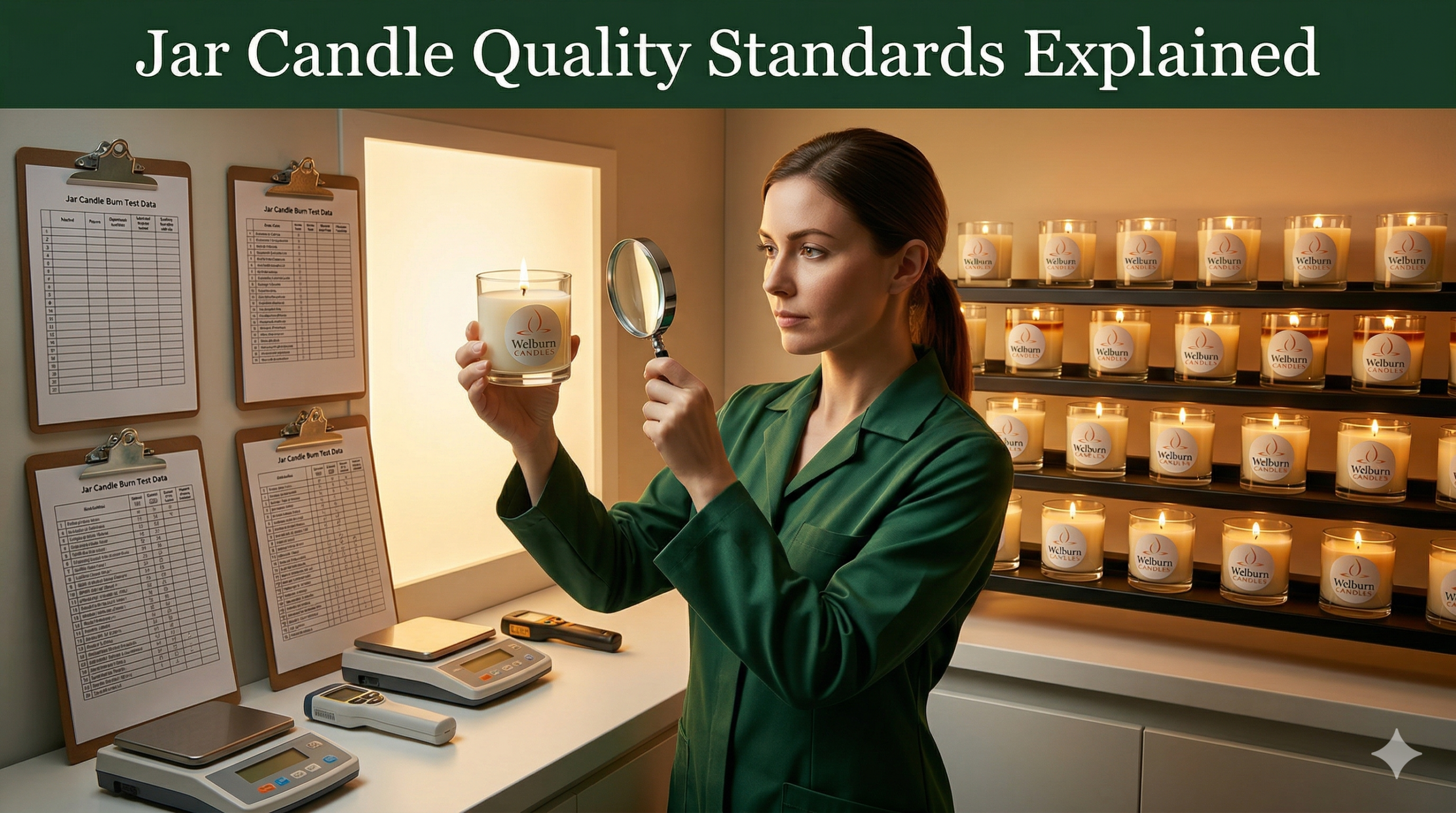
Quality is the word every candle manufacturer uses. But what does quality actually mean in measurable, verifiable terms for jar candles? At Welburn Candles, quality is not a marketing claim — it is a documented, tested, and certified commitment backed by our ISO 9001:2015 quality management system. This guide explains the specific quality dimensions that matter for jar candles and how to evaluate them when assessing a manufacturing partner. For the broader manufacturing context, see our jar candle manufacturing guide.
Burn Performance Standards
Full Melt Pool Development.
A well-manufactured jar candle should develop a full melt pool — wax melted from edge to edge of the vessel — within the first burn session. The time to full melt pool is a function of wick sizing, wax blend, vessel diameter, and fragrance load. Too small a wick creates tunnelling; too large creates excessive flame height and soot.
Welburn Candles tests every new SKU through multiple burn sessions to confirm:
- Full melt pool achieved within the first burn — typically 2-3 hours for a 200ml jar
- Consistent melt pool depth across successive burns
- Absence of tunnelling, mushrooming, or excessive wick drift
- Maximum flame height compliance per applicable standards — see BSI candle safety standards
Fragrance Throw Performance.
A key commercial quality standard for scented jar candles is fragrance throw — the strength and longevity of fragrance release in both cold and hot states. At Welburn Candles, we test cold throw (unlit candle at room temperature) and hot throw (full melt pool burn) for every new scented formulation. Our scented candle formulation guide provides more detail on optimising fragrance performance.
Vessel Quality Standards
Thermal Integrity.
Glass vessels must withstand thermal cycling — repeated heating and cooling through normal candle use — without cracking. All vessels used by Welburn Candles are tested for thermal integrity as part of our new product development process.
Dimensional Consistency.
For retail brands, vessel dimensional consistency ensures that labels fit correctly, lids seat properly, and the product looks identical across all units in a batch. Welburn Candles’ vessel specification includes dimensional tolerances and our QC team checks incoming vessel batches against these specifications.
Surface Quality.
Glass vessels are inspected for surface bubbles, inclusions, mould seam visibility, and base flatness. Any vessel with visible defects is rejected before entering production.
Wax Quality Standards
- Surface finish: Soy and natural wax candles may exhibit minor natural frosting — this is a characteristic of natural wax, not a defect. Excessive frosting, cracking, or sinkholes indicate a formulation or temperature control issue.
- Fill level consistency: Wax fill level should be consistent across all units in a batch (±2–3mm is an acceptable tolerance for natural waxes that contract slightly during cooling)
- Colour consistency: For coloured or tinted candles, colour should be consistent batch-to-batch within agreed tolerance
- Fragrance binding: No visible fragrance oil pooling on the wax surface — indicative of incorrect fragrance addition temperature or incompatibility
Compliance and Safety Documentation Standards
For retail buyers sourcing jar candles for European markets, safety and compliance documentation is as important as the physical product. Welburn Candles provides a complete compliance documentation package with every order, including IFRA compliance certificates, REACH declarations, CLP allergen disclosures, Safety Data Sheets, and burn test records.
Frequently Asked Questions
Q: What burn test duration does Welburn Candles perform before approving a new SKU?
A: All new SKUs at Welburn Candles are burn-tested for a minimum of 40 hours, with observations and measurements recorded at 2-hour intervals. Testing includes melt pool development, flame height, fragrance throw assessment, vessel temperature monitoring, and final vessel integrity check after cooling.
Q: How can I verify a candle manufacturer’s quality claims independently?
A: Request burn test documentation, quality certification evidence, and third-party inspection reports. For significant orders, commissioning a third-party pre-shipment inspection through a recognised inspection body provides independent quality verification. Welburn Candles supports client-appointed third-party inspections.
Q: What causes tunnelling in jar candles and how does Welburn Candles prevent it?
A: Tunnelling occurs when the wick is too small for the vessel diameter, causing the melt pool to fail to reach the vessel edge. Welburn Candles prevents tunnelling through rigorous wick selection testing — we develop a wick specification for every new vessel-wax-fragrance combination and validate it through burn testing before production.
Q: Does Welburn Candles provide quality certificates with every order?
A: Yes — every Welburn Candles order is accompanied by a quality certificate confirming the batch has been produced to specification and passed our quality inspection process. Additional compliance documentation — IFRA certificates, REACH declarations, CLP allergen disclosures — is provided as standard for European market orders.
Q: What should I do if I receive a jar candle delivery that doesn’t meet quality standards?
A: Contact Welburn Candles’ quality team immediately with photographic documentation of the issue. Our quality management system includes a non-conformance process that ensures all quality issues are investigated, root-caused, and resolved with corrective actions to prevent recurrence.
Require jar candles that meet the highest quality standards? Contact Welburn Candles to discuss your quality requirements and request our compliance documentation overview.