Jar candles are the dominant format in the premium home fragrance market globally. For brands, retailers, and importers sourcing jar candles at scale, identifying and evaluating the right manufacturing partner requires a structured approach that goes well beyond comparing price lists. This guide provides a complete sourcing framework for jar candle buyers — from initial vessel evaluation through quality standards assessment to compliance documentation review. For our comprehensive jar candle manufacturing overview, see jar candle manufacturing guide: raw material to retail.
Why Jar Candle Manufacturer Selection Is Uniquely Important
Jar candle manufacturing involves a more complex set of interdependent decisions than other candle formats. The vessel, wax, wick, fragrance, lid, label, and packaging must all be specified, tested, and approved as an integrated system — not as individual components. A manufacturer who excels at tealight production may not have the precision-pour capability, wick-centring systems, and vessel quality controls required for premium jar candle production.
At Welburn Candles, jar candle production is supported by German machinery specifically configured for precision vessel filling, wick-centring systems for every vessel diameter in our range, and multi-stage visual quality control adapted for glass vessel assessment.
Evaluation Dimension 1: Vessel Range and Glass Quality
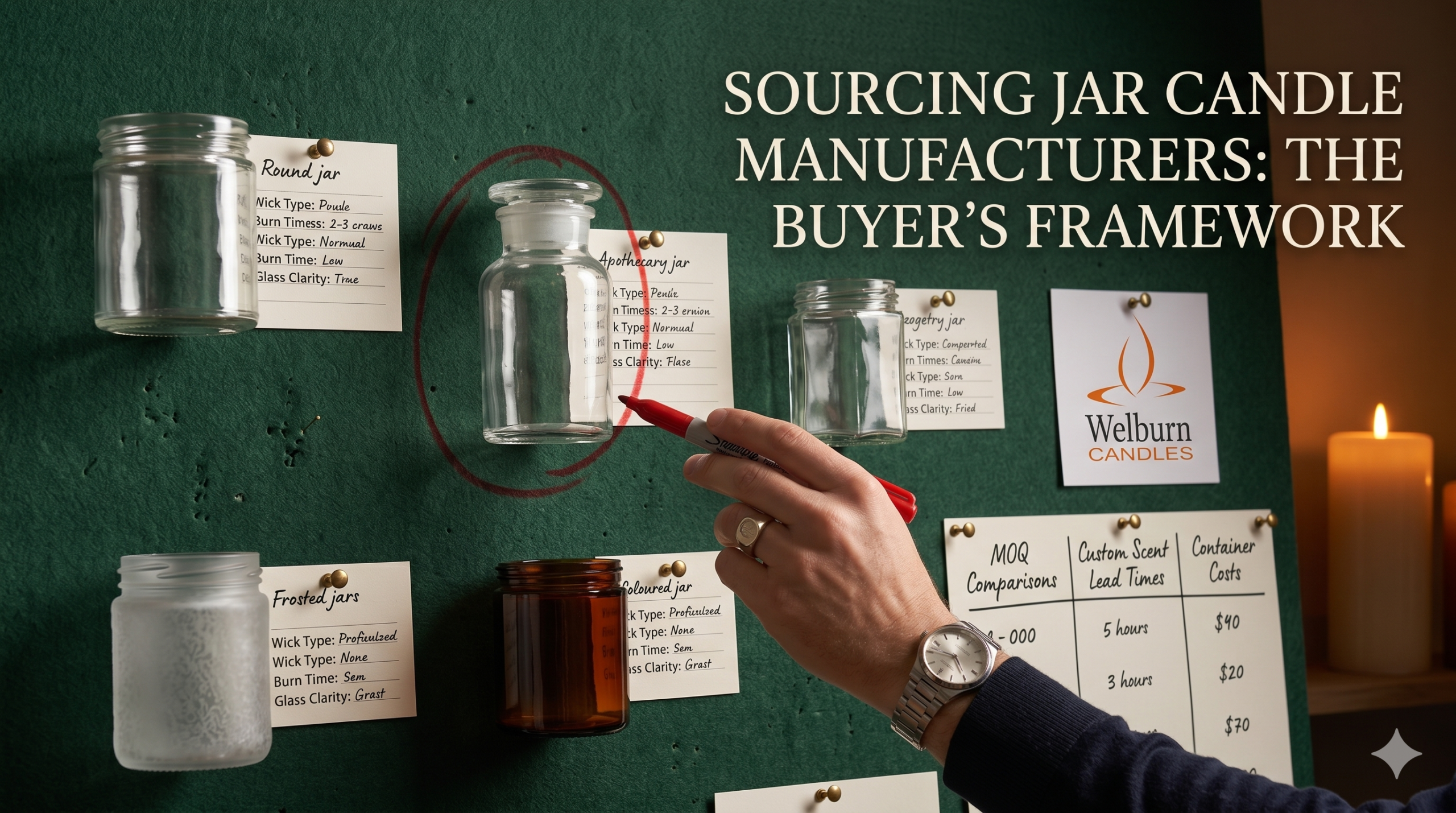
A capable jar candle manufacturer offers a meaningful vessel range — not a single glass option. The ability to source round tumblers, apothecary jars, hexagonal vessels, and frosted or coloured glass options within a single manufacturing relationship is commercially valuable. It enables you to develop a tiered product range — entry, mid, and premium — without managing multiple suppliers.
When evaluating vessel quality, assess wall thickness, base flatness, surface clarity, lid fit precision, and dimensional consistency across samples. Any visible bubbles, surface inclusions, or mould seam visibility on the sample set signal a lower-grade glass supplier that will create problems at scale.
Evaluation Dimension 2: Wax and Fragrance Formulation Capability
The best jar candle manufacturers maintain formulation capability across wax types — paraffin blends, soy, and coconut-soy — and have developed proprietary temperature protocols for precision pour. Ask for technical specifications: pour temperature tolerance, fragrance addition temperature control, and burn test documentation for standard SKUs. At Welburn Candles, we control pour temperature to ±2°C and test every new SKU for a minimum of 40 burn hours. See our scented candle formulation guide for our wax-fragrance technical approach.
Evaluation Dimension 3: Private Label and Customisation Range
For brand owners, the manufacturer’s private label capability determines how distinctive your jar candle range can be. Evaluate whether the manufacturer offers exclusive fragrance development, custom lid sourcing, label design support, and multi-language packaging production. Welburn Candles’ private labelling service covers the full spectrum from fragrance development to export-ready branded packaging.
Evaluation Dimension 4: Compliance Documentation
For jar candles destined for European markets, compliance documentation is not optional. Your manufacturer must provide IFRA certificates, REACH declarations, CLP allergen disclosure documentation, and Safety Data Sheets as standard. Ask for specimen documentation before sampling — a manufacturer who hesitates on compliance documentation at the pre-sample stage will be a compliance liability at production stage.
Evaluation Dimension 5: Production Scale and Export Experience
Confirm that your manufacturer’s production capacity accommodates your peak demand requirements — particularly important for seasonal peaks like Christmas, when jar candle demand can increase by 300–400% for some brands. Verify export experience by asking for the countries they currently supply and the documentation they provide for your target market. See our jar candle export guide for the specifics of importing jar candles into European markets.
Frequently Asked Questions
Q: What is the most important quality test for jar candles from a new manufacturer?
A: The melt pool test. Burn a new sample jar candle for three hours in its first burn session. A well-manufactured jar candle should develop a full wax melt pool — melted from edge to edge of the vessel — within this first burn. Any evidence of tunnelling (the wick burning down without melting the wax to the vessel edge) indicates a wick sizing or formulation issue that will not resolve itself and will generate customer complaints.
Q: How do I assess a jar candle manufacturer’s fragrance throw performance objectively?
A: The most reliable method is a room-fill test conducted in a standardised room size (typically 15–20 square metres). Light the candle, allow it to reach full melt pool (usually 2–3 hours), and assess fragrance strength and character in the test room. Compare this against the manufacturer’s own claimed fragrance performance, and against any reference product you are trying to match or exceed.
Q: Can Welburn Candles produce jar candles to my existing label artwork?
A: Yes — Welburn Candles applies client-supplied label artwork to jar candle production as standard. We review artwork for print production suitability, CLP compliance completeness, and correct allergen declarations before approval. Our team flags any compliance issues before labels are printed, avoiding costly reprints. Contact Welburn Candles to discuss your specific requirements.