Tealight Candle Manufacturers: A Complete Sourcing Guide for US & EU Buyers
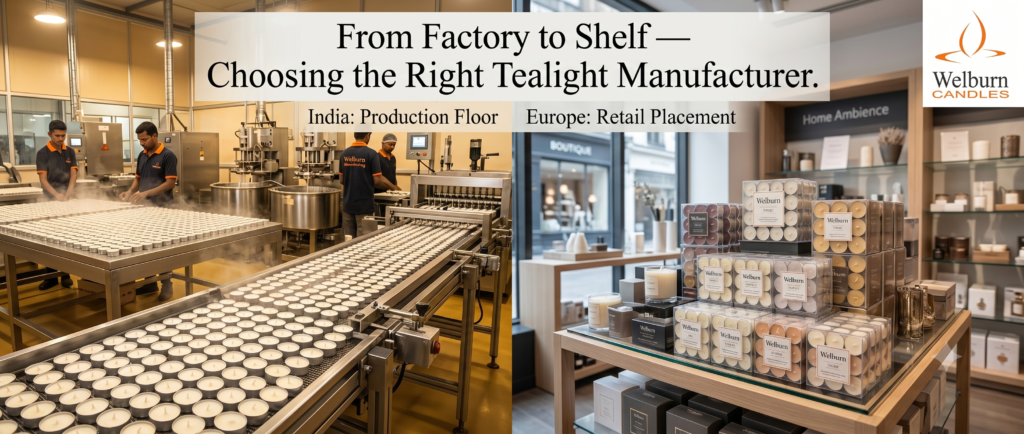
The global tealight candle market is served by hundreds of tealight candle manufacturers — in China, India, Turkey, Poland, and the US. For Western buyers, the choice of manufacturer has profound implications for product quality, compliance, brand positioning, and supply chain resilience. This guide helps you navigate the selection process systematically. Welburn Candles is a leading tealight candle manufacturer based in India, supplying bulk tealights to wholesale buyers, private label brands, and hospitality operators in the US and EU. Contact us for specifications and pricing. The Global Tealight Manufacturing Landscape Manufacturing Origin Key Advantage Key Risk EU/US Compliance Track Record China Very low unit cost, high volume Quality inconsistency, IP risk, freight unpredictability Variable — requires careful vetting India Cost-competitive, English fluency, fragrance expertise, REACH/ASTM experience Longer freight transit than China in some routes Strong — growing compliance infrastructure Poland/EU Proximity to EU market, no import duty Significantly higher cost, limited scale Excellent — domestic compliance Turkey Mid-cost, shorter EU freight Less fragrance specialisation Good — growing EU export capacity For US buyers prioritising value-to-quality ratio and supply chain diversification away from China, Indian tealight candle manufacturers have become the preferred alternative. For EU buyers, the combination of lower cost and strong compliance capability makes India highly compelling despite the freight distance. Read about Welburn’s export track record. What to Look for in a Tealight Candle Manufacturer • Own manufacturing facility (not a trading company acting as agent) • Automated production line for consistent fill weight and wick centering • In-house or third-party burn-time testing capability • REACH and IFRA compliance documentation for all fragranced products • Export experience specifically to your target market • Stable raw material sourcing (own supplier agreements, not spot-market dependent) • Quality control team separate from production — rejection capability matters Certifications That Matter for US and EU Tealight Import For EU Import: REACH compliance (fragrance ingredients), CLP hazard classification and labelling, IFRA compliance certificate, CE marking (where applicable), and a Statement of Conformity for the finished product. European Chemicals Agency (ECHA) guidance provides the definitive reference for candle importers. For US Import: ASTM F2517 labelling compliance, CPSC (Consumer Product Safety Commission) general conformity, state Prop 65 compliance if selling in California, and NCA best-practice alignment. CPSC candle safety guidance is required reading for US candle importers. Welburn Candles provides full compliance documentation packages with every export order. Request our compliance document list. OEM vs Standard Range: Which Tealight Manufacturer Model Do You Need? Standard Range Buying: You order from the manufacturer’s existing product catalogue — white unscented tealights, standard sizes. Lower MOQ, faster lead time, no development cost. Good for hospitality, events, and value retail. OEM/Custom Manufacturing: You specify custom wax type, fragrance, cup colour, burn time, packaging. The manufacturer produces to your specification. Higher MOQ, 4–6 week development lead time, your brand IP. Essential for private label retail brands. Welburn Candles offers both — see our private label programme. Related Sub-Blogs in This Series → Tealight Candle Manufacturers in India: Why India Leads the Export Market → Scented vs Unscented Tealight Candles: Manufacturing and Market Differences → Tealight Candle Manufacturers: OEM vs Private Label — Which Is Right for You? FAQs: Tealight Candle Manufacturers How do I know if a tealight manufacturer is factory-direct or a trading company? Ask to see images of the production line with the factory name visible. Request the factory registration certificate. Ask for a video call showing the production floor. Trading companies typically cannot produce these without significant delay or redirection. What is the average production capacity of a tealight candle manufacturer in India? A mid-size Indian tealight manufacturer with automated filling lines can produce 500,000–2,000,000 tealights per month. Welburn Candles maintains capacity for sustained wholesale and export supply with scalable production scheduling. Do tealight candle manufacturers in India speak English? Yes — English is the standard language of business communication in Indian export manufacturing. Documentation, sample discussions, specifications, and export paperwork are all handled in English at professional manufacturers.
How to Find the Right Candle Wholesale Supplier for US and European Markets
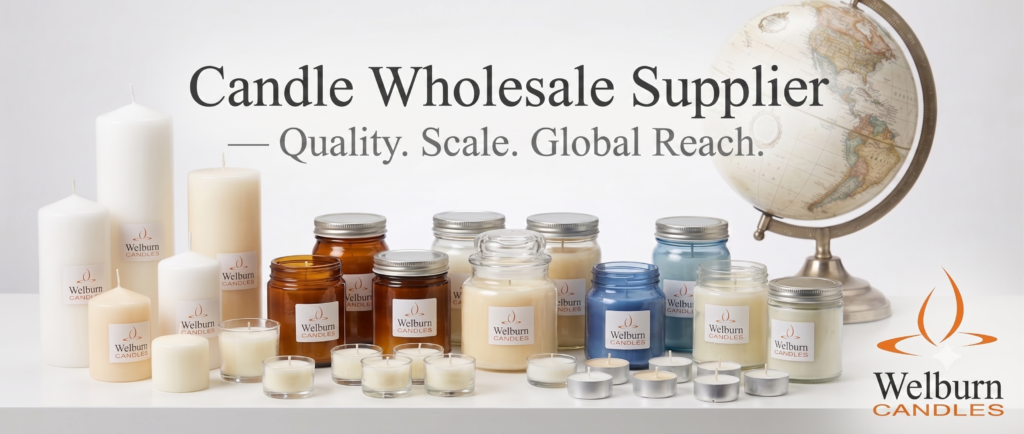
The global candle market exceeded $14 billion in 2024 and is projected to grow at over 5% CAGR through 2030, according to Grand View Research. For US and EU importers, retailers, and private label brands, choosing the right candle wholesale supplier is one of the most consequential business decisions — affecting product quality, margin, compliance, lead time, and brand reputation simultaneously. This guide tells you what to look for in a wholesale candle supplier, how Indian manufacturers like Welburn Candles compare to other sourcing destinations, and what to ask before signing a wholesale supply agreement. What Makes a Candle Wholesale Supplier Reliable? Reliability in wholesale candle supply is not just about price. It is the intersection of: • Consistent product quality across batches (same burn time, fragrance throw, finish) • Regulatory compliance for destination market (REACH/CLP for EU; ASTM/NCA for US) • On-time delivery with documented lead times • Transparent pricing with no hidden freight or documentation charges • Financial stability to handle large orders without cash-flow disruptions • Willingness to provide certificates of analysis, third-party test reports, and batch documentation Why US and EU Buyers Source Wholesale Candles from India India has become a strategically significant wholesale candle supply source for Western markets. India’s candle export data from DGFT shows consistent year-on-year growth in candle exports to Europe, the US, and the Middle East. Key advantages: • Factory-direct pricing that is 30–60% below comparable products from European or US domestic manufacturers • Deep fragrance expertise — India has one of the world’s richest traditions in scent crafting • Large-scale production capacity alongside custom and low-MOQ flexibility • English-language communication and export documentation fluency • Growing number of ISO-certified, REACH-compliant factories with EU and US export track records Types of Wholesale Candle Suppliers: Which Do You Need? Supplier Type What They Do Best For Risk Trading Company Aggregate from multiple factories Low MOQ, product variety Inconsistent quality, no factory control Factory-Direct Manufacturer Own production facility Volume buyers, custom products Higher MOQ, direct negotiation OEM/Private Label Specialist Custom formulation + branding Brand builders, D2C, retail chains Longer lead time, higher setup cost Distributor / Importer Local warehouse, fast delivery Speed-sensitive buyers Premium pricing, limited customisation Welburn Candles operates as a factory-direct candle wholesale supplier with private label capability — combining the price advantage of direct manufacture with the flexibility of custom branding. View our product range or contact us for wholesale pricing. Key Questions to Ask Any Candle Wholesale Supplier • “Can you provide REACH compliance certificates for all fragrance ingredients?” (Mandatory for EU import) • “What is your wax source and specification — fully refined paraffin, soy USDA, or blend?” • “Do you have third-party burn-time test reports for your products?” • “What is your actual production capacity per month for this product?” • “Can I see buyer references from US or EU importers you have shipped to in the last 12 months?” • “What is your defect rate and what is your replacement/credit policy?” Compliance Requirements for US and EU Wholesale Candle Import European Union: All fragranced candles must comply with EU CLP Regulation (EC No 1272/2008) for hazard classification and labelling. REACH substance restriction compliance is mandatory. Certain fragrance allergens must be declared on product labels above threshold concentrations. United States: Candles must comply with ASTM F2517 (candle labelling) and CPSC (Consumer Product Safety Commission) guidelines. The National Candle Association publishes voluntary best practice guidelines widely adopted by US retailers. Related Sub-Blogs in This Series → How to Evaluate a Candle Wholesale Supplier Before Placing Your First Order → Candle Wholesale Pricing: What Affects Cost and How to Negotiate → Seasonal Candle Wholesale Buying: Planning Your Q4 and Holiday Supply FAQs: Candle Wholesale Supplier What is a typical MOQ for a wholesale candle supplier? MOQs vary widely: trading companies may accept 100 units, factory-direct manufacturers typically require 500–3,000 units per SKU. At Welburn Candles, we offer flexible MOQs starting at 500 units for private label and custom orders, with lower thresholds for standard product lines. How do I verify that a candle wholesale supplier is compliant with EU regulations? Request REACH compliance certificates for all fragrances, CLP hazard classification documentation, and wick composition certificates confirming no lead or zinc core. Ask if they have experience exporting to EU buyers and can provide a reference or prior export documentation. What payment terms are typical for international wholesale candle orders? Standard terms are 30–50% advance payment with balance paid against bill of lading (pre-shipment). For established wholesale relationships, 30-day net payment terms may be available. Welburn Candles accepts T/T, L/C, and select escrow payment methods. Can I source multiple candle types from a single wholesale supplier? Yes. A full-service candle manufacturer like Welburn supplies tealights, pillar candles, jar candles, votives, and container candles — allowing buyers to consolidate all candle SKUs with a single supplier and a single shipping container.
Tealight Candle Bulk Manufacture: The Complete Buyer’s Guide for US & European Brands
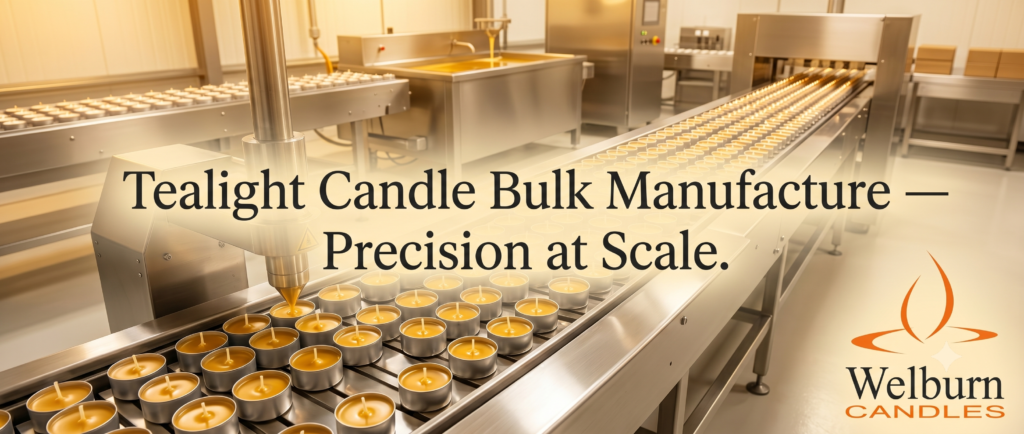
If you are sourcing tealights at scale for the first time — or switching suppliers — the stakes are higher than they appear. A tealight candle is a simple product, but bulk tealight manufacture is a precision operation. Burn time consistency, wick centering, cup seal quality, smokelessness, and fragrance load all vary dramatically between a well-run factory and a low-cost, low-quality operation. This guide covers everything you need to evaluate a tealight candle bulk manufacturer: wax selection, production processes, quality control, compliance for US and EU markets, pricing benchmarks, and what to look for before placing your first container order. For Welburn Candles’ full tealight range, visit our tealight candle manufacturer page. What Makes Tealight Bulk Manufacture Different from Other Candle Types Tealights are high-volume, low-unit-value products. The economics only work at scale — and scale requires automation, tight process control, and raw material consistency. A manufacturer producing 10,000 tealights a day makes entirely different operational decisions than one producing 1,000 units of a premium jar candle. Key characteristics of professional tealight bulk manufacturing: • Automated cup-filling lines for consistent wax weight (±0.2g tolerance in premium operations) • Pre-tabbed wick insertion before pour — not manual placement after • Temperature-controlled pour zones preventing shrinkage and surface cracking • Inline burn-time testing from each production batch • Cup crimping and sealing for standard aluminium and clear polycarbonate variants Wax Types Used in Tealight Bulk Manufacture Wax selection is the single biggest driver of both burn quality and price per unit in bulk tealight production. Wax Type Burn Time Market Positioning US/EU Compliance Fully Refined Paraffin 3–5 hrs (standard cup) Value/mid-market Compliant (REACH, FDA) Paraffin Blend (soy/palm mix) 4–6 hrs Mid-market, eco positioning Compliant with certification Natural Soy Wax 4–6 hrs Premium / clean-burn Fully compliant, preferred EU Coconut Wax 5–7 hrs Luxury / natural Fully compliant, premium tier Welburn Candles offers tealight bulk manufacture across all four wax types. For buyers targeting natural and organic retail shelves in the US or EU, we recommend soy or coconut wax tealights — which qualify for clean-label positioning and command higher retail prices. For hospitality, events, and value-retail, fully refined paraffin delivers the most cost-competitive per-unit economics. Standard vs Custom Tealight Manufacturing Standard Tealight Bulk Orders: White unscented paraffin tealights in aluminium cups are the most ordered product globally. Standard sizes: 9g (3.5 hr burn), 12g (5 hr burn), 18g (8 hr burn). Available in packs of 10, 24, 50, and 100. Browse Welburn’s standard tealight range. Custom OEM Tealight Manufacturing: For brands building their own retail line, custom options include: coloured wax, fragrance addition (0.5–6% fragrance load), clear polycarbonate cups, custom printed cups, branded packaging (retail boxes, pillow packs, shrink sleeves). Lead time: 4–6 weeks from artwork approval. Quality Standards for US and European Market Entry Tealight candles exported to the US and EU must meet specific compliance benchmarks. In the EU, candles are governed by CLP Regulation (EC) No 1272/2008 for fragrance classification and REACH for substance restrictions. In the US, ASTM F2517 governs candle labelling requirements and the NCA (National Candle Association) provides industry best practices. What to verify with any bulk tealight manufacturer: • REACH compliance certificate for fragrances (mandatory for EU import) • ASTM F2517 labelling compliance (US) • Burn time test reports from a third-party lab • Wick composition certificates (cotton or paper — not lead or zinc core) • Batch consistency documentation (wax weight, fragrance load, burn time per batch) MOQs and Pricing: What to Expect from a Bulk Tealight Manufacturer MOQs for bulk tealight manufacture vary by manufacturer and product complexity: Product Type Typical MOQ Price Range (FOB India) Lead Time White unscented paraffin tealight 5,000–10,000 units $0.08–$0.18/unit 3–4 weeks Scented paraffin tealight 3,000–5,000 units $0.15–$0.30/unit 4–5 weeks Soy wax tealight (unscented) 3,000 units $0.20–$0.38/unit 4–5 weeks Custom branded / private label tealight 500–1,000 units $0.25–$0.55/unit 5–6 weeks Welburn Candles offers low MOQ tealight bulk manufacture with export-ready packaging for first-time buyers — a key advantage for US and EU importers testing new SKUs. Contact Welburn Candles for a factory-direct quote. How to Evaluate a Tealight Bulk Manufacturer Before Ordering • Request sample production batch with burn-time test report included • Verify factory certifications (ISO, BIS, export registration) • Ask about wick supplier and get wick composition certificates • Confirm fragrance IFRA compliance certificates for scented variants • Inspect packaging: is export-grade corrugated used? Are cups nested or individually separated? • Ask for references from US or EU buyers they have shipped to previously Related Sub-Blogs in This Series → How Tealight Candle Bulk Manufacture Works: From Raw Wax to Retail Pack (Sub Blog 1) → Wax Types for Bulk Tealight Manufacturing: Paraffin vs Soy vs Coconut (Sub Blog 2) → Tealight Bulk Manufacture for Hotels and Events: What Buyers Need to Know (Sub Blog 3) FAQs: Tealight Candle Bulk Manufacture What is the minimum order quantity for bulk tealight candles? Most professional tealight manufacturers require 3,000–10,000 units as a minimum for standard products. At Welburn Candles, we offer lower entry MOQs for custom private label orders to support first-time buyers and growing brands. How long does a bulk tealight candle order take to produce and ship? Standard production takes 3–5 weeks from order confirmation. For export to the US or EU, allow an additional 3–4 weeks sea freight (20–25 days transit). Air freight is available for urgent orders at additional cost. Are tealight candles exported from India compliant with EU/US regulations? Yes, when manufactured by a compliant factory. Welburn Candles provides REACH compliance certificates, ASTM-aligned labelling, IFRA-compliant fragrance certificates, and lead-free wick declarations for all export orders. What cup materials are available for bulk tealight manufacture? Standard options: silver aluminium cups (most common), clear polycarbonate cups, and coloured aluminium cups. Custom cup printing is available for OEM/private label orders above 2,000 units. Can I order both scented and unscented tealights in the same shipment? Yes. Welburn Candles can
Sustainable Candle Manufacturing: Practices, Materials, and Certifications That Matter
Sustainability has moved from a niche differentiator to a mainstream retail expectation — particularly in European markets where consumers, regulators, and retailers are increasingly holding brands accountable for their environmental and social impact. For candle brands, sustainability spans raw material sourcing, wax type selection, fragrance ingredients, packaging, manufacturing practices, and end-of-life product design. This guide explains what genuinely sustainable candle manufacturing looks like — and how Welburn Candles supports clients in building credibly sustainable candle brands. For our broader manufacturing overview, see our candle manufacturer standards guide. Sustainable Wax Selection Wax type is the most visible sustainability signal in a candle brand. Three wax options are well-positioned for sustainability claims: Soy Wax Derived from soybeans — a renewable agricultural crop — soy wax is the most widely used sustainable wax alternative globally. It burns cleaner than paraffin, supports higher fragrance loads, and carries natural sustainability credentials valued by consumers across Germany, the Netherlands, and Scandinavia. Welburn Candles sources soy wax from suppliers with responsible farming documentation. Coconut Wax Coconut wax — derived from sustainably harvested coconut oil — is the premium natural wax choice. Biodegradable, renewable, and producing an exceptionally clean burn, it is the preferred wax for luxury and wellness candle brands competing at the top of the European market. Coconut-Soy Blends Coconut-soy blends combine the sustainability credentials of both natural waxes with practical performance advantages. Welburn Candles recommends this wax for private label clients targeting premium European retail. Explore our scented candle wax types guide for a detailed wax comparison. Ethical Manufacturing Certifications Sustainability is not only about materials — it extends to the working conditions and ethical practices of the manufacturing facility. Welburn Candles holds SA 8000 social accountability certification — independent, audited confirmation that our facility meets international standards for worker rights, fair wages, and ethical management. This certification provides candle brands sourcing from Welburn Candles with a credible, verified ethical manufacturing story for their brand communications. Sustainable Fragrance Sourcing Fragrance ingredients carry their own sustainability considerations. Welburn Candles sources fragrance oils compliant with IFRA Standards and can provide certified organic essential oil formulations for clients pursuing organic or natural positioning. Our aromatherapy candle clients have access to GC/MS-tested, origin-verified essential oils — supporting both therapeutic authenticity and ingredient transparency. Eco-Conscious Packaging Options Packaging sustainability is increasingly scrutinised by European retail buyers. Welburn Candles offers a comprehensive range of eco-packaging options including FSC-certified kraft boxes, recycled tissue and void fill, water-based inks for label printing, and packaging designed for complete recyclability or compostability. See our private label candle packaging design guide for packaging options across market positions. Frequently Asked Questions Q: Can Welburn Candles produce fully vegan candles? A: Yes — soy wax, coconut wax, and coconut-soy blend candles are all plant-derived and suitable for vegan certification claims. Beeswax candles are not vegan. All Welburn Candles fragrance formulations can be verified as free from animal-derived ingredients. We can provide documentation to support vegan certification applications. Q: How does Welburn Candles manage carbon footprint in its production process? A: We continuously work to optimise energy efficiency in our production facility, source materials from certified responsible suppliers, and consolidate export shipments to minimise freight emissions. Contact our sustainability team for our current environmental performance overview. Q: Are there specific sustainability certifications that European candle retailers require? A: Requirements vary by retailer and market. The most widely requested are COSMOS Organic or COSMOS Natural (for organic and natural claims), FSC certification for packaging, REACH compliance documentation, and SA 8000 manufacturing certification. Welburn Candles supports clients in preparing sustainability documentation for specific retailer requirements. Building a genuinely sustainable candle brand? Contact Welburn Candles to discuss our sustainable manufacturing options and certification support.
Aromatherapy Candles for Sleep: Formulating for the Fast-Growing Sleep Wellness Market
Sleep is the fastest-growing subcategory within the global wellness market. According to the Global Wellness Institute, sleep-focused wellness products represent a multi-billion dollar annual market that is growing at double digits as consumers across Europe, North America, and Asia invest in improving their sleep quality. Aromatherapy candles positioned specifically for sleep — formulated with genuine sleep-supporting essential oils at therapeutic concentrations — are one of the most commercially compelling aromatherapy product opportunities available to wellness brands. At Welburn Candles, sleep-focused aromatherapy candle formulation is one of our most developed specialisms. This guide explains the science, formulation approach, and commercial opportunity. The Science of Aromatherapy for Sleep The mechanism by which specific essential oils support sleep is well-documented in clinical literature. Inhalation of aromatic compounds triggers olfactory-limbic pathway activation — sending chemical signals to the brain’s emotional and autonomic nervous system regulation centres. Several essential oils have demonstrated measurable effects on sleep quality, sleep onset latency, and subjective sleep experience in clinical studies. Key Sleep Essential Oils and Their Evidence Base Lavender (Lavandula angustifolia) True lavender is the most scientifically studied sleep-supporting essential oil. Multiple randomised controlled studies demonstrate lavender inhalation’s effects on sleep quality, anxiety reduction, and heart rate variability — all markers of the parasympathetic nervous system activation conducive to sleep onset. At Welburn Candles, our sleep formulations use authenticated Lavandula angustifolia (not lavandin, which has a different chemical profile and weaker anxiolytic effects), verified through GC/MS analysis. Roman Chamomile (Anthemis nobilis) Roman chamomile essential oil contains apigenin — a flavonoid compound with documented mild sedative properties. Combined with lavender in a sleep blend, chamomile deepens the relaxation effect while contributing a delicate, apple-like sweetness to the fragrance character. Vetiver (Vetiveria zizanioides) Vetiver is a deeply grounding, earthy essential oil with a complex woody-smoky character. Its sedative and anxiolytic properties complement lavender in sleep formulations — particularly effective for customers whose sleep difficulty is associated with racing thoughts or mental hyperactivity. Cedarwood (Cedrus atlantica) Cedarwood essential oil contains cedrol, a compound shown in research to have sedative effects through inhalation. Its warm, woody base note character provides an excellent anchoring base note for sleep blend compositions. Formulating a Sleep Aromatherapy Candle Blend At Welburn Candles, our sleep blend formulations are developed as therapeutic synergies — not simply mixtures of sleep-associated oils. The blend architecture considers: All blends are verified for IFRA compliance and CLP allergen disclosure. See our full essential oil candle formulation guide for the complete development process. Frequently Asked Questions Q: How should I position aromatherapy sleep candles for European wellness retail buyers? A: Lead with ingredient authenticity — specify which essential oils you use, their botanical origin, and verification methodology. Avoid unsubstantiated medical claims. Effective positioning language: ‘formulated with GC/MS-verified lavender essential oil, traditionally associated with calm and relaxation’ or ‘designed to support your sleep wind-down routine’. This evidence-adjacent language builds credibility without making claims your product cannot legally support. Q: Can Welburn Candles produce sleep-focused aromatherapy candles as private label for my wellness brand? A: Yes — sleep-focused aromatherapy candle formulations are available both as standard wholesale products from our aromatherapy range and as exclusive private label development. Contact Welburn Candles to discuss your sleep wellness candle brief.
Natural Scented Candle Manufacturing: Soy, Coconut, and Essential Oil Formulations
Natural scented candles are the most commercially dynamic segment in the global home fragrance market. Driven by European and North American consumers’ growing preference for clean ingredients, sustainable production, and ingredient transparency, natural scented candles have grown from a niche wellness category to a mainstream retail segment that commands premium retail price points. At Welburn Candles, natural scented candle manufacturing — using soy wax, coconut wax, and essential oil formulations — represents a significant and growing share of our private label and wholesale production. This guide explains everything buyers and brand owners need to know. For our full scented candle formulation context, see scented candle formulation guide. Soy Wax Scented Candles: Manufacturing and Market Positioning Soy wax is derived from hydrogenated soybean oil and is the most widely used natural wax globally. At Welburn Candles, soy wax scented candles are formulated with fragrance loads of 6–10% and custom wick selections developed for each vessel diameter to ensure full melt pool development and consistent hot throw. Soy wax’s most distinctive characteristic — natural frosting, the mottled crystalline surface pattern that develops over time — is a natural property of the wax, not a manufacturing defect. European and US consumers who purchase natural wax candles are generally aware of this characteristic. However, formulation techniques can minimise visible frosting for buyers who prefer a cleaner surface appearance. Coconut Wax Scented Candles: Premium Natural Manufacturing Coconut wax delivers the most exceptional fragrance throw available in natural wax candles. Derived from coconut oil, it is biodegradable, renewable, and creates a luxuriously smooth, creamy white surface that communicates premium natural quality immediately. At Welburn Candles, we formulate coconut-soy blend scented candles with fragrance loads of 8–12%, exploiting coconut wax’s superior fragrance binding capacity for maximum hot throw performance in the premium natural tier. Essential Oil Formulations: Natural Fragrance for Wellness Positioning Essential oil-based scented candles position at the intersection of home fragrance and wellness — the fastest-growing consumer goods segment globally. For scented candle manufacturers formulating with essential oils, the primary technical challenge is achieving consistent fragrance throw at therapeutic concentrations while maintaining stable burn performance. At Welburn Candles, every essential oil used in our natural scented candle formulations is verified through GC/MS analysis for purity and therapeutic compound concentration. Our aromatherapy-positioned natural scented candle formulations are developed with qualified aromatherapist input and are available for wholesale buyers through our aromatherapy candle range or as private label custom development. IFRA Compliance for Natural Scented Candles Natural fragrance ingredients — including essential oils — are subject to IFRA Standards in the same way as synthetic fragrance compounds. Some naturally derived fragrance chemicals have IFRA usage limits — meaning that a candle formulated with essential oils at high usage rates requires careful IFRA compliance checking. Welburn Candles provides IFRA compliance certificates for all natural formulations, including essential oil-based blends. Frequently Asked Questions Q: Do natural soy wax candles burn differently from paraffin candles? A: Soy wax candles typically burn at a slightly lower temperature than paraffin, creating a cooler, longer burn. The melt pool develops more slowly, and full melt pool may take slightly longer to develop in the first burn session. This cooler, slower burn is often positioned as a quality and safety advantage for natural candle brands. Q: Can Welburn Candles produce natural scented candles with certified organic ingredients? A: Yes — Welburn Candles offers certified organic essential oil options for clients pursuing organic certification or natural beauty retail channel supply. Contact Welburn Candles to discuss organic ingredient options for your specific formulation brief.