Private Label Soy Candles: Why Natural Wax is Dominating US & EU Retail
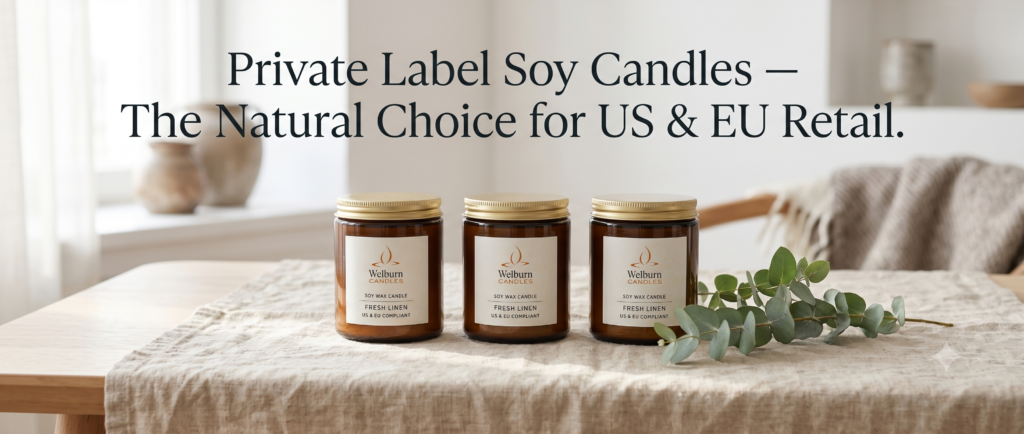
Soy wax candles have moved from a niche wellness segment to a mainstream retail staple in both the US and EU. For private label candle brands, soy wax is no longer just a preference — it is increasingly the baseline expectation at premium and mid-market retail price points. This sub-blog is part of our main guide: Private Label Candles Manufacturers: Complete Guide. Why Soy Wax Has Won in US and EU Premium Retail Consumer preference data from Mintel’s 2024 Home Fragrance Report shows that ‘natural’ and ‘clean-burning’ are the top two purchase drivers for candles in the US and UK markets (after fragrance). Soy wax fulfils both claims: it is plant-derived, biodegradable, and burns at a lower temperature that produces less soot than standard paraffin. In EU markets, particularly Germany, France, and Scandinavia, sustainability certification is increasingly required by major retailers (Rewe, Carrefour, IKEA supplier networks) for candle range listings. Soy wax qualifies for USDA BioPreferred labelling in the US and ‘natural wax’ claims under EU marketing guidelines. Building a Private Label Soy Candle Range A well-structured private label soy candle range for US/EU retail typically includes: • 2–3 hero fragrances that anchor the brand identity (e.g., Lavender, Sandalwood, Fresh Linen) • Seasonal limited editions for Q4 (holiday) and spring rotation • A signature vessel — glass jar, tin, or custom ceramic — that is visually distinctive on shelf • Clean, minimal packaging that communicates ‘natural’ without over-claiming • Product claims backed by certificate: ‘100% Soy Wax’, ‘Cotton Wick’, ‘IFRA Compliant Fragrance’ Welburn Candles manufactures private label soy candles with full IFRA and REACH compliance, and offers a curated fragrance library of 100+ scents pre-tested for soy wax performance. Start your private label enquiry. Quick Links ← Back to Main Blog: Private Label Candles Manufacturers: Complete Guide → Related: Private Label Candle Packaging Design Guide → See also: Welburn Private Label Programme FAQs: Private Label Soy Candles Can I claim ‘100% natural’ on a soy wax candle? Soy wax is a natural, plant-derived material. You can make ‘100% natural wax’ claims if the soy wax in your product has not been hydrogenated with synthetic additives. Always verify with your manufacturer that the soy wax specification supports the claims you intend to make. Are private label soy candles more expensive than paraffin? Yes — typically 20–40% more per unit due to higher wax raw material cost. However, soy candles command a retail price premium of 50–100% over equivalent paraffin candles, making the margin economics typically favourable. What fragrance loads work best in soy wax for private label candles? Soy wax performs best with 8–12% fragrance load for jar candles and 3–6% for tealights. Higher loads improve scent throw but can cause seeping and surface issues if not properly optimised. Welburn’s formulation team tests every fragrance-wax combination before production.
Tealight Candle Manufacturers in India: Why Global Buyers Are Choosing India
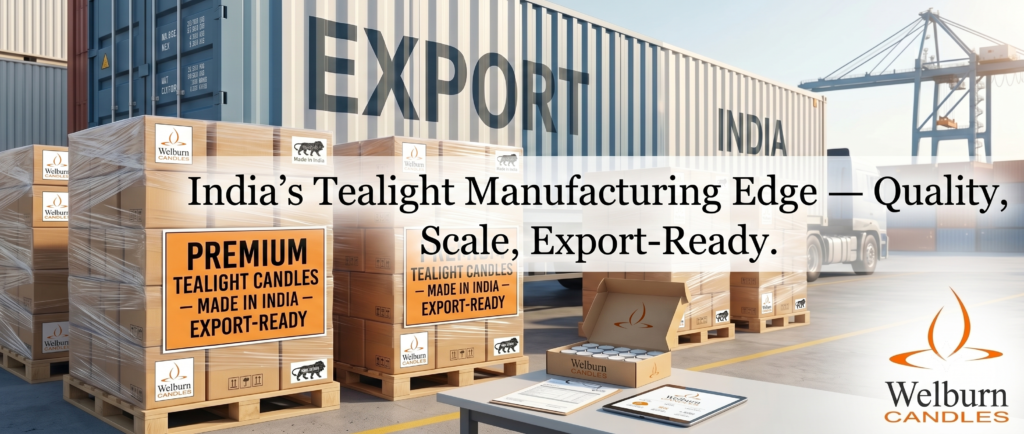
India’s rise as a global tealight candle manufacturing hub is no accident. It is the result of a converging set of advantages — deep-rooted fragrance expertise, growing investment in compliant manufacturing infrastructure, competitive labour costs, and a large English-speaking export professional base — that together make India uniquely competitive in the $14bn global candle market. This sub-blog is part of our main guide: Tealight Candle Manufacturers: Complete Sourcing Guide. India’s Advantages in Tealight Candle Manufacturing Fragrance Heritage: India has one of the world’s deepest traditions in scent — attar manufacturing in Kannauj, essential oil distillation in Uttarakhand, and a 2,000-year history of incense and aromatic product production. This heritage translates to sophisticated in-house fragrance development capability that Chinese manufacturers typically cannot match. Cost Structure: Factory-direct tealight pricing from India is typically 30–50% below equivalent quality from European manufacturers and 15–25% below Chinese peers at comparable quality and compliance levels. According to India’s Ministry of Commerce export data, candle exports have grown over 40% in the past five years, driven by US and EU demand. Compliance Infrastructure: Indian export manufacturers have invested heavily in REACH compliance capability, IFRA fragrance testing, and ASTM-aligned quality systems — driven by EU and US buyer requirements. Welburn Candles provides complete compliance documentation with every export shipment. Supply Chain Diversification: Post-2020, US and EU buyers have actively sought supply chain alternatives to China. India has been the primary beneficiary in the candle category. Logistics: India to US and EU Sea freight from India to the US East Coast: 20–25 days. US West Coast: 18–22 days. EU (Rotterdam, Hamburg): 18–24 days. UK (Felixstowe): 18–22 days. Air freight: 5–7 business days to any major US or EU city. Welburn Candles is based in India with established freight forwarding relationships for export to the USA, UK, Europe, and the Middle East. Quick Links ← Back to Main Blog: Tealight Candle Manufacturers: Complete Guide → Related: Scented vs Unscented Tealight Manufacturing → Shop: Welburn Tealight Candle Range FAQs: Indian Tealight Candle Manufacturers Does sourcing tealights from India incur import duty in the EU? EU import duty on candles (HS code 3406) from India is typically 3.7% under MFN rates. With the India-EU Free Trade Agreement (in negotiation as of 2026), this rate may reduce. US import duty under HTS 3406 is 3.7%. Confirm current rates with your customs broker. What is the quality difference between Chinese and Indian tealight manufacturers at similar price points? At the same price point, Indian manufacturers generally offer superior fragrance quality and compliance documentation. Chinese manufacturers often have advantages in scale and packaging variety. For fragrance-forward or compliance-critical products, Indian manufacturers are typically the stronger choice.
How to Evaluate a Candle Wholesale Supplier Before Placing Your First Order
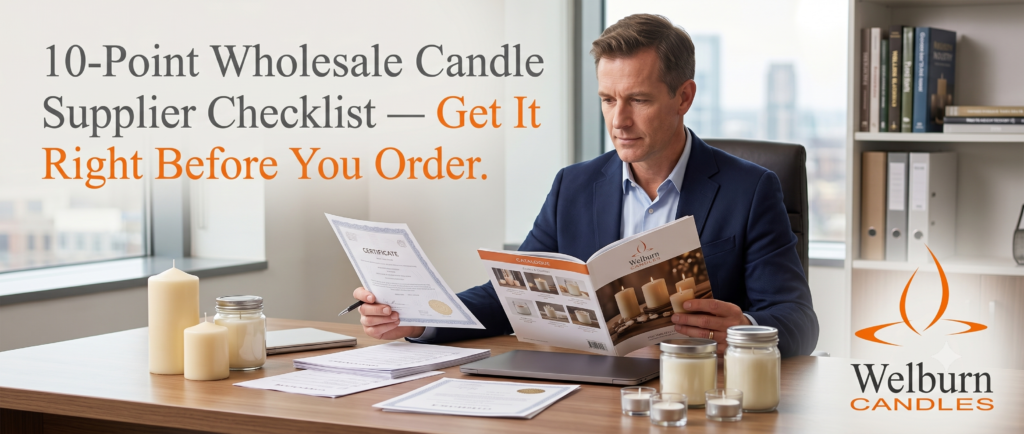
The candle wholesale market has a wide quality distribution. This 10-point checklist helps US and EU buyers separate professional, export-ready candle wholesale suppliers from lower-quality operations that look similar in brochures and websites. This sub-blog is part of our main guide: Candle Wholesale Supplier: US & EU Sourcing Guide. 1. Factory-Direct or Trading Company? Understand who you are buying from. Factory-direct suppliers have control over quality, consistency, and pricing. Trading companies aggregate from multiple manufacturers, which can mean inconsistent quality across shipments. Ask: ‘Is this your own manufacturing facility?’ 2. Product Compliance Certificates Request REACH certificates (EU) or ASTM compliance documentation (US). A professional candle wholesale supplier will have these ready without hesitation. Absence of documentation is a red flag. 3. Sample Policy A reputable supplier will send samples before bulk order — typically charging for samples (credited against first order). Be wary of suppliers who cannot send samples or who only show photos. 4. Wax Specification Transparency Know exactly what wax you are buying: fully refined paraffin, crude paraffin, soy, or blend. Ask for the wax melt point and source. This directly affects burn quality and your ability to make product claims to your customers. 5. Burn Time Test Reports Request third-party burn time test reports. Suppliers making burn time claims without test documentation are providing unverified specifications. 6. Wick Composition Certificate Lead-core wicks are banned in the EU and US. Request a wick composition certificate confirming cotton or paper construction. This is non-negotiable for compliant candle wholesale supply. 7. Fragrance IFRA Compliance All fragrance ingredients must comply with IFRA guidelines. Request IFRA compliance statements for any scented products, and check that allergen concentrations comply with EU CLP thresholds. 8. Production Capacity vs Your Volume Verify that the supplier’s actual production capacity comfortably exceeds your order volume. A manufacturer near capacity is a supply risk — especially in Q3/Q4 when demand peaks. 9. Export Track Record Ask for references from buyers in your target market. A supplier with demonstrated EU or US export history understands documentation requirements, packaging standards, and logistics. 10. Communication and Responsiveness Pre-order communication quality predicts post-order service quality. A supplier who responds slowly, vaguely, or inconsistently before you have placed money on the table will be worse after. Quick Links ← Back to Main Blog: Candle Wholesale Supplier Guide for USA & Europe → Related: Candle Wholesale Pricing: What Affects Cost → Contact: Request Wholesale Pricing from Welburn Candles FAQs: Evaluating Wholesale Suppliers How many samples should I request before a bulk candle order? Request at least one sample of every product variant in your planned order. Test burn time, scent throw, and packaging quality. For large first orders (above $10,000), a small ‘pilot order’ of 100–200 units is a worthwhile step before full commitment. What is a reasonable sample turnaround time? Professional wholesale candle suppliers typically dispatch samples within 3–7 business days. Longer than 2 weeks with no explanation is a sign of production disorganisation. Should I use a sourcing agent for wholesale candle buying from India? For first-time buyers, a sourcing agent with candle industry experience can reduce risk. For buyers with clear specifications and direct communication skills, factory-direct engagement typically produces better pricing and relationship quality.
How Tealight Candle Bulk Manufacture Works: From Raw Wax to Retail Pack
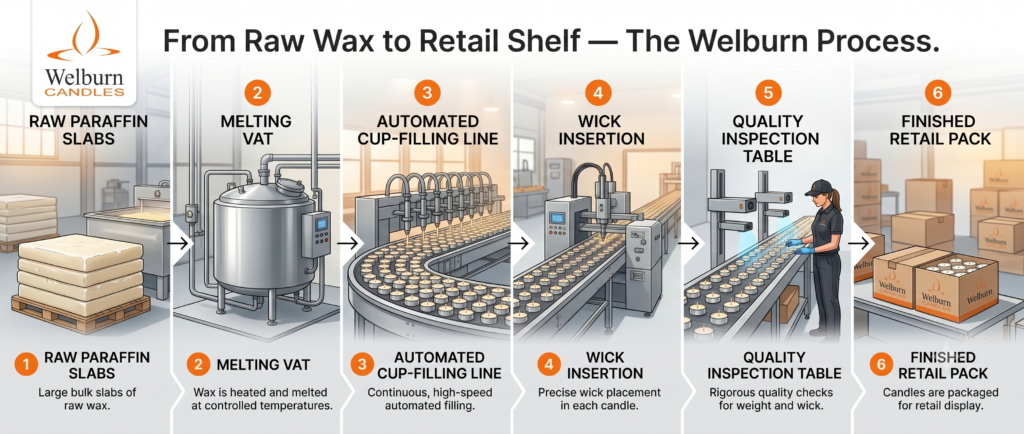
Understanding the tealight candle bulk manufacture process helps buyers set realistic expectations, ask the right questions, and identify quality gaps before placing large orders. This sub-blog walks through every stage of production at Welburn Candles. This sub-blog is part of our main guide: Tealight Candle Bulk Manufacture: Complete Buyer’s Guide. Stage 1: Raw Material Procurement and Testing Every tealight bulk order begins with raw material sourcing. Wax (paraffin, soy, or coconut), wicks, fragrance oils, and aluminium or polycarbonate cups are procured from certified suppliers. Incoming wax is tested for melt point, viscosity, and colour consistency before it enters the production floor. Fragrance oils are tested against IFRA guidelines and REACH substance lists for EU market compliance. Stage 2: Wax Preparation Wax blocks are loaded into jacketed melting tanks and heated to precise temperatures — typically 80–90°C for paraffin, 65–75°C for soy. Fragrance oil (if ordered) is blended at a controlled pour temperature to maximise fragrance retention. Colour dye, if required, is added and mixed to an even dispersion before the batch is approved for the filling line. Stage 3: Automated Cup-Filling This is the core of tealight bulk manufacture — and where factory quality diverges most sharply. Professional operations use automated filling lines that dispense wax at a controlled flow rate and weight. Each cup receives a consistent pour weight (±0.2g tolerance). The filling line speed on a standard Welburn production line produces 15,000–20,000 tealights per shift. Pre-tabbed wicks are already seated in the cup before filling, ensuring centered wick position. Stage 4: Cooling and Solidification Filled cups pass through a temperature-controlled cooling tunnel or rest on cooling tables at 20–22°C ambient. Controlled cooling prevents surface cracking, sinkholes, and wick lean — the three most common tealight cosmetic defects. Soy and coconut wax tealights require longer cooling times than paraffin to prevent frosting. Stage 5: Quality Control Inspection Each production batch undergoes a multi-point quality check: wax weight verification (sample scale check), wick centering visual inspection, surface finish check, and burn-time testing from a sample of every batch. Burn testing is conducted against the ASTM F2167 standard for burn performance. Failed batches are remixed, not shipped. Stage 6: Packaging and Export Preparation Tealights are packed into retail configurations (10pk, 24pk, 50pk, 100pk) and then into export-grade corrugated master cartons. Each carton is labelled with product specifications, batch number, wax type, fragrance (if applicable), country of origin, and HS code. Export documentation — commercial invoice, packing list, COA, REACH certificates — is prepared for customs clearance. For private label tealight orders, branded retail boxes and inserts are packed at this stage. Quick Links ← Back to Main Blog: Tealight Candle Bulk Manufacture: Complete Guide → Related: Wax Types for Bulk Tealight Manufacturing → Shop: Welburn Tealight Candles FAQs: Tealight Manufacture Process How do I know if a manufacturer uses automated filling or manual production? Ask for a video of the production line. Automated filling lines produce consistent wax weights — request the fill weight tolerance specification (should be ±0.2–0.5g). Manual operations typically cannot achieve this consistency at scale. What causes tealight surface imperfections (sinkholes, cracks)? These are caused by uncontrolled cooling — too-rapid temperature drop or inconsistent ambient conditions. A quality manufacturer uses temperature-controlled cooling areas. Sinkholes also indicate under-pour (insufficient wax weight per cup). Can I visit the Welburn factory before placing a bulk order? Yes. Welburn Candles welcomes factory visits from international buyers. For those unable to travel, we offer a comprehensive factory video tour and third-party factory audit coordination.
Candle Manufacturers: The Complete Sourcing Guide for US & European Buyers
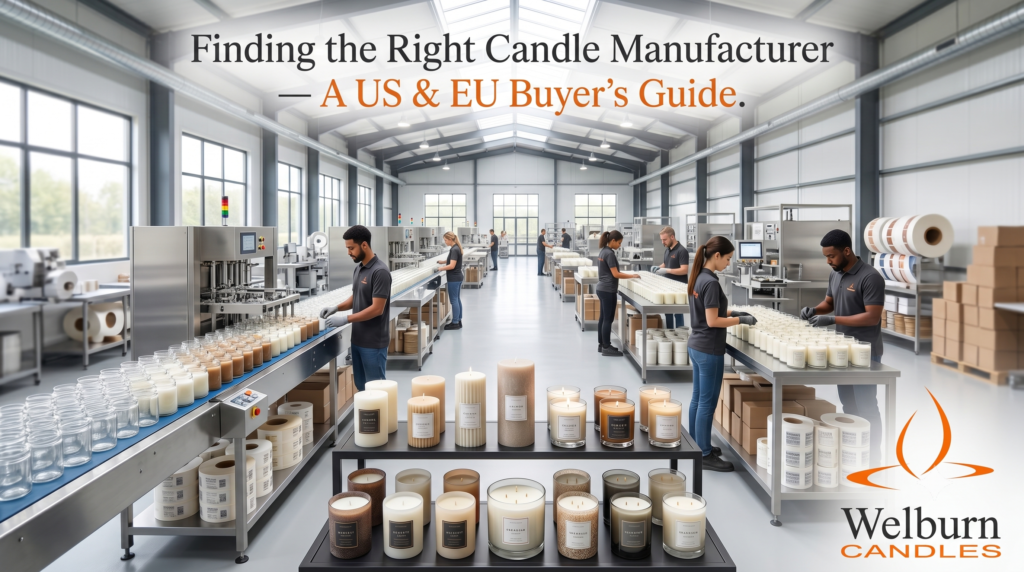
The global candle manufacturing landscape is vast and highly differentiated. From single-artisan operations to facilities producing 50 million units annually, candle manufacturers vary enormously in capability, compliance, reliability, and alignment with different buyer needs. For US and European importers and brand owners, navigating this landscape efficiently requires a structured evaluation framework. Welburn Candles is a full-service candle manufacturer based in India, exporting premium candles to the US, UK, Europe, and the Middle East. We offer private label manufacturing, OEM production, and tealight bulk manufacturing at competitive factory-direct pricing. The Candle Manufacturing Industry: Key Segments Candle Type Key Markets Premium Level Manufacturing Complexity Tealight Candles Hospitality, mass retail, events Low–Medium High volume, automated Pillar Candles Home décor, gifting, religious Medium Semi-automated Container/Jar Candles Premium retail, D2C, gifting Medium–High Precision pour, vessel-dependent Votive Candles Hospitality, religious, retail Low–Medium Semi-automated Luxury Candles Premium boutique, gift, travel retail High Artisan/handcraft elements What Separates Professional Candle Manufacturers from Small Operations Scale, compliance infrastructure, and process control are the three primary differentiators: • Professional manufacturers have dedicated QC teams separate from production — not the same person doing both • Raw material testing infrastructure — wax melt point, viscosity, fragrance composition verification • Documented batch records for every production run — enables recall traceability • Export compliance capability — REACH, CLP, ASTM, IFRA documentation on demand • Financial stability for large order deposits and consistent supply • Scalable production capacity with predictable lead times India as a Candle Manufacturing Source for US & EU Buyers India’s candle manufacturing sector has undergone a significant professionalisation in the last decade, driven by increasing Western buyer requirements and growing export volumes. According to India’s Export Promotion Council for Handicrafts (EPCH), candle and wax product exports have grown over 40% in five years. Key advantages of Indian candle manufacturers for US and EU buyers: • 30–60% cost advantage over European domestic production • Deep fragrance expertise and in-house scent development capability • Growing compliance infrastructure (REACH, IFRA, ASTM-aligned quality systems) • English-language communication and professional export documentation • Increasing focus on natural and sustainable candle production to match Western market trends Read more: Indian Candle Manufacturers: Why Global Buyers Choose India. Full-Service vs Specialist Candle Manufacturers Full-Service Manufacturers (like Welburn Candles) offer the complete product range — tealights, pillars, containers, votives, private label, OEM, gift sets — with end-to-end service from concept to export. Ideal for buyers consolidating SKUs, building a brand range, or seeking a single reliable supply partner. Specialist Manufacturers focus on one product type (e.g., tealight-only or luxury jar-only). Appropriate for buyers with very large, single-product-type volumes where deep specialisation delivers cost advantages. Related Sub-Blogs in This Series → Candle Manufacturers for Retailers: What US & EU Buyers Should Know → How to Request a Quote from Candle Manufacturers: What to Include → Candle Manufacturers and Sustainability: What US & EU Buyers Are Demanding FAQs: Candle Manufacturers How do I find reputable candle manufacturers for US and EU supply? B2B sourcing platforms (Alibaba, IndiaMART, Global Sources) provide manufacturer listings, but require careful vetting. Trade shows (Ambiente Frankfurt, NY Now, India International Trade Fair) provide direct access to manufacturers. Referrals from other importers in complementary product categories are often the highest-quality leads. What export certifications should a candle manufacturer have for EU supply? For EU export: ISO 9001 (quality management), REACH compliance documentation, IFRA compliance for fragranced products, and if claiming sustainability, relevant certifications (FSC for packaging, USDA Organic for natural wax, Rainforest Alliance for palm-derivative inputs). Is it better to source candles from one manufacturer or multiple? Single-source: simpler logistics, stronger relationship, consolidated shipments, better pricing leverage. Multi-source: supply resilience, product diversity, competitive price tension. Most buyers start single-source and diversify as volume grows. Can candle manufacturers in India handle small initial orders? Yes. Welburn Candles specifically supports first-time buyers with lower MOQs and sample-first ordering. A small pilot order before a full container commitment is a standard approach we encourage for new wholesale relationships.
Private Label Candles Manufacturers: The Complete Guide for US & EU Brands (2026)
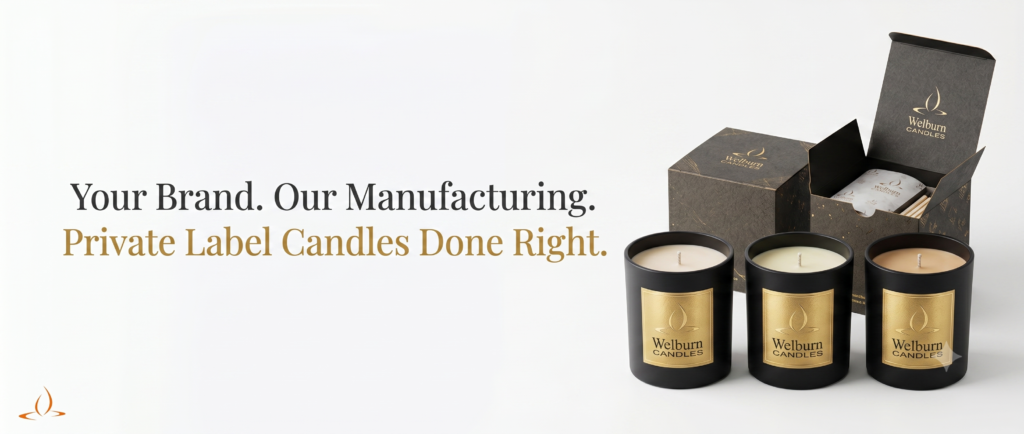
Private label candle manufacturing is the most efficient way to build a candle brand at any scale — from a boutique D2C startup to a national retail chain. Rather than building your own production facility, you partner with a specialist private label candles manufacturer who handles wax sourcing, fragrance development, production, and packaging — while you focus on brand building, marketing, and distribution. This guide covers the entire private label candle journey: from choosing a manufacturer to launching on retail shelves. Welburn Candles is one of India’s leading private label candles manufacturers — exporting to the US, UK, Europe, and the Middle East. Start your private label enquiry here. What Private Label Candle Manufacturing Actually Covers Private label candle manufacturing is an end-to-end service, not just production. A full-service private label partner covers: • Brand consultation and product brief development • Fragrance selection from a curated, IFRA-compliant library (or custom fragrance development) • Wax selection and prototype development • Vessel and packaging sourcing (jars, tins, boxes, labels) • Artwork and label design support (or working with your designer) • Sample production and approval • Bulk manufacturing • Quality control and batch documentation • Export packaging and customs documentation • Worldwide shipping Welburn Candles provides all of the above as an integrated service. Explore our full private label programme. Choosing the Right Private Label Candle Manufacturer: 7 Critical Criteria 1. Fragrance Capability Can they develop custom scents, or are you limited to a pre-set catalogue? The best private label manufacturers offer both — catalogue selection for speed, custom development for differentiation. 2. Wax Range Do they offer paraffin, soy, coconut, and blended options? US and EU consumers increasingly expect natural wax options. A manufacturer limited to paraffin limits your brand positioning. 3. Packaging Flexibility Vessel selection (glass, tin, ceramic, wood-lid), label printing (CMYK, white ink, gold foil, embossing), box and outer packaging — the more options, the stronger your brand execution. 4. MOQ Accessibility Low MOQs are essential for new brands. Avoid manufacturers requiring 5,000+ units per SKU for a first order — this prevents new brand development and market testing. 5. Compliance Documentation Non-negotiable for US and EU retail: REACH/IFRA for EU, ASTM/CPSC for US. A private label manufacturer who cannot provide these is a liability, not a partner. 6. Export Experience Have they shipped to your market before? Do they understand your country’s import documentation requirements? Do they have freight forwarder relationships that protect your delivery timeline? 7. Communication Quality Pre-order responsiveness, willingness to answer detailed questions, and proactive project management are the best predictors of post-order experience. Private Label Candle Ranges: What Can Be Customised? Element Options Available Notes Wax Type Paraffin, Soy, Coconut, Blend Determines burn profile, cost, sustainability claim Fragrance Catalogue (100+ options) or custom Custom requires 2–3 week development Vessel Glass jar, tin, ceramic, wood-lid Vessel is often the biggest cost driver Label Digital print, foil, embossed, custom shape Welburn has in-house design support Box/Outer Printed box, kraft, magnetic close, gift set Retail-ready or e-commerce packaging available Pack Formats Single, duo, trio, gift set Multi-SKU orders consolidated in one shipment Private Label Candles for US Market: Key Considerations US retail buyers — particularly mass retail and specialty chains — require ASTM F2517 compliant labelling, California Prop 65 warnings for lead or heavy metal content above thresholds (easily avoided with cotton wicks), and FTC Green Guide compliance for any ‘natural’ or ‘eco’ claims. For D2C brands, platform requirements (Amazon, Etsy, Faire) also apply. Private Label Candles for EU Market: Key Considerations EU retail import requires CLP labelling compliance for all fragranced candles, REACH regulation compliance for restricted substances, IFRA-compliant fragrance certificates, and import CE documentation where applicable. Countries like Germany, France, and the Netherlands have active customs authority inspection of candle imports — documentation quality is essential. Related Sub-Blogs in This Series → Private Label Soy Candles: Why Natural Wax is Dominating US & EU Retail → Private Label Candle Packaging: How to Design for US & EU Retail Shelves → How to Start a Private Label Candle Brand: Step-by-Step Launch Guide FAQs: Private Label Candles Manufacturers What MOQ should I expect from a private label candles manufacturer? Welburn Candles starts at 500 units per SKU for most private label candle types. For tealights and standard products, lower thresholds may be possible. Larger orders (2,000+ units) unlock better unit pricing and packaging customisation options. How long does private label candle manufacturing take from start to shelf? From initial brand brief to delivered product: 8–12 weeks typically. This includes 2 weeks for fragrance and packaging development, 1 week for sample approval, 4–5 weeks production, and 3–4 weeks sea freight. Rush timelines with air freight are available. Can I develop a signature fragrance for my private label candle brand? Yes. Welburn Candles offers custom fragrance development as part of its private label service. Your signature scent is developed exclusively for your brand and is not shared with other buyers. Custom fragrance development typically adds 2–3 weeks to the timeline. Do private label candle manufacturers provide product photography? Some manufacturers offer basic product photography for catalogue and website use. Welburn Candles provides sample product photos. For professional brand imagery, we recommend using the samples we send for a professional lifestyle shoot tailored to your brand. What is the difference between white label and private label candles? White label means the product is pre-made and sold to multiple buyers who apply their own labels — minimal customisation. Private label implies a higher degree of brand customisation (fragrance, packaging, vessel) specific to your brand. Welburn Candles provides true private label — custom to your brief.