Scented Candle Manufacturers for Hotel, Spa & Hospitality Amenity Programs
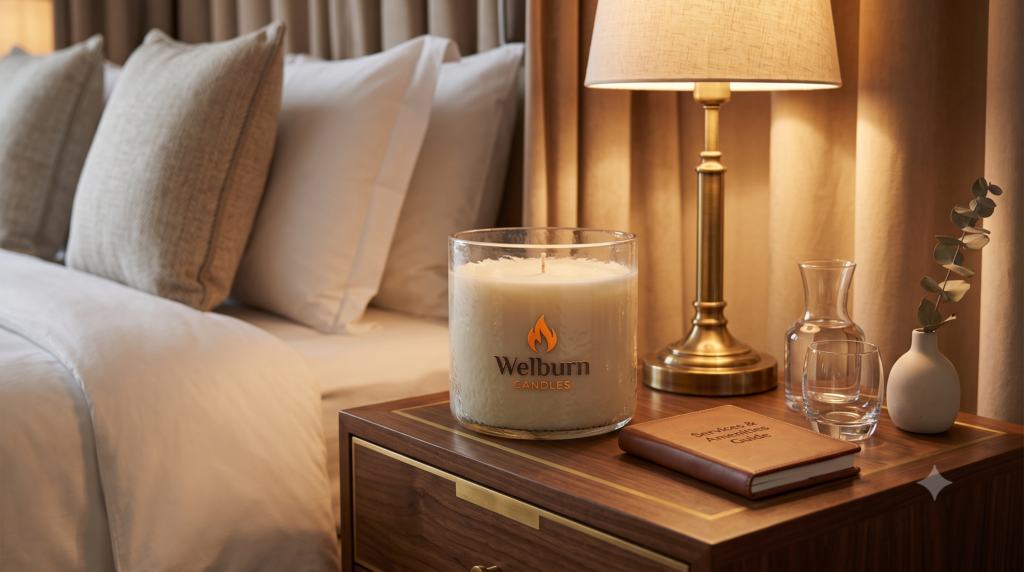
This guide is part of our main cluster: Scented Candle Manufacturers: A Buyer’s Guide to Fragrance, Wax & Compliance Introduction Hospitality procurement has different priorities than general retail. A hotel or spa amenity program isn’t just buying a candle — it’s buying a consistent piece of brand identity that needs to smell identical whether a guest experiences it in a Dubai property or a New York property, and needs to reliably restock at scale without quality drift between orders. Batch-to-Batch Consistency Is the Real Requirement For hospitality brands with a signature scent, consistency matters more than almost any other factor. A scented candle manufacturer without tight fragrance formulation control can produce a batch that’s subtly “off” from the last one — something a general retail customer might not notice, but that a returning hotel guest or a brand standards audit absolutely will. Burn Safety for Guest Rooms and Spas Hospitality environments carry higher liability exposure than typical retail, which makes burn safety testing and clear burn-time labelling especially important — guests need clear guidance, and properties need documentation they can point to if questioned by insurers or brand standards teams. Bulk Reorder Reliability and Lead Time SLAs Unlike a one-time retail order, hospitality amenity programs need predictable, recurring supply — new property openings, seasonal refreshes, and standard restocking all depend on a manufacturer that can commit to reliable lead times, not just a one-off production run. Private Label Branding for Hotel Gift Shops Beyond in-room amenities, many hospitality brands sell private label candles in gift shops as a retail extension of the guest experience — often using the same signature scent as the in-room amenity candle, which is another reason batch consistency across both product lines matters. Why Jar Format Dominates Hospitality Amenity Programs Most hospitality amenity candles use jar formats specifically for the fragrance throw and shelf presence in guest rooms — see our full jar candle manufacturing guide for the format-specific considerations that apply here. Our Hospitality Manufacturing Experience With in-house fragrance formulation and ISO 9001:2015 certified production, we support hospitality brands with consistent signature-scent production and the reliable reorder scheduling that amenity programs depend on. Reach out to discuss a hospitality amenity program partnership. FAQs Can you match a signature hotel scent consistently across large orders? Yes, our in-house fragrance formulation process is built specifically to maintain batch-to-batch consistency, which is essential for hospitality brands maintaining a signature scent across properties. What burn-time safety standards apply to hospitality candles? Hospitality candles should meet the same core fire safety standards as retail candles, with particularly clear burn-time labelling given the higher liability context of guest-facing environments. Do you support recurring bulk reorder contracts? Yes, we work with hospitality brands on predictable reorder scheduling to support property openings, seasonal refreshes, and standard amenity restocking.
Scented Candle Manufacturers for European Home Fragrance Brands
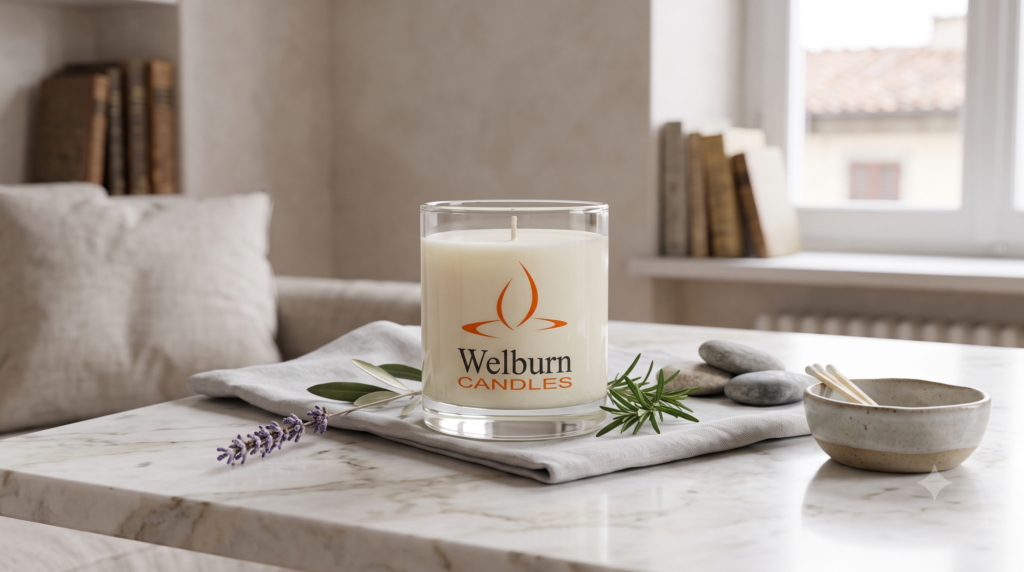
This guide is part of our main cluster: Scented Candle Manufacturers: A Buyer’s Guide to Fragrance, Wax & Compliance. Also see our related private label guide: Private Label Candles for Italy and Spain Introduction European home fragrance brands operate in one of the most design-literate and regulation-conscious candle markets globally. Whether you’re building a brand out of France, Germany, or the Nordics, sourcing decisions need to account for both fragrance trend sensibility and a compliance framework that goes beyond what’s required in other export markets. REACH Compliance Alongside IFRA EU-bound scented candles need to satisfy REACH chemical registration and safety requirements in addition to IFRA fragrance usage limits. These aren’t interchangeable — REACH covers broader chemical safety and registration obligations, while IFRA specifically governs fragrance ingredient concentration limits. A scented candle manufacturer exporting into the EU needs working familiarity with both. EU Labelling Requirements CLP pictograms and burn time warnings are standard requirements on EU-bound candle packaging, and label accuracy matters — mismatched or missing hazard information is one of the more common reasons shipments get flagged at EU customs or by retail compliance teams. Fragrance Trends Across European Markets Fragrance preference varies meaningfully by country. France and the broader Francophone market lean toward sophisticated, layered fragrance profiles; Germany and the Nordics show strong demand for clean, botanical, minimal-ingredient positioning consistent with the region’s broader naturkosmetik retail culture. A manufacturer capable of formulating across this range — rather than offering one fixed fragrance catalog — gives you room to tailor by market. How This Connects to Private Label Launches Fragrance formulation is really the foundation underneath a private label launch, which is why this guide pairs directly with our existing European private label market guides for Italy and Spain, France, and Netherlands — if you’re building a private label brand for any of these markets, fragrance compliance and formulation is the layer that needs to be right first. Our European Compliance & Formulation Experience We formulate fragrance in-house with REACH and IFRA compliance built into the process, and our export experience into the EU spans two decades of shipping candle products that meet CLP labelling requirements on arrival. Talk to our team about fragrance development for your European market launch. FAQs Is REACH compliance different from IFRA? Yes — REACH governs broader chemical safety and registration requirements for substances sold in the EU, while IFRA specifically sets usage limits on fragrance ingredients. EU-bound candles need to satisfy both. What fragrance trends are popular in the EU home fragrance market? It varies by country — French markets tend toward sophisticated, layered fragrance profiles, while Germany and the Nordics show strong preference for clean, botanical, minimal-ingredient formulations. Can you supply both fragrance formulation and private label packaging together? Yes, we handle fragrance formulation and private label packaging development as one integrated process rather than separate handoffs, which keeps your brand positioning consistent from scent to shelf presence.
Scented Candle Manufacturers: What Buyers Need to Know About Fragrance & Compliance

The Quality Gap You Can’t See on the Label Of everything that goes into a candle, fragrance is the one variable that’s hardest to evaluate from a spec sheet — and the easiest place for a low-quality scented candle manufacturer to cut corners. Two candles can look identical on paper — same wax, same jar, same wick — and still perform completely differently once lit, because fragrance formulation is where manufacturing skill actually shows. If you’re evaluating suppliers, understanding a handful of technical basics will save you from finding out about a problem after your first bulk shipment has already reached customers. Fragrance Load: The Number That Determines Everything Fragrance load refers to the percentage of fragrance oil blended into the wax. Too low, and your candle will smell faint even unlit (weak “cold throw”) and barely noticeable once burning (weak “hot throw”). Too high, and you risk poor burn quality — soot, uneven melt pools, or the fragrance oil actually destabilizing the wax structure. A manufacturer who understands wax-fragrance compatibility will calibrate load differently depending on whether you’re using soy, paraffin, or a blend, not apply one fixed percentage across every product. IFRA Compliance: Non-Negotiable for Export Markets The International Fragrance Association (IFRA) sets usage limits on fragrance ingredients based on safety research, and compliance is effectively required if you’re selling into EU or US retail — non-compliant fragrance formulations can and do get flagged at import or by retail buyers doing due diligence. This is one of the first questions to ask any manufacturer directly: is your fragrance formulation IFRA compliant, and can you provide documentation? A manufacturer who hesitates on this question is a manufacturer worth reconsidering. Wax-Fragrance Compatibility Different waxes retain and release fragrance differently: None of these are “better” in the abstract — the right choice depends on your target market and price point, which is exactly why this conversation should happen with your manufacturer, not be decided by default. Common Defects From Under-Qualified Manufacturers If you’ve dealt with inconsistent quality before, it likely traces back to one of these: A manufacturer with proper in-house fragrance and wick-testing capability catches these before they reach your customer, not after. Why Fragrance and Private Label Should Be the Same Conversation Scented candles are where private label differentiation actually happens — your jar and your packaging can look similar to a competitor’s, but a signature fragrance blend is genuinely yours. This overlaps closely with our aromatherapy candle formulation work, since aromatherapy positioning depends entirely on getting essential-oil-adjacent fragrance blends right. Our Fragrance & Compliance Capabilities We formulate fragrance in-house rather than outsourcing it, which means wax selection, fragrance load, and wick sizing are calibrated together rather than treated as separate steps. Combined with ISO 9001:2015 certification and 20+ years of export experience to the USA, EU, UK, and beyond, that in-house control is what lets us support IFRA-compliant private label fragrance development from first sample to bulk reorder. Want to sample a fragrance blend built specifically around your brand positioning? Talk to our team about a sample run. FAQs What is IFRA compliance and why does it matter for scented candles? IFRA sets safety-based usage limits on fragrance ingredients, and compliance is effectively required for EU and US retail. Non-compliant formulations can be flagged at import or during retail buyer due diligence, so it’s worth confirming compliance documentation with any manufacturer before committing to bulk production. Why do some scented candles lose their smell halfway through burning? This usually comes down to fragrance load and wax-fragrance compatibility. If the load is too low for the wax type, or the wax isn’t retaining fragrance oil well as it melts, hot throw drops off well before the candle is finished. Can I request a custom fragrance blend for my brand? Yes — we formulate fragrance in-house, which allows for iterative sampling until a blend matches your brand positioning, whether that’s a clean minimalist scent profile or a bold, layered fragrance. What’s the difference between cold throw and hot throw? Cold throw is how strongly a candle smells unlit, which matters for retail shelf appeal and unboxing. Hot throw is how the fragrance performs once burning, which is what actually drives repeat purchases.
Natural Scented Candle Manufacturing: Soy, Coconut, and Essential Oil Formulations
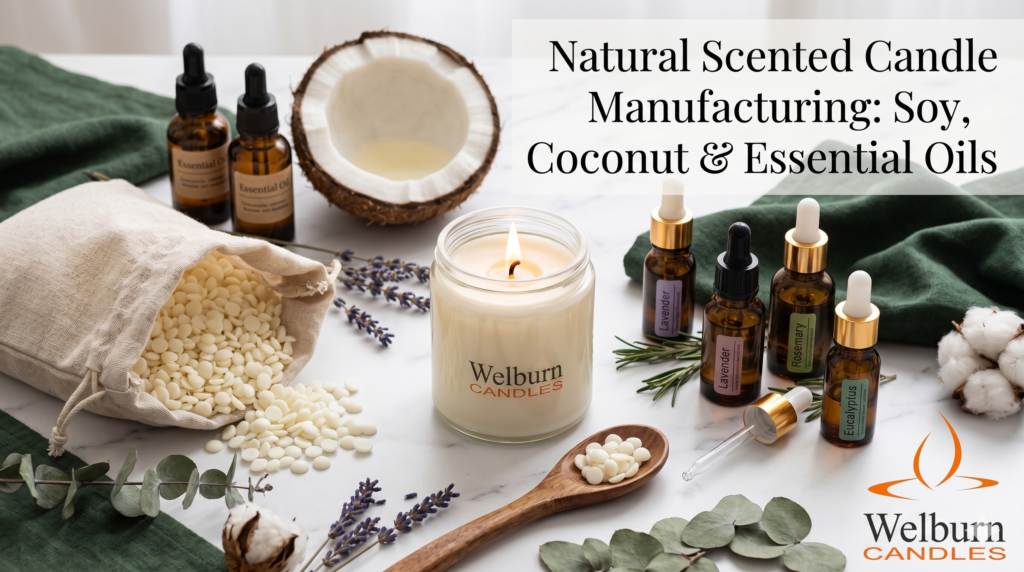
Natural scented candles are the most commercially dynamic segment in the global home fragrance market. Driven by European and North American consumers’ growing preference for clean ingredients, sustainable production, and ingredient transparency, natural scented candles have grown from a niche wellness category to a mainstream retail segment that commands premium retail price points. At Welburn Candles, natural scented candle manufacturing — using soy wax, coconut wax, and essential oil formulations — represents a significant and growing share of our private label and wholesale production. This guide explains everything buyers and brand owners need to know. For our full scented candle formulation context, see scented candle formulation guide. Soy Wax Scented Candles: Manufacturing and Market Positioning Soy wax is derived from hydrogenated soybean oil and is the most widely used natural wax globally. At Welburn Candles, soy wax scented candles are formulated with fragrance loads of 6–10% and custom wick selections developed for each vessel diameter to ensure full melt pool development and consistent hot throw. Soy wax’s most distinctive characteristic — natural frosting, the mottled crystalline surface pattern that develops over time — is a natural property of the wax, not a manufacturing defect. European and US consumers who purchase natural wax candles are generally aware of this characteristic. However, formulation techniques can minimise visible frosting for buyers who prefer a cleaner surface appearance. Coconut Wax Scented Candles: Premium Natural Manufacturing Coconut wax delivers the most exceptional fragrance throw available in natural wax candles. Derived from coconut oil, it is biodegradable, renewable, and creates a luxuriously smooth, creamy white surface that communicates premium natural quality immediately. At Welburn Candles, we formulate coconut-soy blend scented candles with fragrance loads of 8–12%, exploiting coconut wax’s superior fragrance binding capacity for maximum hot throw performance in the premium natural tier. Essential Oil Formulations: Natural Fragrance for Wellness Positioning Essential oil-based scented candles position at the intersection of home fragrance and wellness — the fastest-growing consumer goods segment globally. For scented candle manufacturers formulating with essential oils, the primary technical challenge is achieving consistent fragrance throw at therapeutic concentrations while maintaining stable burn performance. At Welburn Candles, every essential oil used in our natural scented candle formulations is verified through GC/MS analysis for purity and therapeutic compound concentration. Our aromatherapy-positioned natural scented candle formulations are developed with qualified aromatherapist input and are available for wholesale buyers through our aromatherapy candle range or as private label custom development. IFRA Compliance for Natural Scented Candles Natural fragrance ingredients — including essential oils — are subject to IFRA Standards in the same way as synthetic fragrance compounds. Some naturally derived fragrance chemicals have IFRA usage limits — meaning that a candle formulated with essential oils at high usage rates requires careful IFRA compliance checking. Welburn Candles provides IFRA compliance certificates for all natural formulations, including essential oil-based blends. Frequently Asked Questions Q: Do natural soy wax candles burn differently from paraffin candles? A: Soy wax candles typically burn at a slightly lower temperature than paraffin, creating a cooler, longer burn. The melt pool develops more slowly, and full melt pool may take slightly longer to develop in the first burn session. This cooler, slower burn is often positioned as a quality and safety advantage for natural candle brands. Q: Can Welburn Candles produce natural scented candles with certified organic ingredients? A: Yes — Welburn Candles offers certified organic essential oil options for clients pursuing organic certification or natural beauty retail channel supply. Contact Welburn Candles to discuss organic ingredient options for your specific formulation brief.
The Scented Candle Buyer’s Guide: How to Source, Evaluate, and Order at Scale
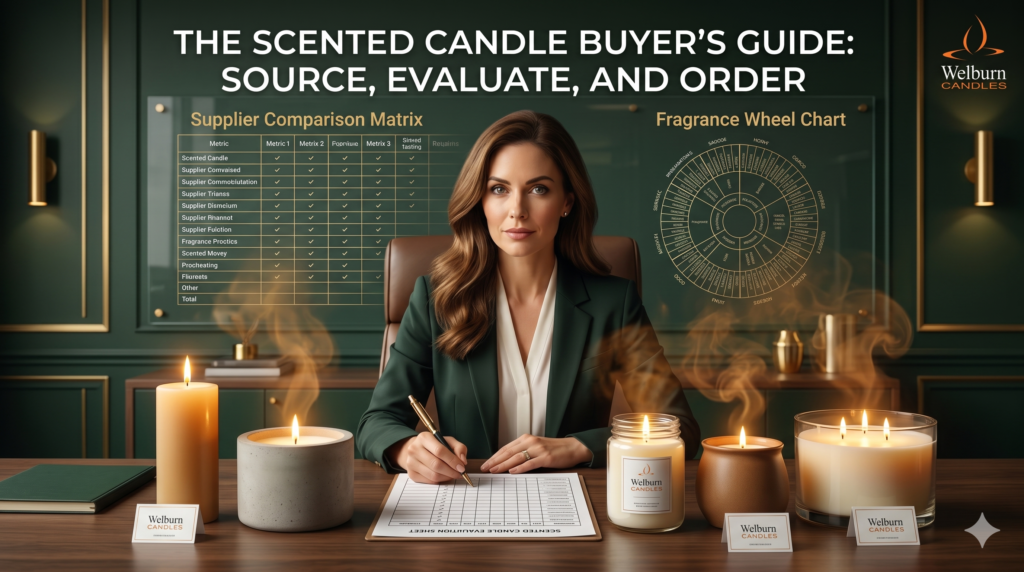
Scented candles are one of the most commercially dynamic product categories in European and global home fragrance retail. But the gap in quality between the best and worst scented candle manufacturers is enormous — and for buyers placing large-scale orders, the consequences of partnering with the wrong supplier extend far beyond a disappointing product: they include compliance exposure, customer returns, and brand reputation damage. This guide provides a complete framework for scented candle buyers — from initial supplier evaluation to sample testing, compliance assessment, and production order management. For our fragrance formulation expertise context, see our scented candle formulation guide. The Scent Throw Evaluation Framework Fragrance performance is the primary quality dimension for scented candles. Buyers evaluating scented candle manufacturers must assess three distinct performance dimensions: 1. Cold Throw Assessment Cold throw is fragrance released by an unlit candle. Assess by removing the candle from its packaging in a neutral-scented room and evaluating fragrance strength and character at ambient temperature. A good scented candle should be clearly perceptible at cold throw — giving customers a meaningful in-store scent experience before purchase. 2. Hot Throw Assessment Hot throw is the fragrance released at full melt pool burn. This is the performance dimension that drives repurchase. To assess hot throw properly, burn the candle in a 15–20 square metre room for a minimum of three hours, allowing a full melt pool to develop. Assess fragrance strength (room-filling versus subtle) and character (does the fragrance match its description?). Compare across all suppliers you are evaluating in the same room under the same conditions. 3. Fragrance Longevity Assessment Fragrance longevity measures whether the scented candle maintains consistent fragrance throw across its full burn life — not just in the first few burns. Ask for multi-session burn data from any manufacturer you are seriously evaluating. At Welburn Candles, our 40-hour burn test protocol captures fragrance performance across the full product burn life. See our scented candle wax types guide for how wax type affects fragrance longevity. Compliance Documentation: The Non-Negotiable Standard Every scented candle in your range sold in European markets must be accompanied by full compliance documentation. This is not a bureaucratic formality — it is the documented proof that your products are safe for consumers and legally compliant for retail in your target markets. Required documentation for EU market scented candles: Welburn Candles provides all of the above as standard for European-market scented candle orders. For market-specific detail, see our scented candle export guide. Ordering at Scale: Planning Your Production Schedule Large-scale scented candle orders require coordinated planning across fragrance sourcing, vessel procurement, packaging production, and production scheduling. At Welburn Candles, buyers placing large-scale orders work with our production planning team to develop a production schedule that meets delivery requirements without compromising quality. Frequently Asked Questions Q: How do I compare fragrance throw performance objectively across multiple scented candle suppliers? A: The most objective comparison methodology is to conduct all hot throw assessments in the same room, with the same ambient conditions, at the same burn stage (full melt pool, same burn duration). Evaluate all candidates on the same day if possible to eliminate environmental variability. Record your assessments against a consistent scoring scale for each performance dimension. Q: What fragrance families sell most consistently in European markets? A: Warm woody and spice compositions, clean florals, and fresh citrus-botanical blends are the most consistently commercial fragrance families across European markets year-round. Gourmand fragrances (vanilla, caramel) perform strongly in colder months and gifting seasons. Our private label fragrance guide covers European fragrance preferences by country in detail. Q: What batch documentation does Welburn Candles provide with scented candle orders? A: Every Welburn Candles scented candle order is accompanied by a quality certificate, fragrance batch IFRA certificate, and packing documentation. For European-market orders, REACH declarations and CLP allergen disclosures are included as standard. Additional documentation including burn test records and raw material safety data sheets is available on request. Contact Welburn Candles to request a specimen documentation pack.
Scented Candles in the Gift Market: A Commercial Strategy Guide for Brands and Retailers
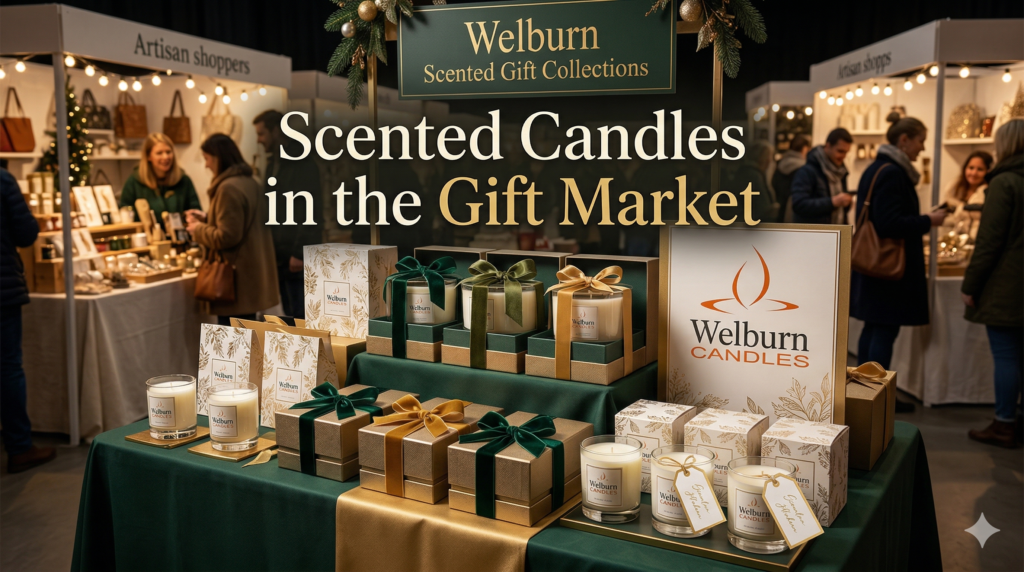
Scented candles are one of the world’s most gifted product categories. Their combination of sensory appeal, premium presentation, universal appropriateness, and wide price range accessibility makes them the default choice for gift buyers across virtually every cultural context and gifting occasion. For scented candle manufacturers and brands, the gift market represents both the highest revenue potential and the most demanding commercial challenge — requiring seasonal planning, premium packaging capabilities, and fragrance strategies optimised for gifting contexts. At Welburn Candles, we supply gift-optimised scented candle ranges to retailers across Europe and globally. This guide shares our gift market strategy framework. See our scented candle formulation guide for the product foundation. Understanding the Scented Candle Gift Market The scented candle gift market operates on fundamentally different dynamics from everyday retail candle sales: Gift-Optimised Product Architecture The Gift Set: Your Highest-Margin SKU. Curated gift sets — two or three complementary fragrances in premium gift packaging — are consistently the highest-margin SKU in most scented candle ranges. They command retail prices disproportionate to their unit cost and are the top-selling item in every major gifting season. The Standalone Premium Candle. A single premium scented candle in a beautiful jar with gift-worthy presentation — ribbon, gift tag, and premium gift box — functions as a default gift for budget-conscious buyers who still want to give something premium. The Limited-Edition Seasonal Candle. Limited-edition seasonal fragrances in exclusive seasonal packaging create urgency and justify premium pricing. The combination of scarcity (‘only available this season’) and occasion relevance makes limited editions the most viral gift candle product. Fragrance Strategy for the Gift Market Gift market fragrance selection requires prioritising broad appeal over personal preference. The most successful gift candle fragrances are: Welburn Candles’ fragrance development team can create gift-optimised fragrance collections for your brand. See our private label fragrance development guide for how our fragrance brief process works. Gift Packaging: The Non-Negotiable Investment Gift candle packaging must communicate premium quality before it is opened. The packaging investment required for gift market success is higher than for everyday retail but is fully justified by the pricing and margin it enables. Welburn Candles offers a comprehensive range of gift packaging options — from premium rigid gift boxes with magnetic closures to seasonal limited-edition packaging. For broader packaging guidance, see our private label candle brand guide. Key Gifting Occasions: A Global Calendar Frequently Asked Questions Q: What scented candle fragrances sell best as gifts in European markets? A: In European gift markets, warm and sophisticated fragrances consistently outperform fresh or green compositions. Top gift-performing fragrance families include warm floral (rose, jasmine), warm spice and amber, vanilla and gourmand, and premium woody or resinous compositions. Country-specific preferences apply, as covered in our export markets guide. Q: How far in advance should I plan scented candle gift sets for Christmas? A: Christmas gift collection production should be planned well in advance to allow fragrance development, sample approval, production, and delivery to retail buyers before their buying season. Contact Welburn Candles to discuss production scheduling for your Christmas collection requirements. Q: Can Welburn Candles produce personalised scented candle gift sets? A: Yes — Welburn Candles can produce scented candles with personalised label options suitable for corporate gifting programmes and personalised retail products. We can also produce bespoke fragrance formulations for corporate clients wanting a fully unique gifting product. Q: What packaging specification should I use for scented candle gift sets? A: For maximum gift market appeal, rigid gift boxes with magnetic closures are the premium standard. Mid-market gift sets perform well in printed folding carton boxes. For an eco-positioned brand, recycled kraft gift boxes with branded tissue paper and a branded card can deliver premium feel at a sustainable price point. Q: Does Welburn Candles supply scented candle gift sets to corporate buyers? A: Yes — Welburn Candles supplies bespoke scented candle corporate gifting programmes to companies across India, the UK, Europe, and the USA. We can create fully branded corporate gifting candle sets with proprietary fragrances, branded packaging, and personalised messaging cards, produced to corporate order quantities. Ready to build a gift-market scented candle strategy that drives revenue? Contact Welburn Candles to discuss gift range development, packaging, and production planning.