
Scented Candles for Export: Reaching European and Global Markets From India
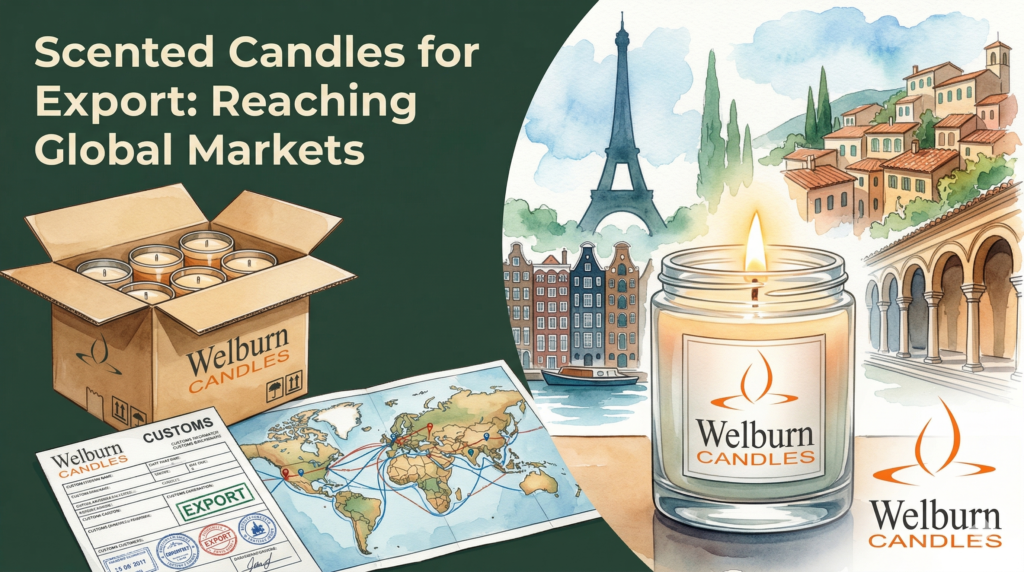
India is one of the world’s leading candle manufacturing hubs, combining artisan fragrance expertise with modern production infrastructure at competitive unit costs. Welburn Candles, based in Bangalore, exports scented candles to over 20 countries — including major European markets, the USA, the Middle East, and the Caribbean. This guide is for importers, brand owners, and retail buyers who want to understand the specific requirements for importing scented candles — with their fragrance compliance dimension — from an Indian manufacturer. For the formulation foundation, see our scented candle formulation guide. The Scented Candle Export Opportunity: Why India? India’s candle manufacturing sector offers a compelling combination of advantages for global buyers: Fragrance Compliance for Scented Candle Export: What Every Market Requires European Union (Italy, France, Spain, Netherlands, Germany). EU fragrance regulations are the most comprehensive in the world. Scented candles exported to EU markets must comply with IFRA Standards for fragrance ingredient usage levels, REACH regulations for chemical substance restrictions, and CLP regulations for allergen labelling. Welburn Candles provides full EU compliance documentation as standard for European-market orders. United Kingdom. Post-Brexit, UK fragrance regulations broadly mirror EU requirements but operate under UK-specific legislation (UK REACH, UK CLP). Welburn Candles has experience supplying both EU and UK market compliant products and provides market-specific documentation sets. United States. US scented candle imports require ASTM F2179 safety standard compliance, IFRA compliance for fragrance ingredients, and California Proposition 65 consideration for products sold in California. Welburn Candles has supplied US market buyers and understands the specific compliance requirements for the US market. Middle East. Middle Eastern markets — particularly the UAE, Saudi Arabia, and Qatar — have significant and growing demand for premium scented candles. Fragrance preferences tend towards rich oud, amber, and rose compositions. Regulatory requirements are generally less prescriptive than European standards, but IFRA compliance provides a sound foundation. Scented Candle Fragrance Labelling for Export Scented candle labels for export must include fragrance allergen disclosures appropriate to each destination market. Welburn Candles produces multi-market label variants and can apply destination-specific labels — in the appropriate language and with the appropriate allergen disclosure format — before dispatch. Fragrance Preferences by Export Market Export-focused scented candle brands benefit from understanding the fragrance preferences of their target markets. Our private label fragrance development guide provides a framework for adapting fragrance strategy to different customer segments and markets. Frequently Asked Questions Q: Does Welburn Candles produce scented candles with market-specific fragrance profiles? A: Yes — Welburn Candles develops scented candle formulations tailored to the fragrance preferences of specific export markets. Our private label clients selling into multiple markets can commission market-specific fragrance variants within their overall range, supported by our fragrance development team. Q: What fragrance documentation is required for scented candle import into Italy? A: Scented candles imported into Italy require IFRA compliance certificates for all fragrance compounds, CLP allergen disclosure documentation for Italian-language label preparation, REACH compliance declarations, and Safety Data Sheets for fragrance ingredients. Welburn Candles provides all of these as standard for EU-market orders. Q: How does Welburn Candles manage fragrance stability during long sea freight journeys? A: Fragrance stability in transit is affected by temperature extremes and prolonged exposure to heat. We use sealed inner packaging for all scented candle export orders and can advise on container placement recommendations to minimise exposure to extreme temperatures. Our quality team can provide guidance on fragrance stability for specific shipping routes. Q: Can I order scented candles in different fragrance strengths for different markets? A: Yes — fragrance load can be adjusted within IFRA safety limits to meet different market preferences. Some markets prefer subtler, lighter fragrance intensities while others respond better to stronger scent throw. Welburn Candles can produce market-specific fragrance intensity variants within your overall scented candle range. Q: What is the most popular scented candle format for European export? A: Glass jar candles in the 200–250ml size range are the most commercially successful format for European export, combining attractive retail price points with substantial burn times and strong fragrance capacity. They also travel well in sea freight with appropriate protective packaging. Planning scented candle exports to European or global markets? Contact Welburn Candles for our export capability overview and fragrance compliance documentation pack.
Scented Candle Wax Types Guide: Choosing the Right Wax for Your Fragrance and Market
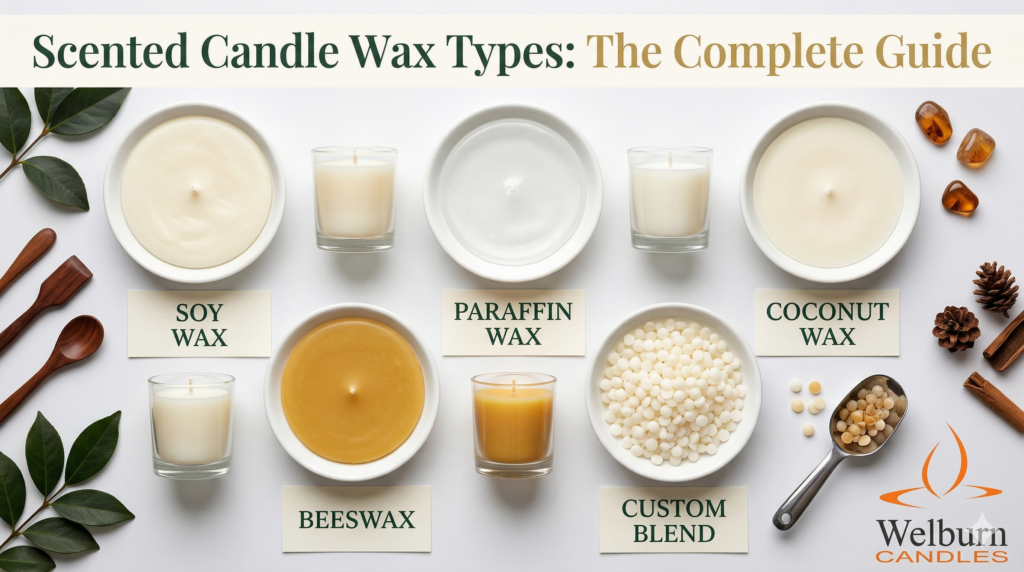
Wax selection is the foundational technical decision in scented candle manufacturing. It determines your candle’s fragrance performance, burn behaviour, surface appearance, sustainability positioning, and commercial cost structure. At Welburn Candles, our scented candle formulation expertise includes extensive experience with all major wax types — and we guide every private label client to the wax choice that best serves their brand’s commercial goals. Paraffin Wax: The Industry Standard Refined paraffin wax remains the most widely used wax in professional scented candle manufacturing globally. Its technical advantages make it the default choice for high-volume production across all market positions from mass retail to premium. Soy Wax: The Natural Market Leader Soy wax has become the first choice for natural and eco-positioned scented candle brands globally. Derived from soybean oil, it offers genuine sustainability credentials alongside strong fragrance performance. Coconut Wax: The Premium Choice Coconut wax is derived from coconut oil and delivers the most exceptional scent throw of any natural wax type. It is the premium wax choice for brands competing at the top of the market. Coconut-Soy Blends: The Best of Both Worlds Welburn Candles recommends coconut-soy blends for private label clients targeting the premium retail segment. These blends combine coconut wax’s exceptional scent throw with soy wax’s natural sustainability positioning and cost management, delivering a performance and positioning combination that neither wax achieves alone. Wax Selection and European Market Positioning European candle consumers — particularly in the Netherlands, Germany, and Scandinavia — are among the world’s most informed and discerning buyers of natural products. Soy and coconut-based waxes are strongly preferred in these markets for their natural credentials. In contrast, French and Italian premium markets often prioritise fragrance performance and luxury aesthetics, where coconut-soy blends excel. Our European compliance guide for private label candles covers market-specific positioning considerations. Frequently Asked Questions Q: Can Welburn Candles produce scented candles in multiple wax types simultaneously? A: Yes — our production facility works with paraffin blends, soy wax, and coconut-soy blends simultaneously. We can produce your core range in soy wax and a premium tier in coconut-soy blend, for example, within the same production schedule. Q: Does wax type affect the fragrance load I can use? A: Yes — different wax types have different saturation points for fragrance oil. Coconut and soy waxes generally accept slightly higher fragrance loads before separation occurs compared to paraffin blends. Our formulation team optimises fragrance load for each specific wax type and vessel combination. Q: Is soy wax genuinely more sustainable than paraffin? A: Soy wax is derived from a renewable agricultural crop rather than petroleum, making it more sustainable in terms of feedstock origin. Overall sustainability also depends on agricultural practices. Welburn Candles sources soy wax from suppliers with responsible farming practices and can provide sourcing documentation. Q: How does wax type affect candle pricing for retail? A: Natural wax candles (soy, coconut) command higher retail prices than equivalent paraffin candles — typically supporting 20–35% premium pricing in European markets due to their natural and sustainable positioning. This premium retail pricing more than compensates for the slightly higher wax cost in most market contexts. Q: Can I switch wax types between batches of the same product? A: No — changing wax type between batches of the same SKU changes the product’s burn and fragrance characteristics, which would represent a product change requiring re-testing and potentially new compliance documentation. Wax type is defined at SKU level and maintained consistently across all production runs. Ready to choose the right wax for your scented candle brand? Contact Welburn Candles for our wax selection consultation and sample comparison set.
Scented Candle Formulation Guide: The Chemistry and Craft Behind Fragrances That Sell
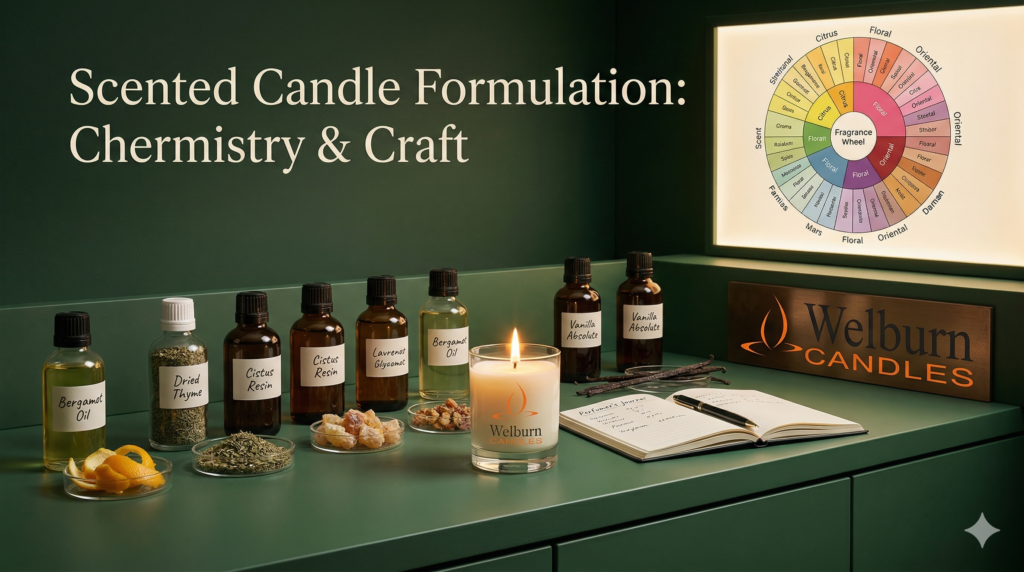
Scent is the invisible dimension of candle quality — the one that drives repeat purchase more reliably than any other factor. At Welburn Candles, we have invested decades in understanding the complex chemistry of wax-fragrance interaction, developing formulation expertise that enables our private label clients to launch scented candles with genuine sensory superiority. This guide exposes the science behind scented candle manufacturing — accessible to brand owners who want to make informed formulation decisions without needing a chemistry degree. For the broader manufacturing context, see our global candle manufacturer guide. The Chemistry of Scent Throw: Why Some Candles Fill a Room and Others Don’t Cold Throw. Cold throw is the fragrance emitted by an unlit candle — what your customer experiences when they pick up your candle in a shop or remove it from its packaging at home. Cold throw is primarily driven by the volatile top notes of the fragrance: lighter molecular weight compounds that evaporate readily at room temperature. Hot Throw. Hot throw is the fragrance released when the candle is burning at full melt pool temperature. It is the scent that fills a room and creates the sensory experience that drives repurchase. Hot throw is driven by the heart and base notes of the fragrance — heavier molecular weight compounds that require heat for effective vaporisation. The Formulation Challenge. Achieving both excellent cold throw and exceptional hot throw is technically demanding. Optimising for cold throw tends to favour lighter, more volatile compounds that can burn off too quickly in hot throw. Optimising for hot throw requires sufficient heavier base notes that may contribute less to cold throw. Welburn Candles’ formulation expertise lies in creating balanced compositions that perform across both dimensions. Wax-Fragrance Interaction: The Science Behind Binding Not all fragrances are compatible with all wax types, and not all wax-fragrance combinations perform equally. The key technical parameters Welburn Candles manages for every new formulation include: IFRA Compliance: The Non-Negotiable Standard All scented candle manufacturers supplying European, UK, and US markets must formulate against IFRA (International Fragrance Association) Standards. IFRA Standards specify maximum usage levels for fragrance ingredients in each product category — candles fall under Category 12. IFRA compliance means:
Scented Candle Safety: What Every Candle Brand Must Know About IFRA and CLP Compliance
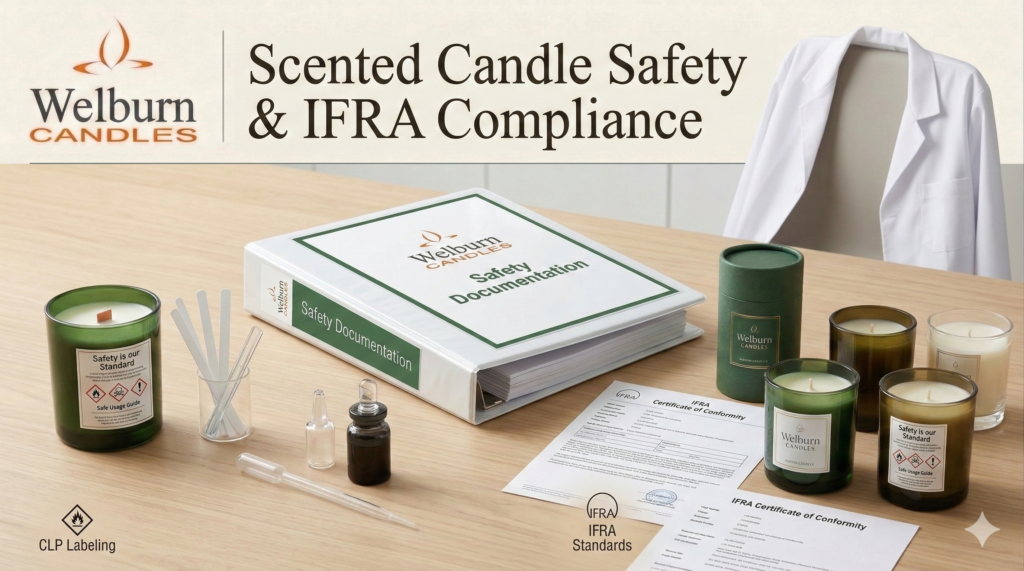
Compliance is not optional in the candle industry — it’s a legal requirement and a fundamental responsibility to your customers. As specialist scented candle manufacturers, Welburn Candles ensures every candle we produce meets or exceeds the applicable safety standards for its target market. This guide breaks down the key regulatory frameworks you need to understand as a candle brand owner — and explains exactly how Welburn Candles’ compliance-first manufacturing approach protects your brand and your customers. Why Candle Safety Compliance Matters Candles are fire products — and fragrance compounds in candles can be skin sensitisers or respiratory irritants if misused. Regulatory frameworks exist to protect consumers, and failure to comply can result in product recalls, fines, retailer delisting, and serious reputational damage. The good news: with the right manufacturing partner, compliance is straightforward and fully integrated into your product development process. IFRA: The International Fragrance Association Standards The International Fragrance Association (IFRA) publishes Standards that specify safe usage levels for fragrance ingredients in consumer products. IFRA Standards are updated regularly as new safety data emerges, and compliance is assessed against the current IFRA Standard amendment at the time of product launch. What IFRA Compliance Means for Your Candles: At Welburn Candles, our perfumery team monitors IFRA Standard updates continuously and reformulates as needed. Every client fragrance formulation is provided with a full IFRA compliance certificate — which is increasingly required by major retailers as a condition of listing. This is particularly critical for our aromatherapy candle manufacturing range, where essential oil concentrations must be carefully managed. CLP Regulations: Classification, Labelling and Packaging In the UK and EU, candles containing fragrances that may cause allergic reactions must include allergen warnings on their labels under CLP (Classification, Labelling and Packaging) Regulations. These regulations specify: What Must Appear on Your Candle Label Under CLP: BS EN 15493 and ASTM Standards: Product Safety Beyond fragrance compliance, the physical safety of candle products is governed by standards including BS EN 15493 (candle fire safety) in the UK/EU and ASTM F2179 in the USA. These standards specify: Welburn Candles tests all new candle formulations and vessel combinations against these standards before approving for production, providing our clients with full test documentation. REACH Regulations for European Market Candles For candles sold in the European Union and European Economic Area, REACH regulations (Registration, Evaluation, Authorisation and Restriction of Chemicals) govern the use of chemical substances in products including candles. REACH compliance requires that restricted substances are identified and managed throughout the supply chain, and that Safety Data Sheets are maintained for all chemical inputs. Compliance Documentation: What Your Retailer Will Ask For Major retailers — from UK department stores to European natural beauty chains — are increasingly requesting comprehensive compliance documentation before listing candle products. Welburn Candles provides our private label clients with: This compliance documentation package is particularly valuable for brands building private label candle ranges for retail listing — and for any brand supplying wholesale jar candles to professional retail buyers who require supplier compliance assurance. ⚖️ Welburn Candles’ compliance team manages the full regulatory documentation process for our manufacturing clients — so you can focus on building your brand while we ensure every product is safe, legal, and retail-ready. ❓ Frequently Asked Questions Q1: Do I need a Product Safety Assessment for my candles? A: Yes, if you’re selling candles commercially in the UK or EU, a Product Safety Assessment (PSA) conducted by a qualified safety assessor is a legal requirement under the EU Cosmetics Regulation (for candles making cosmetic or wellness claims) and strongly recommended under the General Product Safety Directive for all candle products. Welburn Candles can connect you with qualified safety assessors as part of our manufacturing service. Q2: What happens if my candle’s fragrance isn’t IFRA compliant? A: Non-IFRA-compliant fragrances in candles can cause skin sensitisation reactions in customers, particularly if candle wax contacts skin when snuffing or handling the vessel. Beyond the health risk, IFRA non-compliance can result in product recalls, trading standards enforcement action, and significant reputational damage if a customer reaction is linked to your product. Q3: How often does IFRA update its standards? A: IFRA updates its Standards regularly — major amendments occur every few years, with interim guidance published as new safety data emerges. Welburn Candles monitors IFRA updates and proactively alerts clients when reformulation may be required to maintain compliance. Q4: Do I need different compliance documentation for UK and EU markets? A: Since Brexit, UK and EU regulatory requirements have diverged somewhat — though they remain broadly aligned. UK brands selling into the EU need to appoint an EU Responsible Person and ensure their products meet EU CLP and REACH requirements. Welburn Candles supports clients selling into both markets with market-specific compliance documentation. Q5: Can I get a candle safety assessment before launching my product? A: Yes — and we strongly recommend this. A pre-launch safety review catches potential compliance issues before you invest in full production, avoiding costly reformulation or recall situations after launch. Welburn Candles integrates compliance review into our product development process as standard. Selling safe, compliant candles protects your customers and your brand. Partner with Welburn Candles for manufacturing that’s compliance-first from day one.
The Best Selling Scented Candle Fragrances by Season
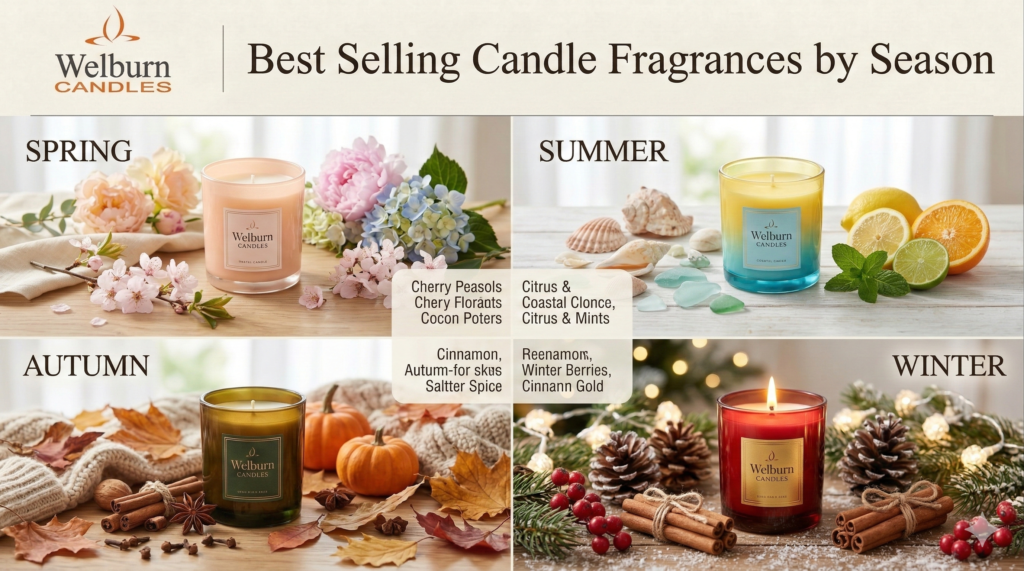
Understanding fragrance seasonality is one of the most valuable strategic advantages a candle brand can have. At Welburn Candles, we analyse sales data across our client base to identify which fragrance families drive the highest sales volumes each season. Spring: Fresh, Floral, and Green Top Spring Fragrances: Summer: Citrus, Marine, and Tropical Top Summer Fragrances: Autumn: Warm, Spiced, and Woody Autumn is the candle industry’s highest sales season. Scented candle manufacturers see their strongest demand in September and October. Top Autumn Fragrances: Winter: Rich, Festive, and Indulgent The Christmas and winter gifting period represents up to 40% of annual candle sales for many brands. Top Winter Fragrances: Building a Year-Round Seasonal Fragrance Strategy Maintain a core range of year-round fragrances complemented by seasonal collections. Explore our private label candle manufacturing guide to understand how seasonal collections fit into a full brand programme. 📅 Plan your seasonal fragrance strategy 6 months in advance. Retail buyers expect to see autumn/winter collections in April–May, and spring/summer collections in October–November. ❓ Frequently Asked Questions Q1: How far in advance should I plan seasonal candle collections? A: Plan at least 6 months ahead for major seasonal collections. This allows time for fragrance development and approval (4–6 weeks), production scheduling (2–4 weeks), and delivery to retailers (2–4 weeks before the season begins). For Christmas, begin planning in February–March. Q2: Should I retire fragrances from previous seasons or keep them? A: Retire limited-edition seasonal fragrances to maintain urgency and drive repeat purchases. However, if a seasonal fragrance becomes a bestseller, consider adding it to your core year-round range. Customer data is your best guide. Q3: How many seasonal fragrances should I introduce each season? A: For most candle brands, 3–5 new seasonal fragrances per season is commercially manageable and sufficient to refresh the range without overwhelming your production capacity or confusing customers. Q4: Can I use the same fragrance bases but adjust them slightly for different seasons? A: Absolutely. A core vanilla fragrance can be brightened with citrus top notes for summer and deepened with spice and amber for winter, creating consistency while delivering genuine seasonal variation. Q5: Which season generates the most candle sales? A: Winter (October–December) consistently generates the highest candle sales volumes, typically representing 35–45% of annual sales. Planning production and cash flow around this seasonal skew is essential for candle brand success. Ready to build a market-leading seasonal fragrance strategy? Welburn Candles is ready to help you develop and produce seasonal collections that drive repeat purchases and retail success.
Scented Candle Manufacturers: The Science and Art of Fragrance Formulation
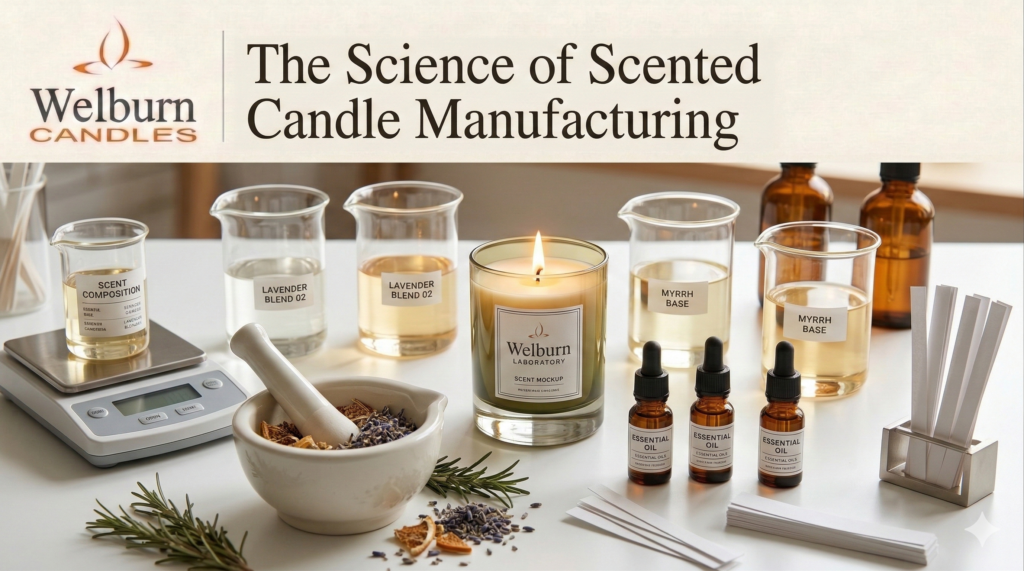
Fragrance is everything in the candle industry. At Welburn Candles, our expertise as specialist scented candle manufacturers has been built over decades of fragrance formulation, blending the art of perfumery with the science of candle chemistry. How Scented Candle Manufacturers Optimise Cold and Hot Throw Cold Throw Cold throw is the fragrance emitted by an unlit candle — what your customer experiences when they pick up the candle in a shop. Driven by the fragrance’s volatile top notes. Hot Throw Hot throw is the fragrance released when the candle is burning — the scent that fills a room and drives repurchase. Achieving both excellent cold throw and exceptional hot throw is one of the most demanding challenges in scented candle manufacturing. Fragrance Load: The Science Behind Expert Scented Candle Manufacturing Wax Type Optimal Fragrance Load Maximum Safe Load Soy Wax 6%–10% 12% Coconut Wax 8%–12% 14% Paraffin Blend 6%–9% 10% IFRA Compliance: The Gold Standard for Fragrance Safety The International Fragrance Association (IFRA) sets global safety standards for fragrance compounds used in consumer products. All Welburn Candles fragrance blends are formulated in strict accordance with IFRA guidelines. Popular Fragrance Families for Scented Candles Fresh and Citrus Lemon verbena, grapefruit, sea breeze — perennial bestsellers, particularly in spring and summer collections. Warm and Woody Sandalwood, cedar, amber, oud — the backbone of premium scented candle ranges. Excellent in large, open-plan living spaces. Gourmand and Food-Inspired Vanilla, caramel, coffee, cinnamon — among the highest-converting fragrances in e-commerce. Custom Fragrance Development with Welburn Candles Our master perfumer team can develop exclusive, custom fragrance blends for your brand’s scented candle range. See our private label candles manufacturing guide for more on how custom fragrance development integrates with our end-to-end service. 🌸 Welburn Candles can develop up to 8 custom fragrance samples simultaneously — accelerating your scented candle range development and getting your products to market faster.