
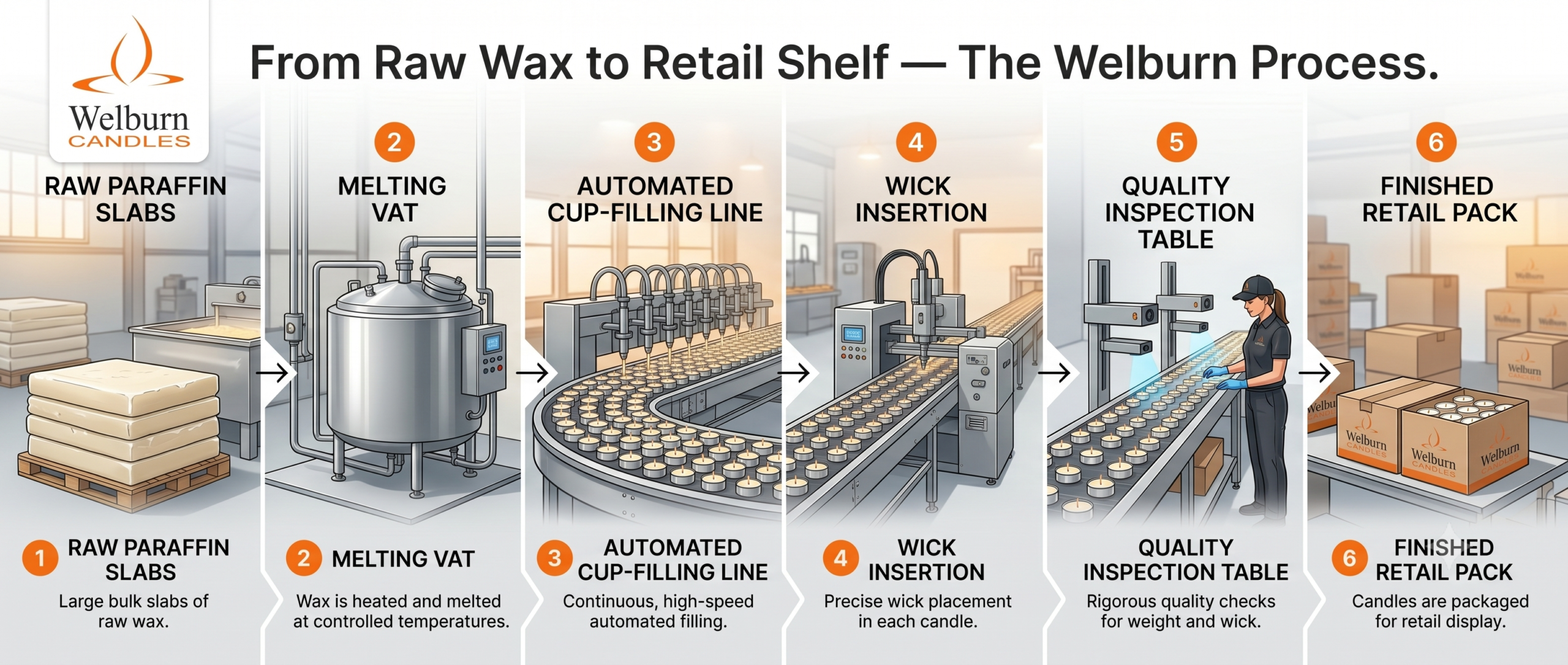
Understanding the tealight candle bulk manufacture process helps buyers set realistic expectations, ask the right questions, and identify quality gaps before placing large orders. This sub-blog walks through every stage of production at Welburn Candles.
This sub-blog is part of our main guide: Tealight Candle Bulk Manufacture: Complete Buyer’s Guide.
Stage 1: Raw Material Procurement and Testing
Every tealight bulk order begins with raw material sourcing. Wax (paraffin, soy, or coconut), wicks, fragrance oils, and aluminium or polycarbonate cups are procured from certified suppliers. Incoming wax is tested for melt point, viscosity, and colour consistency before it enters the production floor. Fragrance oils are tested against IFRA guidelines and REACH substance lists for EU market compliance.
Stage 2: Wax Preparation
Wax blocks are loaded into jacketed melting tanks and heated to precise temperatures — typically 80–90°C for paraffin, 65–75°C for soy. Fragrance oil (if ordered) is blended at a controlled pour temperature to maximise fragrance retention. Colour dye, if required, is added and mixed to an even dispersion before the batch is approved for the filling line.
Stage 3: Automated Cup-Filling
This is the core of tealight bulk manufacture — and where factory quality diverges most sharply. Professional operations use automated filling lines that dispense wax at a controlled flow rate and weight. Each cup receives a consistent pour weight (±0.2g tolerance). The filling line speed on a standard Welburn production line produces 15,000–20,000 tealights per shift. Pre-tabbed wicks are already seated in the cup before filling, ensuring centered wick position.
Stage 4: Cooling and Solidification
Filled cups pass through a temperature-controlled cooling tunnel or rest on cooling tables at 20–22°C ambient. Controlled cooling prevents surface cracking, sinkholes, and wick lean — the three most common tealight cosmetic defects. Soy and coconut wax tealights require longer cooling times than paraffin to prevent frosting.
Stage 5: Quality Control Inspection
Each production batch undergoes a multi-point quality check: wax weight verification (sample scale check), wick centering visual inspection, surface finish check, and burn-time testing from a sample of every batch. Burn testing is conducted against the ASTM F2167 standard for burn performance. Failed batches are remixed, not shipped.
Stage 6: Packaging and Export Preparation
Tealights are packed into retail configurations (10pk, 24pk, 50pk, 100pk) and then into export-grade corrugated master cartons. Each carton is labelled with product specifications, batch number, wax type, fragrance (if applicable), country of origin, and HS code. Export documentation — commercial invoice, packing list, COA, REACH certificates — is prepared for customs clearance. For private label tealight orders, branded retail boxes and inserts are packed at this stage.
Quick Links
← Back to Main Blog: Tealight Candle Bulk Manufacture: Complete Guide
→ Related: Wax Types for Bulk Tealight Manufacturing
→ Shop: Welburn Tealight Candles
FAQs: Tealight Manufacture Process
How do I know if a manufacturer uses automated filling or manual production?
Ask for a video of the production line. Automated filling lines produce consistent wax weights — request the fill weight tolerance specification (should be ±0.2–0.5g). Manual operations typically cannot achieve this consistency at scale.
What causes tealight surface imperfections (sinkholes, cracks)?
These are caused by uncontrolled cooling — too-rapid temperature drop or inconsistent ambient conditions. A quality manufacturer uses temperature-controlled cooling areas. Sinkholes also indicate under-pour (insufficient wax weight per cup).
Can I visit the Welburn factory before placing a bulk order?
Yes. Welburn Candles welcomes factory visits from international buyers. For those unable to travel, we offer a comprehensive factory video tour and third-party factory audit coordination.