
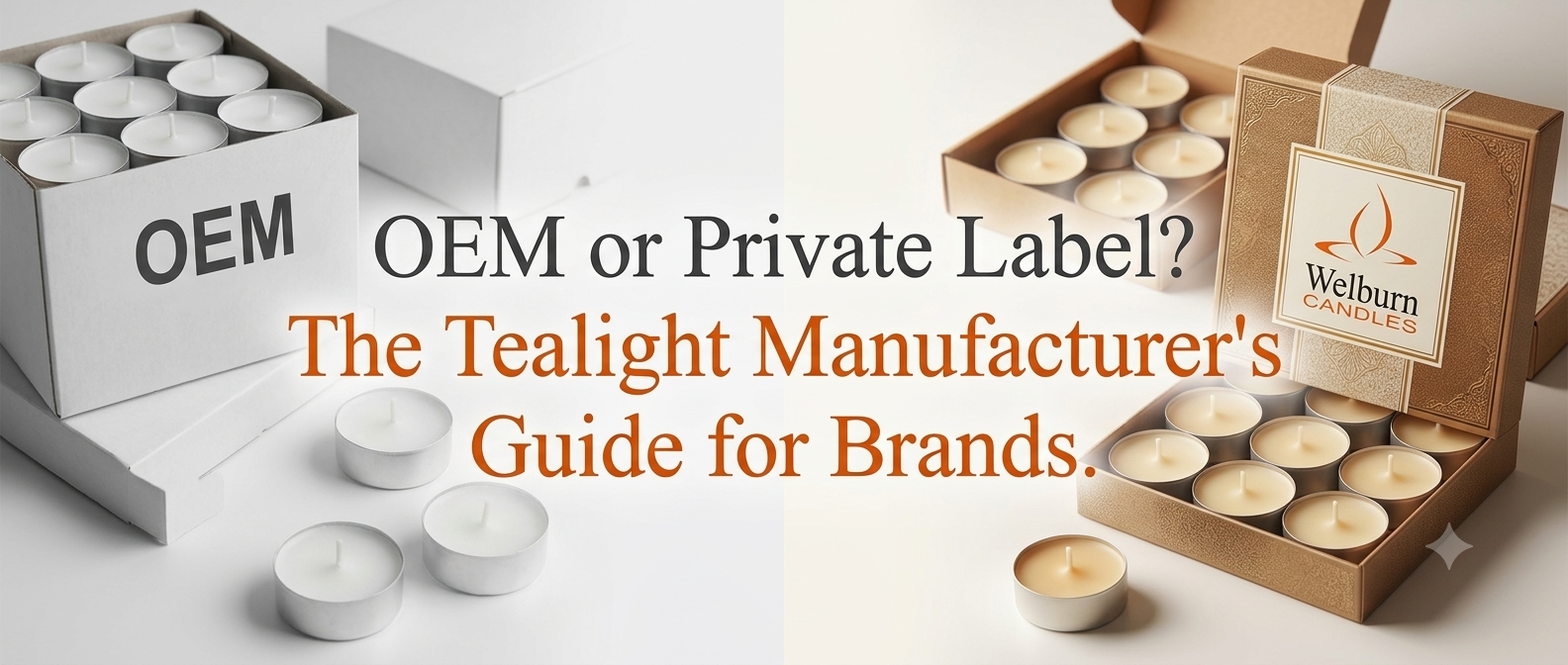
If you are a brand considering tealight candle manufacturing for the first time, you will encounter two primary engagement models: OEM (Original Equipment Manufacturing) and Private Label. These terms are often used interchangeably but describe different arrangements with different implications for your brand, MOQ, timeline, and cost.
This sub-blog is part of our main guide: Tealight Candle Manufacturers: Complete Sourcing Guide.
OEM Tealight Manufacturing: What It Means
OEM (Original Equipment Manufacturing) in the candle context means: the manufacturer produces to YOUR specific design and formulation. You own the product specification — the wax type, fragrance formula, cup design, burn time, weight. The manufacturer builds it to your blueprint.
OEM is appropriate when you have developed your own formula, have specific performance requirements, and are producing at sufficient volume to justify the development investment. Welburn Candles’ OEM capability includes custom cup printing, unique fragrance formulation, and proprietary wax blend development.
Private Label Tealight Manufacturing: What It Means
Private label means: the manufacturer has existing tealight formulations, and you apply your brand identity (logo, packaging, label) to their product. You are not designing the product from scratch — you are selecting from proven, tested formulations and branding them as your own.
Private label is the fastest and lowest-risk path to market for new candle brands. Lower development cost, shorter lead time, proven product performance. Welburn Candles’ private label programme supports buyers from brand brief to retail-ready product.
Comparison: OEM vs Private Label for Tealights
| Factor | OEM | Private Label |
| Product Differentiation | Maximum — your unique formula | Moderate — your brand on proven product |
| Development Time | 4–8 weeks | 2–4 weeks |
| MOQ | Higher (1,000–5,000 units) | Lower (500+ units) |
| Cost | Higher (development + production) | Lower (production only) |
| IP Ownership | You own the specification | Manufacturer retains formula IP |
| Best For | Established brands, premium positioning | New brands, speed-to-market, testing |
Which to Choose: A Decision Framework
Choose OEM if: You have a clear product differentiation strategy, existing customer demand to justify higher MOQ, and the budget for development investment.
Choose Private Label if: You are launching a new brand, testing market demand, prioritising speed to market, or building a product range before committing to custom formulation investment. Explore Welburn’s private label tealight options.
Quick Links
← Back to Main Blog: Tealight Candle Manufacturers: Complete Guide
→ Related: Tealight Candle Manufacturers in India
→ See also: Private Label Candles Manufacturers: Complete Guide
FAQs: OEM vs Private Label Tealights
Can I start with private label and transition to OEM later?
Yes — this is the typical growth path for successful candle brands. Private label allows you to validate market demand and build revenue with low upfront investment, then invest in custom OEM formulation once you have a proven customer base.
Who owns the formula in OEM manufacturing?
In a proper OEM arrangement, you own the product specification and formula. Ensure this is documented in your manufacturing agreement before sharing any proprietary formula details.