How to Start a Private Label Candle Brand: Step-by-Step Launch Guide
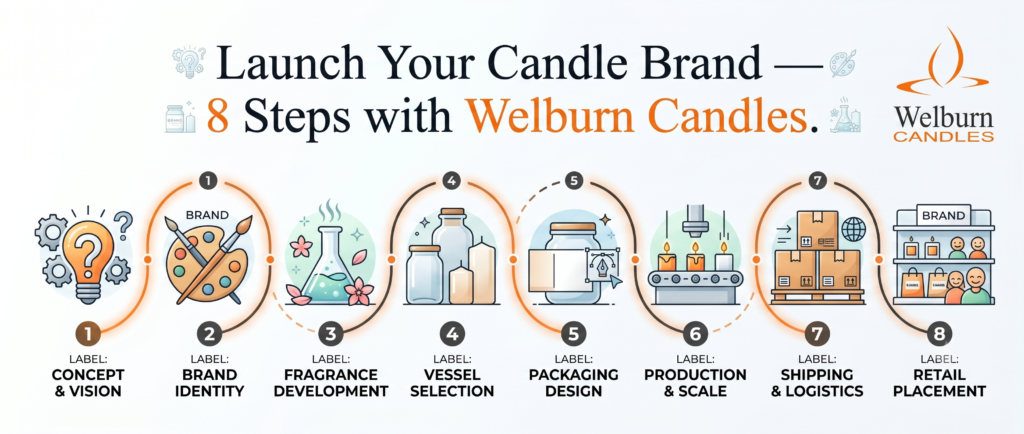
Starting a private label candle brand is more achievable than most first-time brand owners expect — if you have the right manufacturing partner and a clear process. This step-by-step guide takes you from initial concept to your first retail-ready product. This sub-blog is part of our main guide: Private Label Candles Manufacturers: Complete Guide. Step 1: Define Your Brand Position Before approaching any manufacturer, answer three questions: Who is your customer? What premium or benefit does your brand offer (natural, luxury, wellness, artisan)? What price point and retail channel are you targeting? This clarity drives every subsequent decision — wax type, fragrance profile, vessel, packaging tier. Step 2: Research Your Target Market Study your competition. What candle brands dominate your target channel — Anthropologie, Whole Foods, Amazon, boutique retail? What fragrances, wax types, and price points are they using? Where is the gap? Tools: Mintel market reports, retail shelf audits, Amazon bestseller analysis. Step 3: Choose Your Manufacturing Partner Select a private label candle manufacturer with experience in your target market. Use the evaluation criteria in our Evaluate a Candle Wholesale Supplier: Checklist. Step 4: Fragrance Development Work with your manufacturer’s fragrance team to develop 2–4 signature scents. Request samples of 5–8 fragrance options. Evaluate cold throw and hot throw. Involve target customers if possible in fragrance testing. Finalise scent names — these become brand IP. Step 5: Vessel and Packaging Selection Choose a vessel that aligns with your brand tier and target channel. Work with the manufacturer’s design team (or your own) to develop label and box artwork. Ensure all compliance elements are incorporated at design stage — not as an afterthought. Step 6: Sample Approval Request pre-production samples. Evaluate: burn performance (burn time, wick centering, even melt pool), scent throw, packaging quality, label print quality. Provide written approval before bulk production begins. Step 7: Bulk Production and Export Production typically takes 4–5 weeks. During production, request quality checkpoint photos. Confirm export documentation is being prepared in parallel: commercial invoice, packing list, REACH/IFRA certificates, COA, and origin declaration. Step 8: Launch and Market Positioning Upon receipt, build your online presence (D2C website, Amazon or Etsy listing, social content). Approach your target wholesale buyers with samples and wholesale pricing sheet. The first 90 days after launch are the most important for generating initial reviews and repeat purchase data. Quick Links ← Back to Main Blog: Private Label Candles Manufacturers: Complete Guide → Related: Private Label Soy Candles: Natural Wax Retail Guide → Start Today: Contact Welburn Candles FAQs: Starting a Private Label Candle Brand How much capital do I need to start a private label candle brand? At 500 units MOQ with mid-range packaging, a starter private label candle order typically runs $3,000–8,000 inclusive of product and shipping. Add $1,000–2,500 for brand development (logo, website, photography). This makes private label candle launching significantly more accessible than most product categories. Can I start a private label candle brand while working full-time? Yes. The private label model is specifically suited to part-time brand building because the manufacturer handles all production complexity. Your time investment is in brand development, marketing, and customer relationships — activities that can be managed around other commitments. How do I find retail buyers for my private label candle brand? B2B wholesale platforms (Faire, Abound, Tundra) are the most accessible entry points for new brands targeting US and EU independent retailers. Trade shows (NY Now, Maison & Objet in Paris, Ambiente in Frankfurt) provide access to larger retail buyers and distributors.
Private Label Candle Packaging: How to Design for US & EU Retail Shelves
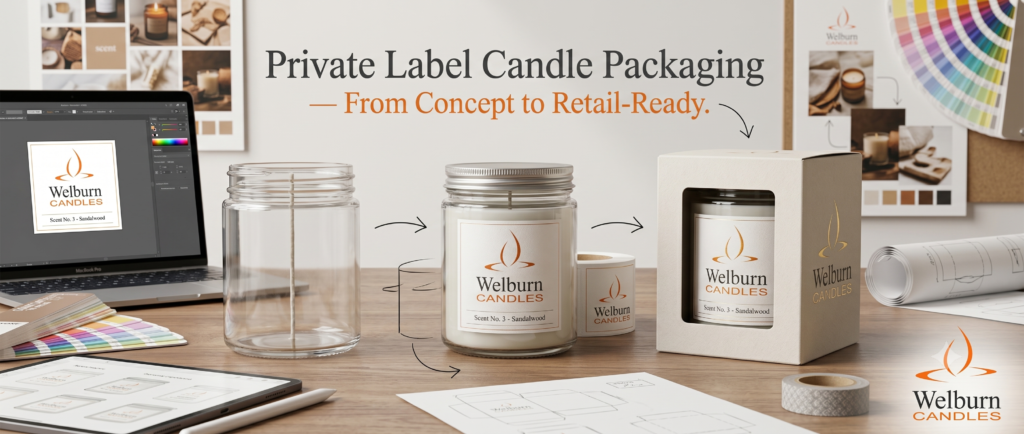
For a private label candle brand, packaging is not a finishing detail — it is the primary purchase driver at retail. Research consistently shows that candle buyers make purchase decisions within 3–5 seconds of shelf exposure, with scent and visual presentation as the two decisive factors. Getting packaging right is therefore as important as getting the product right. This sub-blog is part of our main guide: Private Label Candles Manufacturers: Complete Guide. Welburn Candles provides end-to-end packaging support through our private label programme. The Four Packaging Decisions That Define a Private Label Candle Brand 1. Vessel Choice: The vessel is the highest-visibility element and often the highest-cost component. Options: clear glass jar (transparent, shows wax colour — strong in US clean-label segment), amber glass (premium, warm aesthetic — strong in EU wellness), matte ceramic (luxury, tactile premium — boutique and gift markets), tin (travel/gifting, lightweight for e-commerce). 2. Label Design: Label finish defines perceived price tier more than almost any other element. Matte label = approachable, artisan. Gold foil = luxury. Embossed or die-cut = premium gift. For EU compliance, labels must carry fragrance allergen declaration if any allergens exceed CLP thresholds, burn time, and wax type disclosure. 3. Box and Outer Packaging: A candle without a box sells at mid-market. A candle in a branded box with tissue wrap and ribbon sells at 2–3x the same retail price. For gift and specialty retail channels (in the US: Anthropologie, Free People, Crate & Barrel; in the EU: John Lewis, Maisons du Monde), a premium outer box is effectively mandatory. 4. Compliance Elements: Both the US and EU require specific labelling elements. For the EU: CLP hazard pictograms (where applicable), allergen declaration, manufacturer details, country of origin. For the US: ASTM F2517 compliance label including burn instructions, safety warning, and manufacturer information. ASTM F2517 full requirements. Trending Private Label Candle Aesthetic by Market (2026) US Trends: Minimalist clean labels, natural earth tones, typeface-led design, hand-lettered brand names, recyclable kraft paper packaging. Consumers respond to ‘founder story’ elements on packaging. EU Trends: Monochromatic and tonal colour palettes, premium weight paper labels, artisan/handmade cues, Nordic hygge aesthetic in Scandinavian markets, sustainable packaging materials (FSC-certified boxes, soy-based inks). Quick Links ← Back to Main Blog: Private Label Candles Manufacturers: Complete Guide → Related: How to Start a Private Label Candle Brand: Step-by-Step → External: ASTM Candle Labelling Requirements FAQs: Private Label Candle Packaging Who designs the labels and packaging — us or the manufacturer? Both options are available at Welburn Candles. We have an in-house design team that can create labels and boxes from a brief. Alternatively, if you have your own designer, we provide a dieline template and print specifications. What is the minimum order for custom printed packaging? Custom printed boxes typically require a minimum of 500 units. For labels, digital printing allows as low as 100-unit label runs for new brand launches. Volume thresholds reduce unit cost significantly. How do I ensure my private label candle packaging complies with EU CLP? Provide your manufacturer with the fragrance safety data sheet (SDS) for each fragrance. The SDS contains the allergen profile needed to determine what declarations are required on your label. Welburn Candles provides CLP-compliant label templates for every export order to the EU.
Private Label Soy Candles: Why Natural Wax is Dominating US & EU Retail
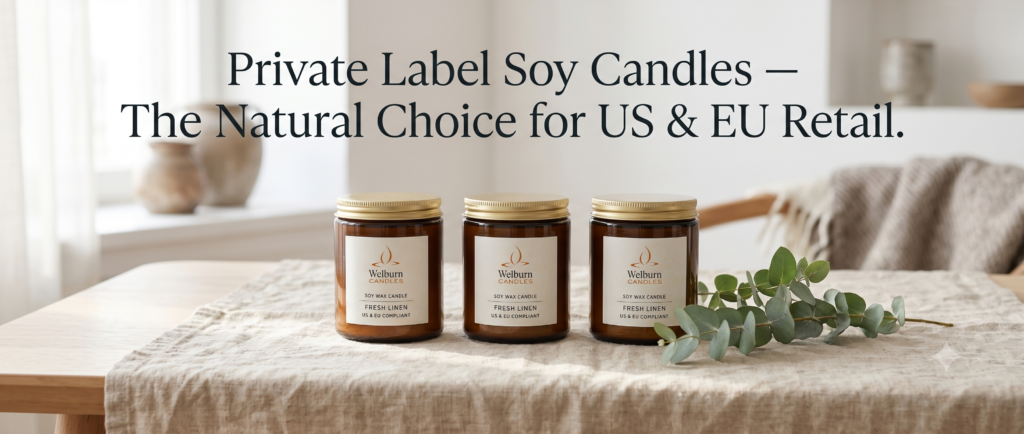
Soy wax candles have moved from a niche wellness segment to a mainstream retail staple in both the US and EU. For private label candle brands, soy wax is no longer just a preference — it is increasingly the baseline expectation at premium and mid-market retail price points. This sub-blog is part of our main guide: Private Label Candles Manufacturers: Complete Guide. Why Soy Wax Has Won in US and EU Premium Retail Consumer preference data from Mintel’s 2024 Home Fragrance Report shows that ‘natural’ and ‘clean-burning’ are the top two purchase drivers for candles in the US and UK markets (after fragrance). Soy wax fulfils both claims: it is plant-derived, biodegradable, and burns at a lower temperature that produces less soot than standard paraffin. In EU markets, particularly Germany, France, and Scandinavia, sustainability certification is increasingly required by major retailers (Rewe, Carrefour, IKEA supplier networks) for candle range listings. Soy wax qualifies for USDA BioPreferred labelling in the US and ‘natural wax’ claims under EU marketing guidelines. Building a Private Label Soy Candle Range A well-structured private label soy candle range for US/EU retail typically includes: • 2–3 hero fragrances that anchor the brand identity (e.g., Lavender, Sandalwood, Fresh Linen) • Seasonal limited editions for Q4 (holiday) and spring rotation • A signature vessel — glass jar, tin, or custom ceramic — that is visually distinctive on shelf • Clean, minimal packaging that communicates ‘natural’ without over-claiming • Product claims backed by certificate: ‘100% Soy Wax’, ‘Cotton Wick’, ‘IFRA Compliant Fragrance’ Welburn Candles manufactures private label soy candles with full IFRA and REACH compliance, and offers a curated fragrance library of 100+ scents pre-tested for soy wax performance. Start your private label enquiry. Quick Links ← Back to Main Blog: Private Label Candles Manufacturers: Complete Guide → Related: Private Label Candle Packaging Design Guide → See also: Welburn Private Label Programme FAQs: Private Label Soy Candles Can I claim ‘100% natural’ on a soy wax candle? Soy wax is a natural, plant-derived material. You can make ‘100% natural wax’ claims if the soy wax in your product has not been hydrogenated with synthetic additives. Always verify with your manufacturer that the soy wax specification supports the claims you intend to make. Are private label soy candles more expensive than paraffin? Yes — typically 20–40% more per unit due to higher wax raw material cost. However, soy candles command a retail price premium of 50–100% over equivalent paraffin candles, making the margin economics typically favourable. What fragrance loads work best in soy wax for private label candles? Soy wax performs best with 8–12% fragrance load for jar candles and 3–6% for tealights. Higher loads improve scent throw but can cause seeping and surface issues if not properly optimised. Welburn’s formulation team tests every fragrance-wax combination before production.
Private Label Candles Manufacturers: The Complete Guide for US & EU Brands (2026)
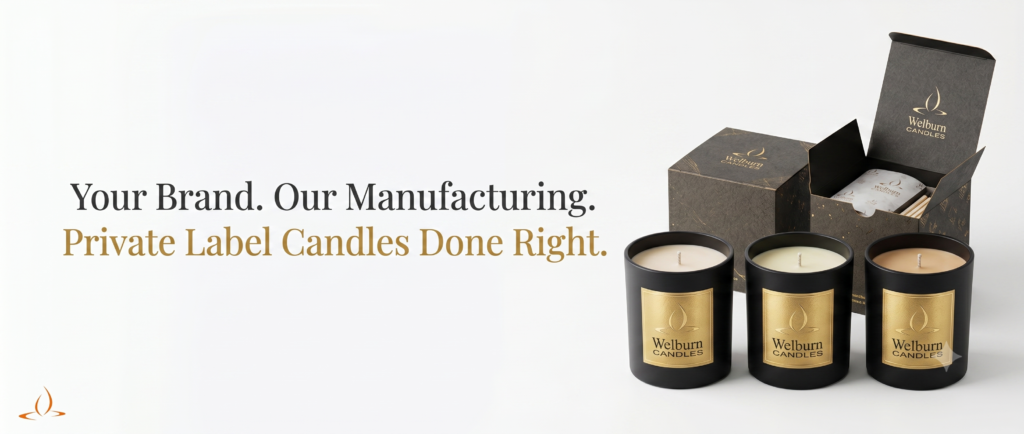
Private label candle manufacturing is the most efficient way to build a candle brand at any scale — from a boutique D2C startup to a national retail chain. Rather than building your own production facility, you partner with a specialist private label candles manufacturer who handles wax sourcing, fragrance development, production, and packaging — while you focus on brand building, marketing, and distribution. This guide covers the entire private label candle journey: from choosing a manufacturer to launching on retail shelves. Welburn Candles is one of India’s leading private label candles manufacturers — exporting to the US, UK, Europe, and the Middle East. Start your private label enquiry here. What Private Label Candle Manufacturing Actually Covers Private label candle manufacturing is an end-to-end service, not just production. A full-service private label partner covers: • Brand consultation and product brief development • Fragrance selection from a curated, IFRA-compliant library (or custom fragrance development) • Wax selection and prototype development • Vessel and packaging sourcing (jars, tins, boxes, labels) • Artwork and label design support (or working with your designer) • Sample production and approval • Bulk manufacturing • Quality control and batch documentation • Export packaging and customs documentation • Worldwide shipping Welburn Candles provides all of the above as an integrated service. Explore our full private label programme. Choosing the Right Private Label Candle Manufacturer: 7 Critical Criteria 1. Fragrance Capability Can they develop custom scents, or are you limited to a pre-set catalogue? The best private label manufacturers offer both — catalogue selection for speed, custom development for differentiation. 2. Wax Range Do they offer paraffin, soy, coconut, and blended options? US and EU consumers increasingly expect natural wax options. A manufacturer limited to paraffin limits your brand positioning. 3. Packaging Flexibility Vessel selection (glass, tin, ceramic, wood-lid), label printing (CMYK, white ink, gold foil, embossing), box and outer packaging — the more options, the stronger your brand execution. 4. MOQ Accessibility Low MOQs are essential for new brands. Avoid manufacturers requiring 5,000+ units per SKU for a first order — this prevents new brand development and market testing. 5. Compliance Documentation Non-negotiable for US and EU retail: REACH/IFRA for EU, ASTM/CPSC for US. A private label manufacturer who cannot provide these is a liability, not a partner. 6. Export Experience Have they shipped to your market before? Do they understand your country’s import documentation requirements? Do they have freight forwarder relationships that protect your delivery timeline? 7. Communication Quality Pre-order responsiveness, willingness to answer detailed questions, and proactive project management are the best predictors of post-order experience. Private Label Candle Ranges: What Can Be Customised? Element Options Available Notes Wax Type Paraffin, Soy, Coconut, Blend Determines burn profile, cost, sustainability claim Fragrance Catalogue (100+ options) or custom Custom requires 2–3 week development Vessel Glass jar, tin, ceramic, wood-lid Vessel is often the biggest cost driver Label Digital print, foil, embossed, custom shape Welburn has in-house design support Box/Outer Printed box, kraft, magnetic close, gift set Retail-ready or e-commerce packaging available Pack Formats Single, duo, trio, gift set Multi-SKU orders consolidated in one shipment Private Label Candles for US Market: Key Considerations US retail buyers — particularly mass retail and specialty chains — require ASTM F2517 compliant labelling, California Prop 65 warnings for lead or heavy metal content above thresholds (easily avoided with cotton wicks), and FTC Green Guide compliance for any ‘natural’ or ‘eco’ claims. For D2C brands, platform requirements (Amazon, Etsy, Faire) also apply. Private Label Candles for EU Market: Key Considerations EU retail import requires CLP labelling compliance for all fragranced candles, REACH regulation compliance for restricted substances, IFRA-compliant fragrance certificates, and import CE documentation where applicable. Countries like Germany, France, and the Netherlands have active customs authority inspection of candle imports — documentation quality is essential. Related Sub-Blogs in This Series → Private Label Soy Candles: Why Natural Wax is Dominating US & EU Retail → Private Label Candle Packaging: How to Design for US & EU Retail Shelves → How to Start a Private Label Candle Brand: Step-by-Step Launch Guide FAQs: Private Label Candles Manufacturers What MOQ should I expect from a private label candles manufacturer? Welburn Candles starts at 500 units per SKU for most private label candle types. For tealights and standard products, lower thresholds may be possible. Larger orders (2,000+ units) unlock better unit pricing and packaging customisation options. How long does private label candle manufacturing take from start to shelf? From initial brand brief to delivered product: 8–12 weeks typically. This includes 2 weeks for fragrance and packaging development, 1 week for sample approval, 4–5 weeks production, and 3–4 weeks sea freight. Rush timelines with air freight are available. Can I develop a signature fragrance for my private label candle brand? Yes. Welburn Candles offers custom fragrance development as part of its private label service. Your signature scent is developed exclusively for your brand and is not shared with other buyers. Custom fragrance development typically adds 2–3 weeks to the timeline. Do private label candle manufacturers provide product photography? Some manufacturers offer basic product photography for catalogue and website use. Welburn Candles provides sample product photos. For professional brand imagery, we recommend using the samples we send for a professional lifestyle shoot tailored to your brand. What is the difference between white label and private label candles? White label means the product is pre-made and sold to multiple buyers who apply their own labels — minimal customisation. Private label implies a higher degree of brand customisation (fragrance, packaging, vessel) specific to your brand. Welburn Candles provides true private label — custom to your brief.
How to Launch a Private Label Candle Brand With No Prior Industry Experience
The single most common misperception about private label candle brand building is that it requires prior industry expertise. It does not. What it requires is a clear brand vision, a reliable private label candle manufacturer, and a structured process. Welburn Candles’ private label programme is designed to guide brand owners who are new to the candle industry through every step of the journey — from the first fragrance brief to the first wholesale order. This is your complete starter guide. For the broader commercial strategy context, see our private label candle retail strategy guide. Step 1: Define Your Brand Identity Before Choosing Your Products The most common mistake new private label candle brand owners make is starting with product selection rather than brand definition. Your brand identity — the values, aesthetic, and emotional positioning you want to own — should drive every product decision that follows. Ask yourself: Who is your target customer? What do they value — natural ingredients, luxury aesthetics, wellness benefits, or sustainable production? What emotional state are your candles designed to create? What price point and retail environment does your brand aspire to? These answers shape fragrance selection, vessel choice, label design, and every other product decision. Step 2: Brief Your Fragrance Direction Fragrance is the most powerful differentiator for a private label candle brand. At Welburn Candles, our fragrance development team works with brand owners — including first-time brand owners — to translate a brand identity into fragrance directions through a structured brief process. You do not need perfumery knowledge; you need a clear sense of the emotion and sensory world your brand inhabits. See our private label candle fragrance guide for the full fragrance brief process. Step 3: Choose Your Launch Vessel and Format For a first private label candle range, simplicity is commercially wise. Starting with a single vessel format — typically a medium round jar (200–250ml) — in two to three fragrances is the most capital-efficient approach. This focused launch enables you to test market response, collect genuine customer feedback, and make informed decisions about range expansion based on real data rather than speculation. Step 4: Understand Your Compliance Requirements Even if you are new to the candle industry, you are not exempt from regulatory requirements. If you are selling in Europe, your candles must meet CLP labelling requirements and your fragrances must be IFRA compliant. Welburn Candles manages this compliance for you as part of our private label service — providing all required documentation and producing compliant labels before dispatch. Our private label candle compliance guide explains what you need to know. Step 5: Build Your DTC Platform Before Retail Outreach Your direct-to-consumer website — typically Shopify — is your brand’s home and your first proof of commercial viability. Build it before approaching retail buyers: a functioning DTC website with professional product photography and initial customer reviews gives retail buyers the confidence that your brand has genuine commercial traction. Welburn Candles’ private label brand guide covers the full DTC-to-wholesale strategy. Frequently Asked Questions Q: How much investment does a first private label candle brand launch require? A: Investment requirements vary significantly depending on your starting vessel range, packaging specification, and initial order volume. Welburn Candles’ team can provide a realistic cost breakdown once your product brief and volume requirements are defined. Contact our private label team to begin a no-obligation consultation. Q: Do I need a business registration before approaching a private label candle manufacturer? A: You do not need an established business entity to begin the consultation and sampling process with Welburn Candles. However, before placing a production order and particularly before importing goods for commercial sale, you should have appropriate business registration and tax registration in place. Consult a business adviser in your market for the specific requirements. Ready to start your private label candle brand journey? Contact Welburn Candles to request our private label starter guide and begin your consultation.
Private Label Candle Manufacturing for Amazon Sellers: The Complete 2026 Guide
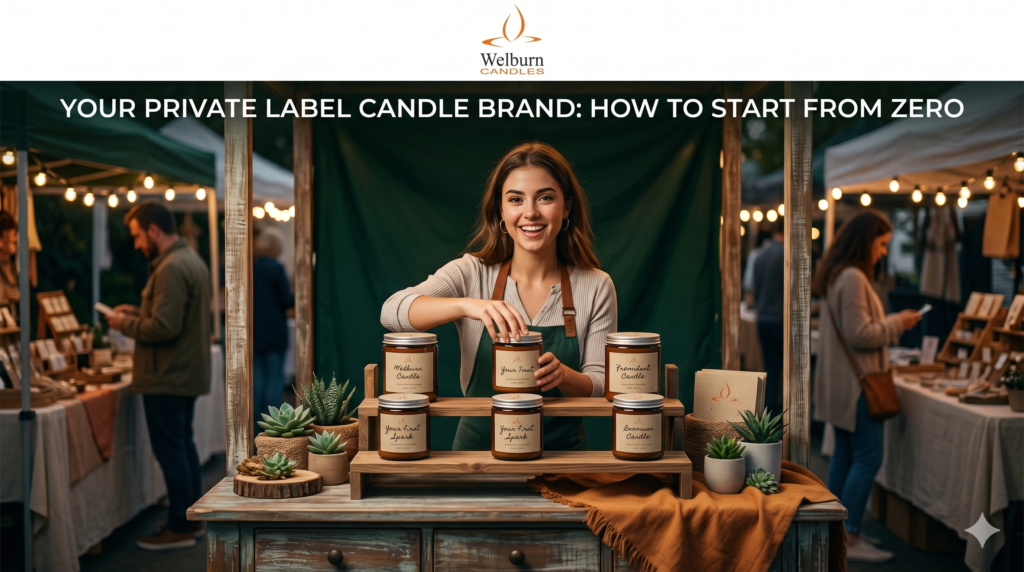
Amazon is one of the most commercially accessible and competitively intense retail environments for private label candle brands. The combination of massive reach, discovery-driven search behaviour, and review-powered conversion makes Amazon an attractive channel — but also one where product quality, packaging compliance, and listing optimisation must all function together for commercial success. At Welburn Candles, we supply private label candle manufacturing for Amazon sellers across the US, UK, EU, and Indian markets. This guide covers every dimension of building a successful Amazon private label candle brand from a manufacturing perspective. For the broader private label brand-building framework, see our private label candle brand guide. Understanding Amazon’s Requirements for Candle Products Amazon applies category-specific requirements to candles that sellers must meet before listing. These include: FBA Packaging: What Your Private Label Candle Manufacturer Must Know Amazon FBA (Fulfilled by Amazon) has specific packaging requirements that must be observed for products to be received into fulfilment centres without rejection. Welburn Candles has experience preparing candle orders to Amazon FBA specifications: 💡 FBA packaging errors cause rejection at Amazon’s receiving docks — a costly problem that delays inventory availability. Always confirm your manufacturer’s FBA experience before production, and request a pre-shipment inspection against the FBA specification. Building an Amazon-Optimised Private Label Candle Range Success on Amazon as a private label candle brand requires product selection, pricing, and presentation strategies aligned with how Amazon’s search and recommendation algorithms work. Product Selection Amazon candle searches skew strongly toward jar candles in the 200–300ml size range. This is the sweet spot for Amazon candle purchasing: strong burn time, attractive retail price, and manageable shipping weight. Welburn Candles produces 200–300ml jar candles in soy, coconut-soy, and paraffin blend wax options. Fragrance Selection for Amazon Amazon candle reviews consistently identify fragrance performance as the primary positive or negative review trigger. Investing in fragrance development that maximises both cold throw (in-box product experience) and hot throw (burning performance) is the most impactful product quality decision for Amazon private label success. Our scented candle formulation guide explains how Welburn Candles approaches scent throw optimisation. Review Generation Strategy Amazon’s review system is the primary commercial differentiator between private label candle brands. Product quality drives review frequency and sentiment — customers who experience a genuinely excellent candle are more likely to leave positive reviews. At Welburn Candles, our 40-hour burn test protocol and fragrance performance standards are designed precisely to deliver the consistent, high-quality experience that generates positive Amazon reviews. Compliance for Amazon EU Marketplaces Amazon EU marketplaces (Amazon.de, Amazon.fr, Amazon.it, Amazon.es, Amazon.nl) require candles to meet EU CLP labelling and REACH compliance standards. For UK Amazon, UK CLP and UK REACH apply. Welburn Candles provides market-specific compliance documentation sets and multi-language labelling for all EU Amazon marketplaces, produced and applied before dispatch. Frequently Asked Questions Q: Can Welburn Candles ship directly to Amazon FBA warehouses? A: Yes — Welburn Candles can ship to Amazon FBA fulfilment centres in the USA, UK, Germany, France, Italy, Spain, and other Amazon markets. Our export team prepares all required documentation for Amazon FBA receipt, including commercial invoices with correct HS codes, certificates of origin, and import compliance documentation. Q: How many SKUs should I start with for an Amazon private label candle launch? A: We recommend starting with three to five SKUs for an Amazon launch. This focused range allows you to collect meaningful review data and conversion metrics before expanding. Choose SKUs that cover two or three fragrance families — typically one floral, one woody/warm, and one fresh — to capture different search intent profiles within the candle category. Q: Does Welburn Candles offer branded insert cards for Amazon unboxing? A: Yes — branded insert cards, brand story cards, and care instruction cards can all be produced and included in packaging as part of your private label production. These inserts contribute to customer experience and can support brand loyalty beyond the Amazon marketplace. Contact Welburn Candles to discuss your full packaging specification.